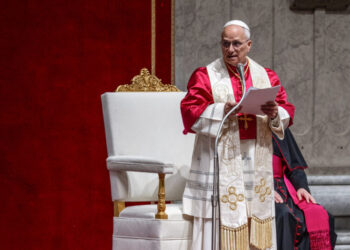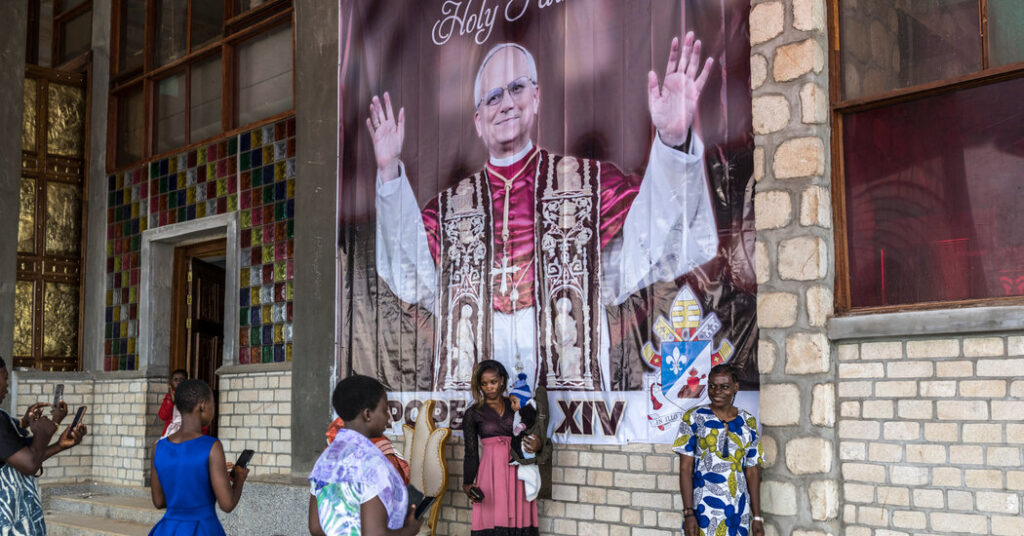
For Catholics, a papal visit to their country is typically a moment of joy and piety. But for the more than eight million Catholics of Cameroon, the arrival of Pope Leo XIV on Wednesday will also be a reminder of some of the biggest disparities within the church.
One in five Catholics lives in Africa, where the religion is growing faster than on any other continent, and in Cameroon, close to 30 percent of the population identifies as Catholic, according to Vatican figures. Yet Africans are still a minority in the senior ranks of Vatican leadership in Rome. Pope Francis, Leo’s immediate predecessor, tried to diversify the College of Cardinals, the group of 121 senior church leaders who advise and elect popes, but Cameroon currently has no cardinals, and Africa has just 14 in the college.
“Cameroon and Africa provide the numbers to keep the church alive,” said Henry Michael Gueche, 36, a technology entrepreneur in Cameroon’s capital, Yaoundé, who described himself as a faithful Catholic. But while Africans have “a seat at the pew,” Mr. Gueche said, they don’t have “a real seat at the table in Rome.”
During his visit, Pope Leo may also wade into discussions about some of Catholicism’s most charged issues. Cameroon was among the African countries where bishops forcefully opposed Francis’ decision to permit priests to bless same-sex couples. It is also a place where polygamy, an embedded cultural practice, clashes with Catholic teaching.
On top of the religious concerns, Leo has stirred debate by agreeing to meet with Paul Biya, 93, the world’s oldest president and an authoritarian who has ruled Cameroon for more than four decades. His government has detained journalists and made secret deals with the Trump administration to accept deported migrants. Mr. Biya has repressed the opposition and last year claimed victory in an election under a cloud of fraud allegations. The country, which is divided between Francophone and Anglophone regions, has also been destabilized by a secessionist movement in the English-speaking regions since 2016.
Because of the political context, some Cameroonians fear the president will use the pope’s visit to airbrush his government’s reputation.
“I do not believe that this is the right time for a papal visit,” the Rev. Ludovic Lado, a Jesuit priest from Cameroon and a visiting scholar at Harvard Divinity School, wrote in an email. Father Lado said he had written to the Vatican’s secretary of state to object to the pope’s trip to Cameroon.
“There is a real risk that such a visit could be instrumentalized to improve the international image of a country struggling with governance challenges,” Father Lado said.
Vatican officials said a papal visit was above all a pastoral excursion designed to show solidarity with the faithful, regardless of their government. But because the Vatican City is its own sovereign state, the pope is officially hosted by political leaders and usually meets with them.
“The trip cannot take place without such a meeting,” said Cardinal Michael Czerny, a senior Vatican official. “And of course there will be people who criticize: ‘How can the pope meet with that criminal? Why doesn’t the pope denounce that criminal?’”
But Cardinal Czerny said that Vatican leaders could not participate in direct political criticism and that they “never attack governments directly.” Otherwise, he said, the Vatican “becomes involved in unnecessary conflicts and is no longer able to play a peacekeeping role.”
Even so, Leo’s visit has raised hopes for some opponents of Mr. Biya that the pope will use his moral authority to support them or to influence the president. The pope has shown willingness in recent days and weeks to take a stronger stance against the policies of President Trump, spurring expectations that he might do something similar when he visits Bamenda, a city in an English-speaking region of Cameroon where some of the harshest intercommunal violence has occurred.
Patrice Nganang, a Cameroonian novelist and professor of Africana studies at Stony Brook University on Long Island in New York, said he hoped the pope would use the visit to urge Mr. Biya to give clemency to jailed Anglophone activists. Mr. Nganang said that the president, who is Catholic, “listens to the pope.”
The church remains one of the last institutions “with any moral legitimacy” in the country, said Charlotte Walker-Said, an associate professor at John Jay College of Criminal Justice in New York City who has studied Catholicism in Cameroon. “Because the state and the political governance apparatus of the country is known to be both corrupt and brutal,” Ms. Walker-Said said, “the church is the only institution that has any ability to criticize.”
Pope Leo will also have to decide whether to address homosexuality, one of the biggest fault lines in modern Catholicism. After Pope Francis said of gay priests, “Who am I to judge?,” and later let priests bless same-sex couples, Cameroonian bishops were among the fiercest opponents.
“Africa operates with its cultural values, its ancestral customs,” said Paul Engoulou, a parish priest in Yaoundé. “As such, it cannot adapt to unnatural practices such as homosexuality.”
Pope Leo has remained neutral on the subject, which divides Catholics in Europe and the Americas as well. In Africa, said Massimo Faggioli, a professor of theology at Trinity College Dublin, the topic might be “a lion that he wants to let sleep.”
A more likely subject for him to take up, analysts said, would be polygamy, a longstanding — if declining — custom in Cameroon. Last month, a commission of African bishops released a report saying that those who wished to be baptized as Catholic could not have multiple spouses but that the church should help them participate in the faith in other ways.
The pope’s visit presents an opportunity to remind Catholics in Cameroon that they should move away from a cultural practice that is “not in the plan of God,” said Cardinal Gerhard Ludwig Müller of Germany, a conservative who used to run the church’s office on doctrine. But the pope would not act “in a paternalistic way,” Cardinal Müller said: “We cannot say the European Christians are perfect and the others have to learn.”
One challenge for the pope in Africa is connecting with people under 30, who represent a large demographic majority throughout the continent. Mr. Gueche, the entrepreneur, said young Cameroonians mostly saw the pope as “a distant moral figurehead rather than a representative of their modern, digital reality.”
Still, some Catholics say the pope’s visit shows he cares for people as they struggle with everyday challenges. “Parents are finding it increasingly difficult to feed their children, to put food on the table, to pay their children’s school fees, to pay for their medical bills and all that,” said John Ibe, a Nigerian businessman living in Cameroon who is chairman of a Catholic parish council in Yaoundé.
At least, Mr. Ibe said, Leo’s arrival “brings a momentary relief for Cameroonians in their ongoing difficulties.”
Francois Essomba contributed reporting from Yaoundé, Cameroon.
Motoko Rich is the Times bureau chief in Rome, where she covers Italy, the Vatican and Greece.
The post Pope Leo’s Challenge in Cameroon: Show African Catholics How Much They Matter appeared first on New York Times.