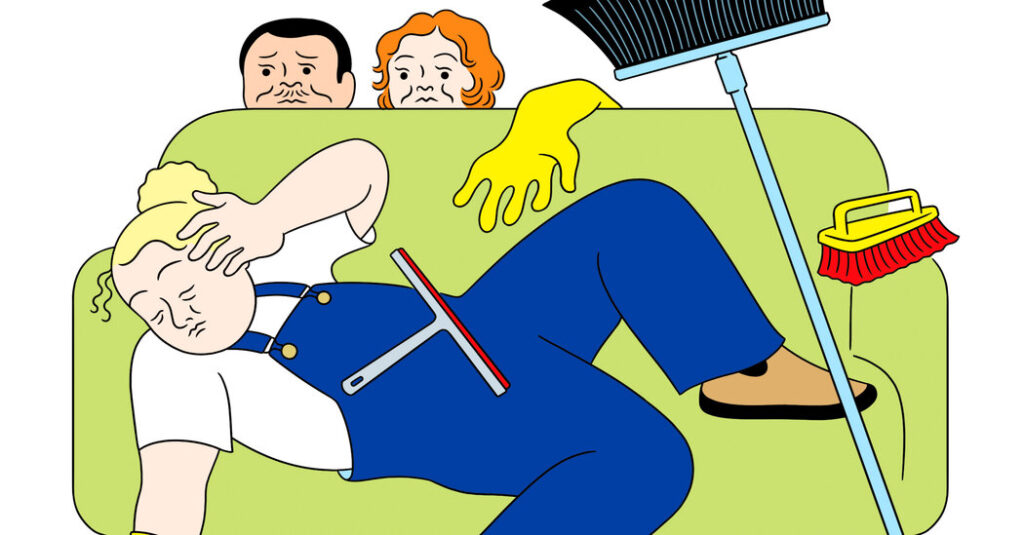
My husband and I are both over 50 and work full time. For the past seven years, we’ve employed a woman, slightly younger than we are, to clean our house. She also cares for our pets when we travel. When Covid hit, we kept paying her for a full year without asking her to come in, and over time we’ve raised her pay voluntarily. Each Christmas, we give her a generous bonus.
Every few years, she goes through periods of mental health difficulty. During those stretches, she stops working and disappears from contact, leaving us unsure whether or when she’ll return. We check in with her by text but do not press her or complain. Eventually she comes back and resumes a regular schedule.
Over the past year, though, the quality of her work has declined sharply. She spends less time at our house, does less overall and often leaves the job unsatisfactorily done. We suspect some of this may reflect physical problems, and she does not have health insurance. Still, we know she depends on this income, and we have hesitated to raise the issue with her. We can afford to pay her every other week, but we are not wealthy. Her help makes possible other parts of our lives that matter to us.
We have never detailed what the job includes, so drawing up a task list now would feel awkward. Any conversation about her performance would be uncomfortable, especially because she used to do the job extremely well. Still, the present arrangement is not sustainable, and we do not know how to proceed. What are our ethical options? — Name Withheld
From the Ethicist:
People who work regularly in other people’s homes can come to seem less like employees than friends or even dependents. And the truth is that, in a wide range of relationships, there isn’t a bright line between the transactional and the personal. But that lack of clarity often serves neither party well in circumstances like these. It can make it harder to speak plainly about expectations, on either side, when things change. At the moment you’re dissatisfied, and your cleaner may be at risk of losing her job without ever being told why or having a chance to address the problem.
You don’t owe her tenure; you do owe her a direct, respectful conversation. Tell her what you’ve noticed. Talk about what you think the job requires, what schedule and standards you expect, and see if there are accommodations that would make the arrangement workable for both of you. The question is whether the job can still be done in a way that meets your needs and acknowledges hers. If, after that conversation, it becomes clear that the work can’t be done at the level you need, you should give her reasonable notice and let her make other plans.
A Bonus Question
I have long had a difficult relationship with my father, and we are now estranged. We were never close. He provided for our family, but with an air of irritation, and he often avoided family life. I’ve seen him manipulate people, and he holds views I find morally repellent. If he were not my father, I wouldn’t want him in my life.
The break deepened after my mother became seriously ill and entered a nursing home. While he was still married to her, my father began a new relationship and moved his girlfriend into the family home. We had a major unresolved fight, followed by many more, including over my mother’s care, until I chose estrangement.
He has since kept reaching out and has now invited me to his wedding, which he announced only three months after divorcing my mother. I have said that before we can move forward, I need a genuine apology and an honest conversation about the past. He has ignored that request.
Do I have any moral obligation to reconcile with him simply because he raised me, or to attend the wedding knowing I am unlikely to receive the acknowledgment and apology that I need? — Name Withheld
From the Ethicist:
You ask whether you should try to repair the relationship, but you already have. You’ve told your father what you need to hear and discuss, and he’s made it clear that this isn’t a conversation he wants to have. (I note that, in a time of TikTok-promoted family estrangements, billed as self-protection from vaguely defined “toxicity,” yours is the sturdily old-fashioned kind; you’re angry at this man for nameable reasons, and find him hard to respect.)
Forgiveness usually involves the forgiven party recognizing and regretting a wrong. But though your father evidently wants to patch things up, he’s unwilling or unable to say he failed you as a father; he may not think he did. Where does this leave you?
A parent, it’s true, is not interchangeable with any other difficult person. You owe him something, as one of the people who raised you. There is history, dependence, identity and often love mixed in with injury. If there’s to be any continued relationship, however, he owes something to you as well. In the meantime, your present course is sound: Keep your distance … but also keep the door open.
Readers Respond
The previous question was from a reader who had discovered that a director of the nonprofit where she volunteers was not being truthful with partner organizations. She wrote:
I volunteer for a small nonprofit organization picking up free food from pantries and delivering it to an impoverished local community. Recently I learned that one of the directors of the organization lied to food pantry personnel to obtain more food for our clients. The pantry normally allocates one bag of food per week for each family. Our director said we were delivering to twice as many families, so each family actually received two bags a week. When asked to provide the names of the clients we were delivering to, our director gave fake names. I’m uncomfortable with lying to sister organizations so we can procure more food than our families would receive under the established rules. And I worry that the extra bags for our families mean that other needy clients don’t get what they need. … Please help me sort this out. — Name Withheld
In his response, the Ethicist noted:
Oh, dear. Accepting donations from a food pantry, pretending to deliver them to twice as many families as are actually receiving help and fabricating nonexistent recipients? Whatever the motives in this case, deception of this kind raises serious issues of integrity, especially because your organization’s leader is lying to people who are themselves trying to do good. … Consider raising your concerns directly with the director. Failing that, share what you’ve learned with the board members of your nonprofit. They can investigate and try to set things right. If they don’t, you may wish to find another place to volunteer. In the long run, the families who depend on this help are best served by an organization that deals in good faith with its partners. … None of this should obscure the larger injustice here. Your quandary should remind us how wrong it is that there are people in this rich society who struggle to feed their families.
(Reread the full question and answer here.)
⬥
Yes, what your director is doing is wrong. But as someone who works in a food pantry, I’d like to say: There is no shortage of food in this country; there’s just a shortage of caring people, companies and local governments who are willing to give it away. Maybe your director is one of those caring people, because whether it’s ethical or not, they are feeding people who need it. — Cheney
⬥
Assuming this is a 501(c) organization under the tax code, it is subject to audit and could potentially lose its charitable status if the board knows about this practice and does nothing to stop it. The organization will also likely have to fire your director in order to protect itself if they discover what is going on. So no, ethically and legally, this is not good under any circumstances. — John
⬥
I volunteer at a food pantry, taking down the names of the families receiving food and the number of people in their household. Since the current administration has cut funding for food resources to the needy, there is almost never enough. And as everyone is struggling to afford rising housing and food prices, the numbers of visitors through our doors have swelled. I regularly have to say no to an additional bag of flour or another orange. Is it sad? Absolutely. Does lying to get more food do anything to fix the problem? No. A lot of work has been done to try to ensure something resembling fairness regarding food availability in our pantry. Lying about client numbers does not help that effort. — Ingrid
⬥
As a corporate investigator, I boil down information and pursue resolution efficiently and consistently. I have found that the single biggest reason people become involved in theft or fraud is because they are able to rationalize their behavior, telling themselves that they’re doing it “for a good reason” — especially if they themselves are not profiting. Unfortunately, using dishonest means to secure anything (worthy or unworthy) is still dishonest. The Ethicist’s advice is good, and I hope the letter writer follows through on it. — Anthony
⬥
I volunteer at my local food bank, and at times of high volume, I’ve taken on extra shifts to help alleviate the pressure, often working from opening until close. What I’ve seen is alarming. At the start of the day, the food bank appears to be brimming with supplies, and some volunteers take this as a sign to look the other way when families ask for more. But as each new shift starts and supplies dwindle, each new slate of volunteers are increasingly unable to provide families with the essentials that they need. In the end, families have to make do with cans of beans rather than milk, eggs or produce; this situation would not have to happen if volunteers stuck to the guidelines. Your nonprofit’s director may think that they’re giving more, but there are often reasons these limits have been set. — Luka
The post My Longtime Housekeeper’s Work Is Slipping. What Should I Do? appeared first on New York Times.