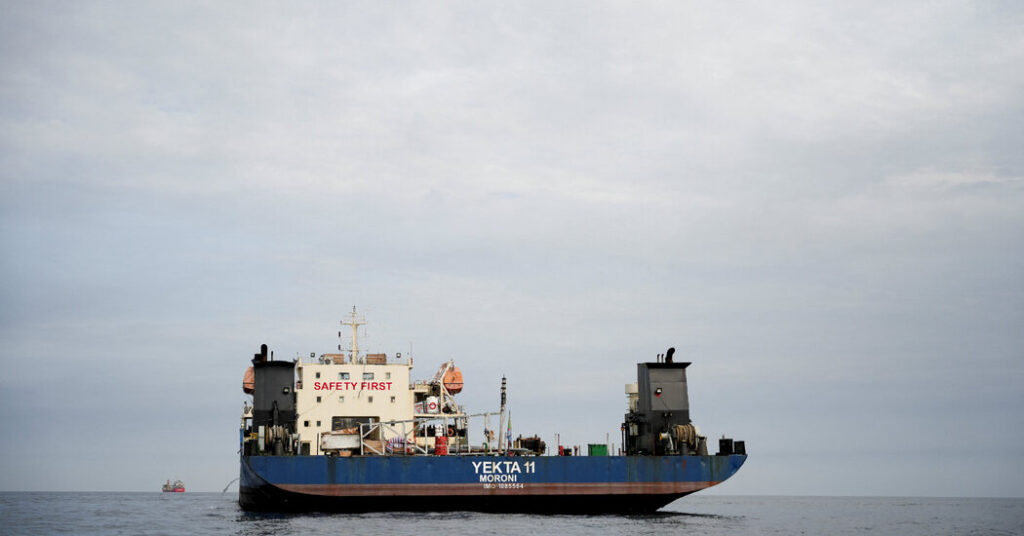
The U.S. Navy blockade of Iranian ports appeared to be working on Wednesday, with no Iran-linked ships visibly able to leave the region since the blockade took effect 48 hours earlier, according to U.S. authorities and vessel-tracking firms.
Several vessels appear to have stopped or slowed after exiting the Strait of Hormuz into the Gulf of Oman, “which may reflect the deterrent effect of the blockade,” Kpler, a maritime data company, noted in a report on Wednesday.
Still, the data is likely incomplete because of how difficult it is track the location of ships in waters in and around the strait. While most commercial vessels are required to travel with transponders that transmit a ship’s name, location and other identifying information, many vessels in the Persian Gulf are hiding their location or falsifying other information, making real-time ship tracking difficult, according to experts.
Adm. Brad Cooper, the U.S. Central Command leader, said late Tuesday that the blockade had been “fully implemented” and had “completely stopped” commercial traffic to and from Iranian ports. More than a dozen Navy warships are patrolling waters east of the strait, enforcing a blockade on all vessels from all nations entering or leaving coastal areas or ports in Iran.
Central Command on Wednesday said that nine vessels had complied with directions to turn around and re-enter an Iranian port or coastal area, though it did not give details. Kpler, which also uses satellite data to track ships when their location looks like it may have been falsified, said that two ships with links to Iran and subject to U.S. sanctions appeared to have made U-turns. Eight additional ships that have historically carried Iranian cargo were stationary in the Gulf of Oman or were slowing down, according to Ana Subasic, an analyst at Kpler.
One of the ships that reversed course, the Rich Starry, a Chinese tanker under U.S. sanctions, was traveling eastward through the strait on Tuesday before turning around. The other ship, the Ostria, was heading toward an Iranian port and was turned back before it could pick up cargo, most likely of Iranian refined products.
Ms. Subasic said there had been no loadings at Iranian ports since the start of the blockade on Monday. “What you’re seeing with the U.S. blockade is they’re trying to stop Iranians from lifting their cargoes, but at the same time getting out as many vessels as they can on the U.S. side.”
President Trump, in announcing the blockade, said that the Navy would encourage ships not linked to Iran to transit the strait. More than a dozen ships without links to Iran moved through the strait on Monday and Tuesday, according to Central Command and tracking firms like Kpler, staying close to the Omani coast and keeping the most distance from possible sea mines in the middle of the waterway.
Traffic around the strait remains at a fraction of its usual levels, and the effects have rippled through the global economy. Since the blockade came into effect, traffic has slowed further, with shipping companies unwilling to risk the crossing.
Nils Haupt, a spokesman for the German shipping company Hapag-Lloyd, which has six vessels and 150 seafarers stranded in the Persian Gulf, said that the situation was still too uncertain to make plans for the company’s ships to exit the Gulf.
He said the company was concerned about the risk of sea mines. Hapag-Lloyd was also still waiting for assurances that its ships would not be targeted by Iran and for answers from U.S. authorities on the order in which stranded ships were supposed to exit the strait.
“We would need security guarantees for the crew, the vessel and the cargo transported,” he said in an email on Wednesday.
Jenny Gross is a reporter for The Times covering breaking news and other topics.
The post Iran-Linked Ships Slow or Stop as U.S. Blockade Is ‘Fully Implemented’ appeared first on New York Times.