Hollywood and Bollywood may be the two biggest “-woods,” but in Northern Nigeria there is a scrappy, thriving filmmaking industry, nicknamed Kannywood. The name comes from Kano, both a city and a state, where moviemakers with modest means churn out an amazing number of productions, all while dealing with strict censors.
Nigeria’s film industry is perhaps better known globally for its bustling Nollywood industry, based in the economic capital of Lagos. But Kannywood, to the north, is a genre that focuses on different cultural aspects.
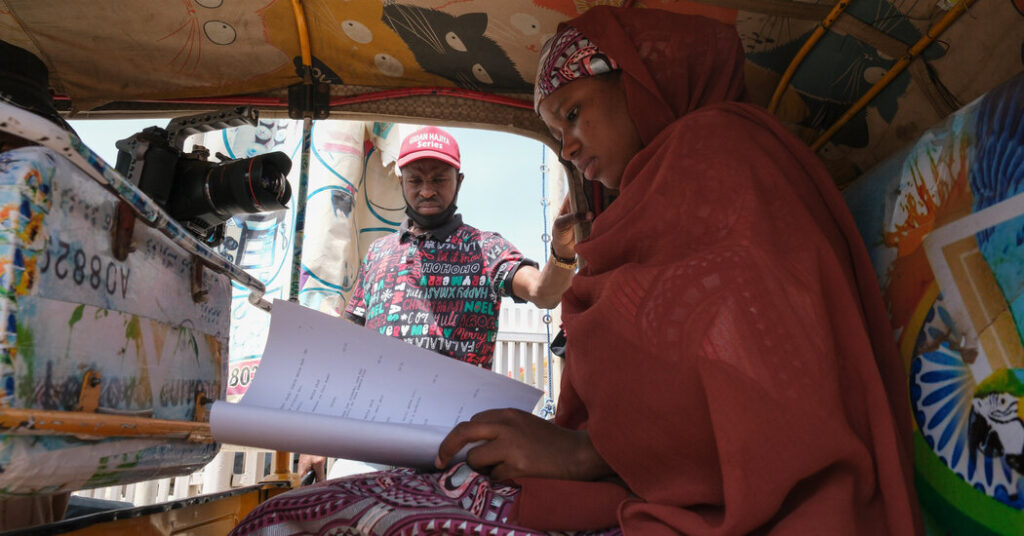
Mansura Isah, an actress, filmmaker and producer in Kano, is a leading figure who has worked in the business since 2001. Today, at 40 years old, she is particularly proud of “Jodha,” a film she finished making late last year. The film touches in part on social issues including H.I.V. awareness and early marriage.
But when Isah took the final cut to the Kano Censorship Board in January, a process every Kannywood filmmaker must go through before a movie can be released, she broke down in tears over the ruling. The officials ordered her to cut out most of a birthing scene.
“They just told me that the way I lifted my legs was not OK, that men can have a fantasy,” she said. She had spent a lot on the movie and especially on that scene, she said, because it’s “the core story.”
“Without that scene,” she added, “that movie can never be the movie that I want people to see.”
Kano State, with a population of more than 16 million, is one of the most populous states in Nigeria, Africa’s most populous country. Of Nigeria’s 36 states, only four have censorship boards.
And while there is a national censorship board in Lagos, it focuses mostly on fiscal accountability, said Abdalla Uba Adamu, a Kannywood expert and former professor of media and cultural communication at Bayero University in Kano.
“The national censorship board doesn’t care if you appear naked,” he said. “I think it’s more for auditing purposes.”
The Kano State Censorship Board was established in 2001, after the state government reintroduced Shariah Law in 2000.
A Kannywood film does not necessarily have to be made in Kano, but it must produced in Hausa, a language spoken by more than 50 million people worldwide, according to Adamu. And in northern Nigeria, the films must adhere to strict cultural standards that follow the conservative Islamic societal standards in the region.
“Whether it is singing, dancing, costumes, even, let’s say, gun warfare, they ban it. So no smoking, no drug use, no to all those sorts of things,” Adamu said. Men and women touching onscreen is also forbidden for the most part, he said.
Abba el-Mustapha, the executive secretary of the censorship board and a former actor, said that the organization’s goal is to promote Hausa culture and ensure that families can watch Kannywood films together. Another essential element of a Kannywood film is that it must promote their culture, he added.
“We want to show our teachings of Islam in our movies,” he said. “This censorship board is not an attacking agency. It’s a friendly agency for the filmmakers to showcase their talent.”
El-Mustapha insisted that despite Isah’s reaction to the board’s demand that she cut the birth scene, the group does not restrict the creativity of filmmakers. There are ways to portray any scene tastefully, he said.
If a filmmaker wants to indicate that a woman is a prostitute, he said, as an example, the scene could depict the woman taking a man to a room “to remove the clothes, and you just ‘off’ the light.”
“Everyone that is viewing knows that the something that is happening is sex. You don’t have to see them naked on the bed,” he added.
El-Mustapha also pointed to the large number of films being made to indicate that censorship was not preventing filmmaking in Kano. Last year alone, more than 500 films and TV series were approved through the board, he said.
Although potential censorship continues to be an issue, other parts of the filmmaking process are brightening, filmmakers say.
“Our equipment is much better now than years ago.” said the Ibrahim Bala between takes while shooting his film “The Footprint of the Elephant.”
Bala, who has been a filmmaker in Kano for 12 years and has directed more than 30 films, added that budgets have increased significantly.
“Initially we would spend maybe 5 or 6 million naira,” he said — about $3,500 to $4,500. “But now producers invest up to 50 or 60 million in a film.”
Part of that growth is tied to YouTube, where many Kannywood films are viewed. Revenue also comes from an increase in advertising, he said.
Local companies pay for strategic product placement, said Bala, as he and his team moved to shoot inside a luxury fabric store in Kano that had done just that — paid to have a scene shot in the store.
A defining feature of Kannywood films has always been a convoluted love story. In Bala’s movie, for example, there is a love rectangle: A man loves a woman who loves another man who loves another woman. But in recent years filmmakers have been integrating social issues into the plots as well, Bala and Isah said.
According to Adamu, Kannywood productions started addressing social issues when AREWA 24, a U.S.-funded, Hausa-language TV station, was created in Kano more than a decade ago.
He said creation of the station was one of two defining moments of modern Kannywood history.
“The first one was the introduction of censorship, which has altered the story lines and everything. And then the second one was American funding to initiate” AREWA 24, he said.
AREWA 24 was created in 2014 at a cost of about $6 million and initially financed by the U.S. State Department’s Bureau of Counterterrorism. At the time, American officials said the channel was crucial to countering the extremism of violent militant groups such as Boko Haram.
It took about four or five years for Kano filmmakers to incorporate social issues into their productions, Adamu said. What helped, he said, was seeing “the success of the TV shows that were inspired by American funding but not American story lines.”
The station was founded, he added, immediately after what he referred to as “the dark period” of censorship.
According to Carmen McCain, a lecturer at the School of Oriental and African Studies in London who has been researching the Hausa literature and film industry for more than 20 years, the heavy censorship began in 2007 when an intimate video of a Kannywood actress was leaked online.
At the time, a well-known actress and her boyfriend had filmed a private video that was saved on her boyfriend’s phone. When the boyfriend took his phone to a local repair shop, workers hacked the phone and leaked the video, McCain said. A social outcry ensued over what was seen as a crisis of Kannywood’s own morality as an industry.
That is when Abubakar Rabo Abdulkarim, the head of the censorship board at the time, came down hard on filmmakers McCain added.
“He was very, very intent on getting rid of the film industry,” she said. Adamu, who referred to Abdulkarim as “the dark lord,” added that filmmakers were fined and even jailed at times for infractions.
When asked what changed to end the “dark period,” Adamu replied: “Well, the dark lord resigned.”
In a twist perhaps worthy of a Kannywood film itself, local media accused the censor of sexual impropriety. Abdulkarim denied the allegations but the public controversy tarnished his reputation, ushering in the end of his career.
Abdulkarim reportedly denied the allegations.
After Abdulkarim resigned in 2010, Adamu said it took a few years for the industry to recover from the years of stricter standards.
Many Kannywood watchers and filmmakers agree that the censorship environment has improved under the current leadership, which is more willing to work with filmmakers on issues such as how much of a woman’s hair must be covered.
El-Mustapha focuses on dialogue with the industry, rather than prosecution, according to Adamu. “After all, el-Mustapha is an active member of the film industry — and he will return to the system after he finishes his tenure,” he added by text message.
Isah’s film, “Jodha,” is scheduled to be released in May, without the birth scene. Despite her sadness over having to cut it, she said she hopes she is setting an example for her daughter and other girls as a woman in male-dominated industry.
She said that sometimes her daughter (she has three other children, all boys) “will just look at me and she’ll say, ‘Mommy I’m proud of you.’” Isah was preparing to welcome her fans to a henna event to prepare for Ramadan celebrations, where her fans had artists paint intricate designs on their hands. It was held by one of her film’s corporate sponsors. Her daughter, she added, also sometimes says: “‘I want to be very strong like you.’”
Isah paused for a moment, then continued: “I have legs. I have hands, I have eyes, and I have a mouth. So I know if I work hard I am going to make it.”
The post In Kannywood, a Film Scene Thrives Despite a Censorship Board appeared first on New York Times.