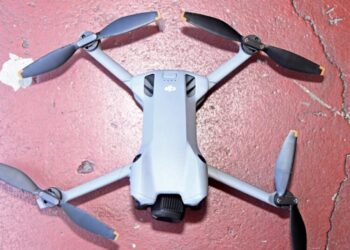
U.S. tech VCs are backing a new play to rebuild the drone stack from the silicon up.
Hyfix Spatial Intelligence just raised a $15 million seed round to create an American-made “brain” for drones and robots, Fortune learned exclusively. The Santa Clara, Calif.-based startup is developing a single autonomous-systems chip that folds flight control, high-precision positioning, secure communications, and onboard compute into one U.S.-manufactured system-on-a-chip. This replaces the mix-and-match electronics that power most drones today.
Craft Ventures led the round, joined by Catapult Ventures, Multicoin Capital, Finality Capital, and hard-tech investor Sky Dayton. (Craft, notably, was cofounded by David Sacks, who until recently was President Trump’s crypto and AI czar.)
“There is currently no end-to-end American supply chain for drones,” Jeff Fluhr, partner at Craft Ventures, told Fortune. “Hyfix is tackling one of the most critical pieces, custom silicon, so U.S. companies can build world-class autonomous systems without depending on foreign technology stacks.”
That gap is colliding with policy. The FCC’s late-2025 move to block approvals and imports of certain Chinese-made drones and radio frequency gear has effectively accelerated demand for domestic alternatives, even as DJI contests the restrictions in court. For startups like Hyfix, the regulatory tailwind is vital.
The market opportunity is large—and still heavily tilted overseas. Global drone revenues are expected to climb into the tens of billions by decade’s end, with commercial applications alone projected to grow from roughly $30 billion in 2024 to about $55 billion by 2030. And, global drone production, Craft Ventures estimates, has already reached the low tens of millions of units annually. Yet DJI continues to dominate, controlling roughly 80% of the global civilian drone market and an even larger share in the U.S.
Hyfix is pitching itself as one of the domestic alternatives those policies are meant to create. The chip is designed to keep working when GPS is jammed or spoofed, a growing concern in both defense and commercial settings. It taps into CEO Mike Horton’s other project, Geodnet—a decentralized network of roughly 21,000 ground reference stations—as well as newer low Earth orbit satellites to get more accurate, harder-to-fool positioning.
“Geodnet is a high-precision geospatial network,” Horton told Fortune. “It uses reference stations that are put up to allow for more resilient and more accurate positioning than GPS alone, which is easily jammed and spoofed and doesn’t work very well for things like robotics.”
Horton and his cofounder, Udan Ercan’s, backgrounds feed directly into that pitch. His career in autonomous systems ranges from early self-driving tractors to drones, while Ercan is a global navigation satellite system expert who built high-precision positioning systems at Topcon and globally. Geodnet’s infrastructure, Horton says, will integrate with Hyfix’s chip so drones can “provide both a trusted position and a more accurate position” even when signals are being manipulated.
The new capital will go toward finishing the chip design and tape-out. Hyfix plans to start shipping production-ready chips to select partners this year and is also building a sub-250-gram reference drone to demonstrate the platform.
Fluhr’s bet extends beyond drones. Within two years, he expects Hyfix to be supplying chips across multiple drone categories. Longer term, he sees the same architecture powering a broader wave of autonomous machines—from industrial systems to humanoid robots.
See you tomorrow,
Lily Mae Lazarus X: @LilyMaeLazarus Email: [email protected] Submit a deal for the Term Sheet newsletter here.
Joey Abrams curated the deals section of today’s newsletter. Subscribe here.
The post Exclusive: Hyfix raises $15 million to build a U.S. alternative to DJI’s drone dominance appeared first on Fortune.