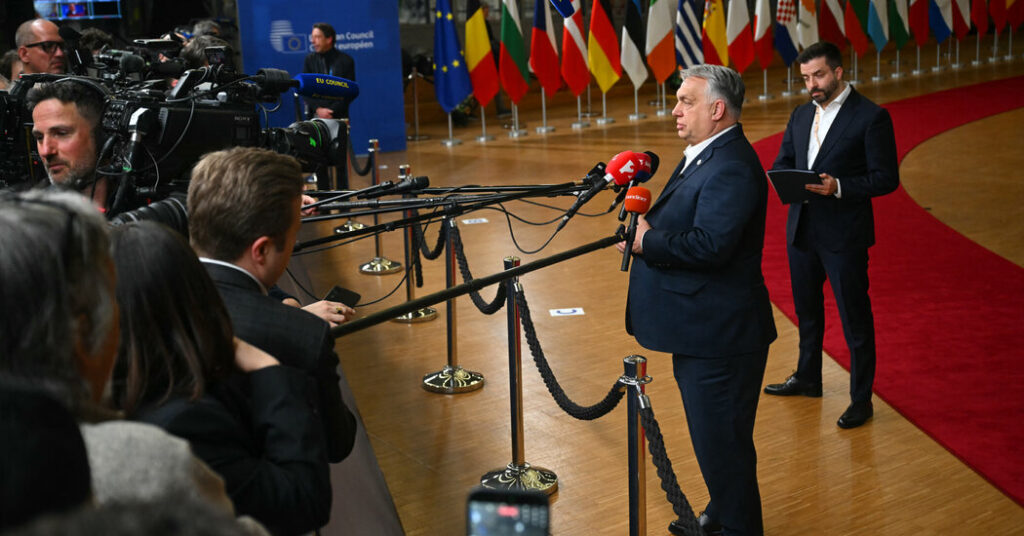
As prime minister of Hungary, Viktor Orban worked with his allies to try to change the European Union from within, to pull power away from Brussels and toward national capitals. One of their tactics was to finance research groups and academics to promote their brand of illiberal populism.
That legacy is likely to live on, at least for a while, despite the resounding defeat of Mr. Orban and his Fidesz party in Sunday’s national elections.
For years, Mr. Orban’s party has funneled money into organizations that hold conferences and publish research shoring up its vision for a more populist and conservative world order. The think tank Danube Institute and the educational institution Mathias Corvinus Collegium in Hungary are aligned with and have been supported by Mr. Orban’s government, and have funded cultural trips to the country and fellowships for major figures on the far right from around the world.
Increasingly central to Mr. Orban’s vision is MCC Brussels, a think tank founded in 2022 with a goal of pushing back on anti-Hungary messaging at the European Union and pressing for a more populist continent. It has evolved into an important forum for lawmakers and thinkers from across the European far right to convene and coordinate. Experts said it is playing a key role in uniting otherwise disjointed parties focused on national interests to a common cause.
Now, it is poised to become a key litmus test for whether Mr. Orban’s influence will last, because chipping away at its influence may not prove entirely straightforward for Hungary’s new government.
“It is a story of the far right realizing that in order to be nationalist, you also have to be internationalist,” said Valentin Behr, a French academic who researches connections between European and American conservatives.
By Brussels standards, the group has a giant budget, about 6 million euros ($7 million) in 2024. That money is provided entirely by the Mathias Corvinus Collegium in Budapest, which gives the think tank the initials in its name.
A few years ago the government gave the educational institution substantial shares in the energy conglomerate MOL, one of the country’s biggest publicly listed companies. As a result, profits from Russian oil have flowed into Mathias Corvinus Collegium coffers, feeding MCC Brussels by extension.
Peter Magyar’s Tisza party, which defeated Fidesz on Sunday, could use its sweeping victory to try to defund Mr. Orban’s network of institutions and claw back assets like those energy shares. Mr. Magyar, who is set to become the new prime minister, has repeatedly promised to do so, including on Monday in the hours after the election. But breaking down the system Mr. Orban built may not prove to be legally easy, experts said.
Even if the new Hungarian government can manage it, MCC Brussels has become prominent enough on the European scene that its officials are hoping they will be able to find new sources of funding and support from elsewhere in Europe, should they need to.
“If it comes to that, and we feel that there’s the possibility of being undermined financially, or in some way they can thwart us, then I think we’ll have to look for alternative sources of finance,” said Frank Furedi, a Hungarian-born sociologist who leads the think tank.
MCC Brussels was born in a London pub. Mr. Furedi was on his way home from a Hungary-related talk in mid-2022 when he noticed Balazs Orban, Mr. Orban’s political adviser (and not a relation), sitting and having a beer with colleagues at the bar. The Hungarian called Mr. Furedi over.
“I just sat down for a few minutes, and I told him that I think that it’s really quite important for you guys to do something in Brussels,” Mr. Furedi explained, saying that someone needed to “rebut all the anti-Hungarian propaganda that’s coming out.”
Within months, the idea had become reality. Within a few years, it was reporting funding in the millions and was hosting major events, including an annual far-right conference that brings top-ranking government officials from around Europe and the world to speak in Brussels.
Speakers have included American figures like Gladden Pappin and Patrick Deneen, both of whom have close ties to U.S. Vice President JD Vance. Mr. Vance himself spoke at Mathias Corvinus Collegium in Budapest just last week.
“They have the same vision of the world, the same idea that Western civilization is under threat,” said Laure Neumayer, a French political scientist with a focus in Central Europe.
As MCC Brussels tried to build up an intellectual basis for populism and worked to establish a trans-Atlantic network, the group followed on years of groundwork laid by The Danube Institute and other far-right think tanks.
But MCC Brussels had its more specific goal of remaking the European Union from within.
Fidesz’s goal is “occupying Brussels,” Balázs Orban, the prime minister’s political adviser, told the MCC Brussels conference in December. The point is to “create a situation where there is a possibility, a real possibility, a real chance of leadership change in Brussels.”
Mr. Furedi is blunt. “The only thing that’s holding populism back is the lack of professionalism, and the intellectual immaturity of these movements,” he said.
The point is to make anti-establishment populists more established.
A question is whether Mr. Magyar will now upend the model.
Mr. Magyar’s party pledged before the election to defund organizations like Mathias Corvinus Collegium, and now that he has won so many seats in parliament, he theoretically has the mandate to do it.
But Petra Bard, a professor of sustainable rule of law at Radboud University in the Netherlands, said the new government would probably have to dissolve such organizations to claw their assets back.
If the parliament and Mr. Magyar try to do that, the Hungarian president, Tamas Sulyok, who was appointed by the old, Fidesz-dominated legislature, could challenge the move in court, using one of the few powers in the mostly ceremonial job. In his victory speech on Sunday, Mr. Magyar called on Mr. Sulyok, who has time left in his term, to depart early and “leave office with as much dignity as he has left.”
Despite the difficulties, Ms. Bard said she thinks Mr. Magyar is likely to at least try to dissolve such organizations, which are privately managed foundations financed by public assets.
“They expressly promised,” she said. “I think people expect them to do it.”
MCC Brussels does not see Mr. Magyar as an ideological opponent. Mr. Furedi pointed out that he “never actually challenged” the more traditional conservative values that “underpinned the Orban regime.”
Beyond that, the group has already received its yearly budget, which Mr. Furedi said was smaller than the 6 million euros it got in 2024, its last published disclosure, but still comfortably in the millions of euros. So the organization would have some room to run even if the educational institution in Budapest was defunded.
“There is no chance of them disappearing from the Brussels scene anytime soon,” said Kenneth Haar, a researcher and campaigner at Corporate Europe Observatory, which focuses on lobbying in European Union policymaking. “Brussels has become an important power base for them.”
Jeanna Smialek is the Brussels bureau chief for The Times.
The post Will Viktor Orban’s Legacy Live On in Brussels, Even Without Him? appeared first on New York Times.