FORT WORTH — Carlos Flores sat silent as speaker after speaker at the City Council meeting told him he had the power to stand up to President Donald Trump.
“Do not comply with a ransom demand,” the newly elected chair of the local Democratic Party begged the council.
“Other cities are fighting, and you should too,” another woman said. “Don’t bend the knee.”
Flores and 10 other council members were weighing an ultimatum from Trump: End the city’s diversity programs or risk losing all federal funding. If Flores and the five other Democrats on the council stuck together, they could defy Trump and vote to keep “diversity, equity and inclusion” — or DEI — in place.
But Flores, the longest serving among them, didn’t like to talk about national politics at all.
“We can’t account for $277.1 million,” he told the room awaiting his vote.
The debate in Fort Worth echoed a dilemma facing local leaders around the country in Trump’s second term. Like Flores, many of those leaders tried to avoid partisan fights. Some thought they had a responsibility to resist Trump. Others thought the cost of defiance was simply too high.
In majority-minority Fort Worth — the 11th-largest city in the country — no one in charge was thrilled about the choice before them. Not the Republican mayor, who declared for Pride Month last year that “y’all means all.” Not the other conservatives on the council, who stopped short of endorsing Trump’s executive orders to root out DEI. Not the Democrats divided over whether they could or should fight back.
But Trump had forced the issue — one element in an aggressive second-term agenda that was proving even more disruptive than his first. And a City Council normally consumed with zoning and construction contracts had reluctantly become a battleground in the country’s most bitter political divides. It was part of a widening group of local governments and institutions responding to pressure from Trump that turned their business into referendums on the president’s agenda.
DEI wasn’t the most popular fight for Democrats to pick with Trump, with the racial justice protests of 2020 giving way to a GOP-led backlash. In Fort Worth, voters were often indifferent to the issue and focused on other things.
“What’s that?” 67-year-old Estevan Flores, a Democrat, said when asked about DEI, echoing many others.
Still, the issue would split council members along racial lines, invigorate a push from the left to oust some Democrats, and highlight the party’s tensions over what it stands for and how to respond to Trump. The public comments at the pivotal council meeting stretched on for nearly three hours.
The final speaker, a local activist named Alexander Montalvo, looked directly at Flores — a Hispanic resident like him.
“The era of weak Latino leadership comes to an end,” Montalvo warned. “You’re either going to be the end of it, or you’re gonna show us you’re gonna fight.”
‘I, as mayor, do not enjoy these moments’
An end to DEI in Fort Worth would mean the end of a dedicated “diversity and inclusion” department, even as some functions, such as the enforcement of civil rights laws, would continue. It would halt the city’s decades-old programs helping businesses owned by underrepresented minorities to get city contracts.
It would also suspend programs that local leaders of both parties were fine with before Trump’s executive order — even proud of.
Mattie Parker, the Republican mayor, calls Fort Worth a “leader” in promoting minority-owned businesses. Over three terms, the 42-year-old has struck a different tone than the biggest names in her party. She has called diversity a strength, expressed sympathy for the families of transgender children and declared little interest in the issues that animate Republican primaries.
So she wasn’t happy to get Trump’s ultimatum on DEI, even as she steered clear of giving an opinion. (“I understand all sides,” she said.)
“I, as a mayor, do not enjoy those moments that are incredibly divisive and we lose sight of what brings us together,” she said in an interview, lamenting that “we end up spending lots of time on an issue [that] could be better spent on other things.”
Flores, the Democratic council member, felt the same way. He tried not to share his opinions of Trump. His role on the council is nonpartisan, and he strove to approach it that way, believing the old axiom that there is no Republican or Democratic way of fixing a pothole.
“Both sides of the aisle can afford to be more pragmatic,” he said. “Partisan politics, again, becomes so entrenched that you start being blinded, right? … ‘You can’t do this because you can’t let the other side win.’ That’s a terrible way to govern, right?”
He represents one of the most heavily Latino districts in the city and saw value in diversity programs. But defying Trump on DEI could cost Fort Worth $40 million in federal funding in one year — $277 million over multiple years. City employees could face lawsuits for carrying out their duties.
Officials from San Francisco to Columbus, Ohio, to New York had joined lawsuits challenging Trump’s efforts to condition federal funding on the end of DEI. But even in the most liberal cities, officials were torn. In Portland, Oregon, a symbol of Democratic resistance to Trump, the mayor eventually changed city policy to keep federal money flowing.
Critics accused leaders of contributing to a pattern of capitulation in Trump’s second term that extended from government entities to businesses to schools and more.
In Fort Worth, attorneys advised the city early on that a lawsuit against the Trump administration was probably doomed, council members recalled — partly because of the conservative bent of their region’s courts, which Trump pushed further to the right through judicial appointments.
The mayor, a lawyer by training, didn’t think the city had much of a choice given the money at stake. When the city’s legal analysis came back, she said, she knew her decision.
She needed at least one Democrat on the City Council to get on board, and she believed a majority of the members would ultimately agree with her.
But an activist campaign to preserve DEI was just getting started.
‘We’ve come too far to fold’
EJ Carrion, the host of a local talk show called “817 Podcast” — named for the Fort Worth area code — believed in DEI. He went to college on a scholarship for minority students funded by Bill Gates’s foundation, becoming the first in his family to attend.
He’d been getting politically involved in 2025, showing up to city and county meetings for the first time to protest a GOP-favored redistricting plan. Now he wanted to do more.
“Oppressive regimes rise not in one bold stroke, but slowly, through silence,” he told the City Council at a meeting in June. “Through small surrenders.”
Carrion and other activists helped organize almost 10,000 form letters to council members. One Sunday before the vote on the city’s DEI programs, Carrion sat down with the one he most hoped to sway: Jeanette Martinez.
Martinez was the first Latina on the council, elected in 2023 to represent a new “opportunity” district carved out to include a high concentration of Hispanic residents. In a way, Carrion thought, it was a DEI seat. He lived in her district, knew her personally and believed her to be thoughtful.
“We need to stand up to authoritarian government that’s pushing down,” Carrion recalled telling her. “You six have the votes to actually signal a sign of boldness in our community.”
Martinez didn’t like her options but felt the cost was too high. She told Carrion she needed to keep critical government services running, he recalled.
“I think we want close to the same things,” Carrion said. “It’s the how that I think everyone’s confused on.”
The night of the vote on Aug. 5, the pews in Fort Worth’s spacious council chambers were unusually full. By the time public comments wrapped up, it was close to 10 p.m.
Nobody was happy.
“I resent the position that we’re being put in,” said Charles Lauersdorf, a conservative council member.
City staff members had devised a plan to replace the city’s minority-owned business program with a new program aimed at small businesses. To the mayor and her allies, that was the best way forward — a practical solution, created with the help of the Black and Hispanic chambers of commerce, and maybe even a model for the country.
But four Democrats, including all three Black members of the council, thought any response that nixed DEI would be an unacceptable surrender. The city could raise taxes and find ways to make do without federal funds, they said.
“I still want to believe that we have come too far to fold under pressure,” said Mia Hall, one of the Black council members. “I’m disappointed.”
Chris Nettles, another Black Democrat, jabbed at the two Latino colleagues who disagreed with them and marveled that other council members were “bending at the knee.” Martinez said she knew what it was like to depend on public assistance and needed to preserve it. A lone person clapped.
Flores bristled at the idea he had to vote a certain way because of his ethnicity. An engineer, he took pride in making fact-based decisions.
He made no mention of Trump as he laid out his conclusion. The facts hadn’t changed.
DEI was suspended on a 7-4 vote.
‘We see you, Carlos!’
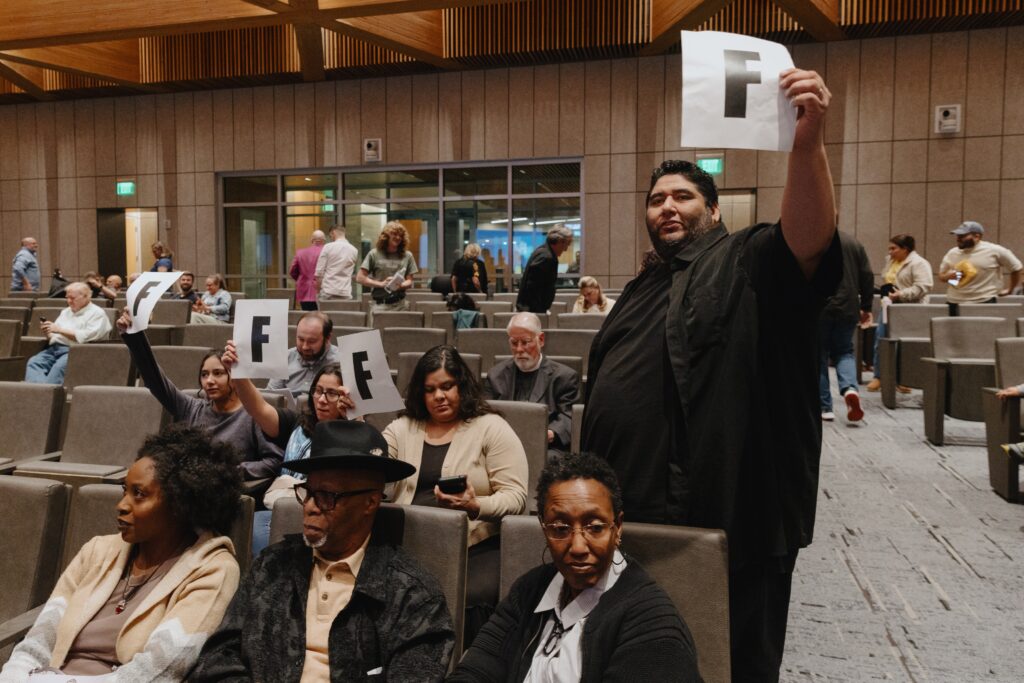
Carrion walked up to the mic for the first council meeting of 2026 with a sheet of paper printed with a big black F.
“We’re grading you guys for 2025,” he said.
He ticked through what upset him, from the DEI vote to the reduction in public comments at meetings not long after.
“Jeanette Martinez, I also give you an F,” Carrion told the council member he had tried to sway, holding up the letter.
“We see you, Carlos!” Carrion later shouted at Flores on his way out the door.
Outside the meetings frequented by a core group of activists, it wasn’t clear that many voters shared Carrion’s anger. Most were unaware of the DEI fight, and even when they had followed it, their feelings were often mixed.
“Trump is an idiot,” said David Sloan, a retired Democrat. “He doesn’t have the right to dictate that.” But he wasn’t sure what the council should have done.
At a Walmart Supercenter on the edge of Martinez’s diverse district, Roshena Padilla — a 48-year-old Black woman who calls herself an independent — said she supports getting rid of DEI because “I don’t need any special considerations.” Abena Howard, a Democrat in her 50s, doesn’t like Trump but is skeptical of diversity programs: “Why are you putting us in a category? Everybody needs help.”
Council members who voted to suspend DEI said they had no regrets.
“I wasn’t elected here to scream at a wall,” Flores said. “I was elected to find solutions for people.”
Martinez pointed to her statement from last year saying the cost of losing the federal funding would be “insurmountable.”
The most concrete impact of cutting DEI, community leaders said, has been the changes to the city’s business programs. They are hopeful about the new small-business program, they say, but are still gathering data on how it plays out.
The DEI issue has been galvanizing for a vocal group on the left. Council members aren’t up for reelection until May 2027, and incumbents rarely face significant opposition, but the activists are feeling bolder about mounting challenges.
“With Trump’s reelection, and seeing how this City Council and how other local governments are handling the pressure from him, we can’t wait; we have to force this,” Montalvo said.
The night after the City Council meeting early this year, Montalvo, Carrion and about two dozen friends gathered for their monthly dinner catch-up. Many were strangers until recently, connected by Carrion’s podcast and their growing political involvement. Over Thai food, they vented about the Republicans who controlled Texas and the Democrats they thought should be pushing back harder.
Carrion agreed with a friend who thought the moderate Democrats were wrong to focus on winning over Republicans. It was better to double down on liberal values and turn out the base, he argued.
Eventually the conversation turned to the City Council. The turnout in May municipal elections has been so low, Carrion said, that Flores has often won with fewer than 1,500 votes.
“You try and tell me it takes less than 4,000 votes to take out Jeanette and Carlos?” Carrion told the table.
“We got that many people listening to the pod!” someone said.
The post What happened when Trump told a city to forget DEI or lose federal money appeared first on Washington Post.