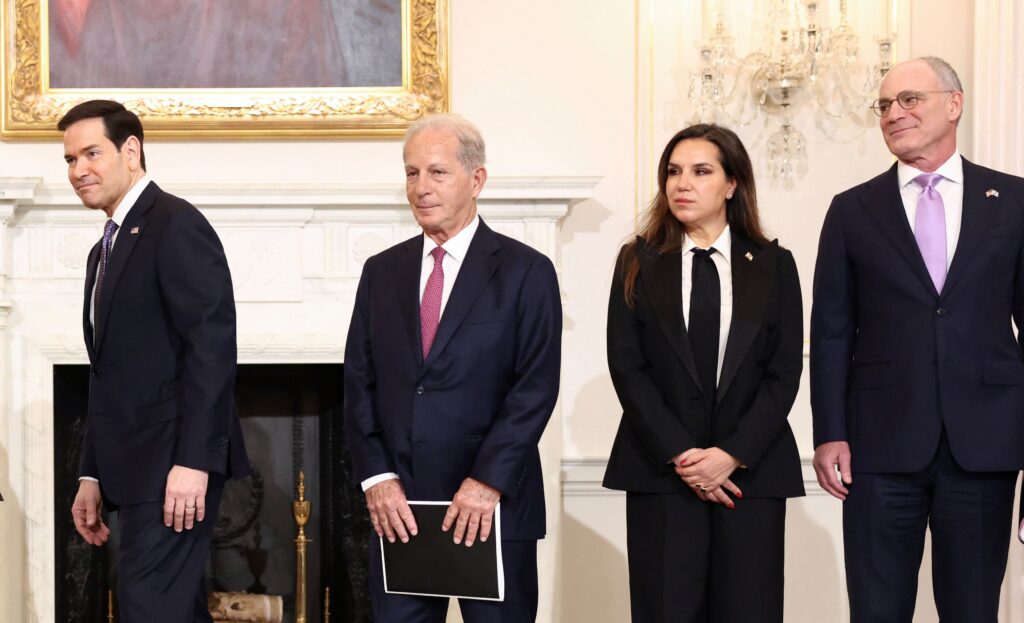
Senior diplomats from Lebanon and Israel met in Washington on Tuesday, a rare face-to-face encounter as their host, Secretary of State Marco Rubio, sought to make peace between the two states.
The event, which lasted more than two hours, was described as a working group aimed at reaching a ceasefire amid ongoing cross-border hostilities. It was attended by Lebanon’s ambassador to the United States, Nada Hamadeh Moawad, and her Israeli counterpart, Yechiel Leiter.
Speaking to reporters afterward, Leiter called the meeting a success, saying that both sides had agreed on a long-term vision that there should be a “clearly delineated border between our countries.” The talks would continue within weeks, he added.
Hamadeh, the Lebanese ambassador, thanked the Americans for “hosting and facilitating the discussions,” which she said were “productive.” In a statement, Hamadeh said she had called for a ceasefire that would allow displaced people to return to their homes, noting the severe humanitarian crisis in Lebanon.
The State Department said that the meeting was the first “major high-level engagement” between Israel and Lebanon since 1993. Tommy Pigott, a spokesperson for the agency, wrote in a statement that the outcome of the “historic” meeting was “fruitful” and that all sides had “agreed to launch direct negotiations at a mutually agreed time and venue.”
The meeting comes amid a shaky two-week ceasefire in the U.S.-Israeli war with Iran during which the Trump administration imposed a naval blockade on the Strait of Hormuz after peace negotiations in Pakistan collapsed over the weekend.
In response to strikes fired at Israel by Hezbollah, a political and paramilitary group in Lebanon and key regional ally of Tehran, Israel had conducted heavy bombardment of Beirut along with a ground invasion of southern Lebanon, where residents were ordered out of more than 10 percent of the country, displacing about 1 million people, according to the United Nations.
Hezbollah has said it fired rockets at Israel as revenge for the killing of Iran’s supreme leader, Ayatollah Ali Khamenei, at the beginning of the war. Over 2,000 people have been killed, including 252 women and 166 children, according to Lebanon’s Health Ministry. Hezbollah strikes into Israel have killed at least 12 soldiers and two civilians, Israel says.
Leiter obliquely referenced the operations Tuesday, telling reporters he hoped that soon the “only reason we’ll need to cross each other’s territory will be in business suits to conduct business or in bathing suits to go on vacation.”
Hezbollah Secretary General Naim Qassem, who is not party to the talks, called for them to be canceled outright, describing them as futile. He urged an end to Israeli “aggression,” as well as a withdrawal from Lebanese territories, the release of prisoners and allowing Lebanese people to return to their homes. Until then, he said, “our decision in the resistance is that we will neither calm down nor surrender — the battlefield will speak.”
The United States had pushed for Tuesday’s meeting, viewing the fighting in Lebanon as an unwelcome distraction from its foreign policy focus in Iran and blaming Hezbollah for the conflict
“This is about bringing a permanent answer to 20 or 30 years of Hezbollah’s influence in this part of the world,” Rubio said Tuesday, before the talks began, “not just the damage that’s inflicted on Israel, the damage that’s inflicted on the Lebanese people.”
“This is a process, not an event. This is more than just one day,” Rubio added.
Since the Trump administration announced the start of a ceasefire with Iran, there has been dispute over whether Israel’s campaign in Lebanon was part of it. Both Pakistan, which mediated the deal, and Iran insist it was, describing it as an intrinsic part of the agreement. Israel remains emphatic it was not.
Vice President JD Vance, who led the U.S. delegation to Islamabad over the weekend, described the disagreement over Lebanon’s inclusion as a “legitimate misunderstanding,” telling reporters, “I think the Iranians thought that the ceasefire included Lebanon, and it just didn’t.”
Israel has ignored calls to respect the truce, insisting it will continue to attack Hezbollah. It unleashed its heaviest attack on Beirut last week, killing more than 300 people, and has carried out further strikes since.
A State Department official, speaking on the condition of anonymity to discuss sensitive diplomacy, denied that there was any link between the talks with Iran in Pakistan and Tuesday’s meeting between Israel and Lebanon at the State Department. “Talks have been planned for a month, before Islamabad was confirmed,” this official said.
Even so, efforts at mediation between Israel and Lebanon had struggled to gain traction, with the United States focused on the war in Iran. Leiter said Tuesday that the United States was the only country that could mediate, rejecting efforts by French President Emmanuel Macron.
“We’d like to keep the French as far away as possible from pretty much everything, but particularly when it comes to peace negotiations, they’re not needed,” Leiter said, adding that France was “not a positive influence” in Lebanon.
The French Embassy in Washington declined to comment.
Israel and Lebanon have not held direct talks with a goal of normalizing relations in decades, and they are likely to be fraught with difficulty as both sides remain far apart.
Last week, Israeli Prime Minister Benjamin Netanyahu said he would open direct negotiations at Lebanon’s request. “The negotiations will focus on the disarmament of Hezbollah and the establishing of peaceful relations between Israel and Lebanon,” he wrote on X.
Lebanese President Joseph Aoun’s office said the sides will discuss “the announcement of a ceasefire and the date for starting negotiations between Lebanon and Israel under American sponsorship.”
Lebanon wants a ceasefire to be implemented ahead of further discussions, similar to the deal between the U.S. and Iran, a Lebanese government official said, speaking on the condition of anonymity because they were not authorized to talk to the news media.
Last month, in response to escalating Israeli attacks, Lebanon’s government appealed to U.S. and European leaders to intervene, calling for not only a ceasefire but support for the Lebanese army to seize Hezbollah’s arsenal, The Washington Post previously reported.
On Saturday, Hezbollah supporters rallied outside the office of Lebanese Prime Minister Nawaf Salam in protest of the talks. In an effort to calm internal tensions, Salam later called off a planned trip to the U.S. scheduled for this week.
Another Lebanese government official, who spoke on the condition of anonymity to discuss sensitive negotiations, said they did not believe the talks would lead to a ceasefire. “What does Lebanon have to offer on a negotiating table? Nothing,” the official said.
Soroka reported from Tel Aviv, and Haidamous reported from Beirut. Mohamad El Chamaa in Beirut contributed to this report.
The post Lebanese, Israeli diplomats hold rare face-to-face meeting in Washington appeared first on Washington Post.