A few days after my wedding in 2024, my husband and I found ourselves happy, jet-lagged and starving in Paris.
We’d been on a heater: The spring weather was crisp and sunny, and I’d just found the perfect sweater at a quaint boutique in the 9th arrondissement (or district). Now we just needed a good lunch. I popped open Google Maps to see what was nearby and clocked a corner cafe with a 4.5 rating and more than 1,500 reviews — a strong sign.
As we started into our entrées, my heart sank: I’d taken us to a bad restaurant.
I am, of course, not the first traveler to encounter a flop meal in the City of Light.
“It’s possible to eat badly in Paris,” said cookbook author David Lebovitz, who has lived in Paris since 2004.
As one of the most visited cities on the planet, Paris may be a culinary capital but it’s also teeming with mediocre-t0-terrible restaurants.
Meg Zimbeck, the founder and editor in chief of the restaurant review website and food tour company Paris By Mouth, thinks it’s not just the city’s problem. Travelers often come to Paris with incredibly high expectations and more refined palates (you can get wagyu steaks at Costco now). What might have dazzled us a few decades ago may no longer register as particularly special, while our bar for food in Paris remains as high as ever.
Still, the city remains one of the best dining destinations for good reason, and “if you know where to go, it’s great,” Lebovitz said.
That takes some legwork.
“You really do need to do some research, and that’s not relying entirely on Google reviews, but sort of cross-referencing sources and taking a real look at the menu,” said journalist Lindsey Tramuta, who wrote the book “The Eater Guide to Paris.”
“And, also, please don’t rely solely on TikTok,” she added.
Here’s what other advice our experts shared.
A big crowd doesn’t always signal good food
Just because a place is packed doesn’t mean the food is excellent. When Lebovitz moved to Paris, he remembers a local friend telling him, “‘In France, we don’t go out for the food. We go out to be with our friends,’” he said.
“People often will go to a restaurant that’s not so great because they like it, or it’s in the neighborhood.”
That doesn’t mean a busy restaurant — or a just-okay restaurant — isn’t worth trying. There are many factors that make a restaurant appealing to a Parisian and traveler alike.
“Do people look like they’re having a nice time? … Do they have a view that you want to look at?” Zimbeck said. “Just do what feels right to you.”
Removing the pressure to find the perfect meal will help you better appreciate the moment.
“If you’re in the right mood with the right person, a mediocre croque monsieur can be really exciting,” Zimbeck said.
Be discerning with internet lists
Humans love a list — and I’m among their most ardent fans, particularly when it comes to food and travel. I read them, bookmark them and even make them myself. But while the internet overfloweth with easy-to-digest lists of places travelers must go when they visit [insert any place on earth here], they are not all worth saving for your own Paris trip.
Lebovitz, who regularly encounters questionable Paris lists, hopes travelers are discerning as they consume them. He notes some people are paid to make them — or paid to include certain establishments. They can also be created by someone who “doesn’t know food,” he said. “They have a different barometer.”
Another red flag: “A lot of these lists get published by people that don’t live here, which doesn’t mean they’re bad lists,” he said. “But places change.”
An example of a quality list: Zimbeck’s Paris By Mouth maintains a list of the company’s 50 favorite restaurants that gets updated three times per year.
“I probably go to 150 restaurants to get those 50,” Zimbeck said. Furthermore, the Paris By Mouth team visits restaurants anonymously and pays full price to avoid special treatment. Most social media lists are not made with the same rigor and transparency.
Instead of blindly following a list or Instagram advice, take some time to find sources you trust. I’ve followed Lebovitz, Tramuta and Zimbeck for years and have bought their books, subscribed to their newsletters and routinely save their recommendations to Google Maps for my own travels.
AI can point you in the right direction
More travelers are turning to AI for itinerary input, but how reliable are the recommendations? I ran a test with Lebovitz asking ChatGPT for a list of the top five restaurants in Paris. The algorithm spit out Restaurant Guy Savoy, Epicure, Restaurant Kei, La Tour d’Argent and Passionné. Lebovitz didn’t have any qualms with the results but noted “these are Michelin-starred restaurants.”
We tweaked the prompt with price parameters to ask about the best restaurants for meals under $100 per person, and were given Les Arlots, Le Servan, Bistrot Paul Bert, La Méditerranée and Bouillon Chartier. Lebovitz supported the first three recommendations, hadn’t been to the fourth, and disagreed with the last.
“Ugh, no,” he said of Bouillon Chartier. “Well, the room is gorgeous and it’s really cheap. It used to be more fun and now there’s lines, there’s tourists, and the food … people don’t go for the food.”
My takeaway from the experiment: AI programs may steer you in decent directions, but still can’t guarantee a great meal. If you do want to use them, do so as a jumping-off point for your research, not the final say.
Translated menus aren’t always a red flag
The typical tourist trap wants to appeal to as many travelers as possible. Obviously a restaurant with a laminated menu advertising in 10 different languages with photos of each dish is a dead giveaway it’s not for Parisians.
But don’t doubt a place’s caliber only because it has a translated menu.
“It’s hard to make these absolute [rules] like ‘don’t go to restaurants with English menus,’” Lebovitz said. “English is becoming the second language in Paris.”
He added: “Often they have English menus just because it’s easier for the servers and the customers.”
Needing a reservation is a green flag
Needing a reservation can feel like a hassle, but it’s often a good sign in Paris.
“A lot of the places that are worth going to actually do require reservations,” Tramuta said.
Zimbeck says that’s because many quality restaurants are small and may only have capacity to serve a small number of patrons per night.
There are exceptions. For example, Clamato, a small, respected seafood restaurant in the 11th arrondissement that Lebovitz likes, does not take reservations.
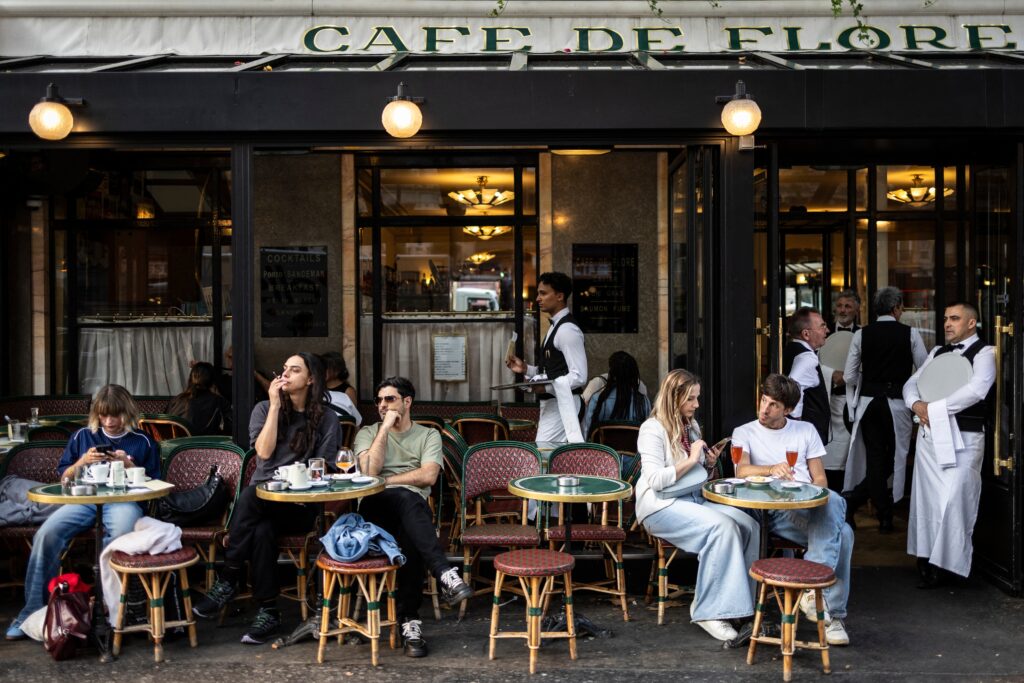
And there are plenty of places where you can have a perfectly good experience on the fly. Grabbing a seat at a sidewalk cafe for a glass of wine or a burger? No reservation.
For a truly special meal, though, or a place with a trendy reputation, expect to book in advance. Many now offer the option to do so online.
But try not to go overboard on the planning. “Leave a little bit up to whim,” Tramuta advised.
When in doubt, picnic
Eating well in Paris does not require sitting down at a restaurant.
If you are having decision fatigue, or have hit your restaurant limit, head to the nearest gourmet shop, grab a sandwich or baguette plus delicious meats and cheeses, a beverage and go picnic with a view. A second portable food option: try one of the city’s many excellent kebab shops.
A few of our favorite people-watching spots include the Jardin du Luxembourg; the banks of the Seine river or the Canal Saint-Martin; Parc des Buttes-Chaumont; and the grassy knoll in front of the Basilique du Sacré-Cœur de Montmartre.
The post How to avoid a terrible restaurant in Paris appeared first on Washington Post.