For years, the palatial United Auto Workers training facility on the Detroit River sat empty, a sign of how far American manufacturing had fallen.
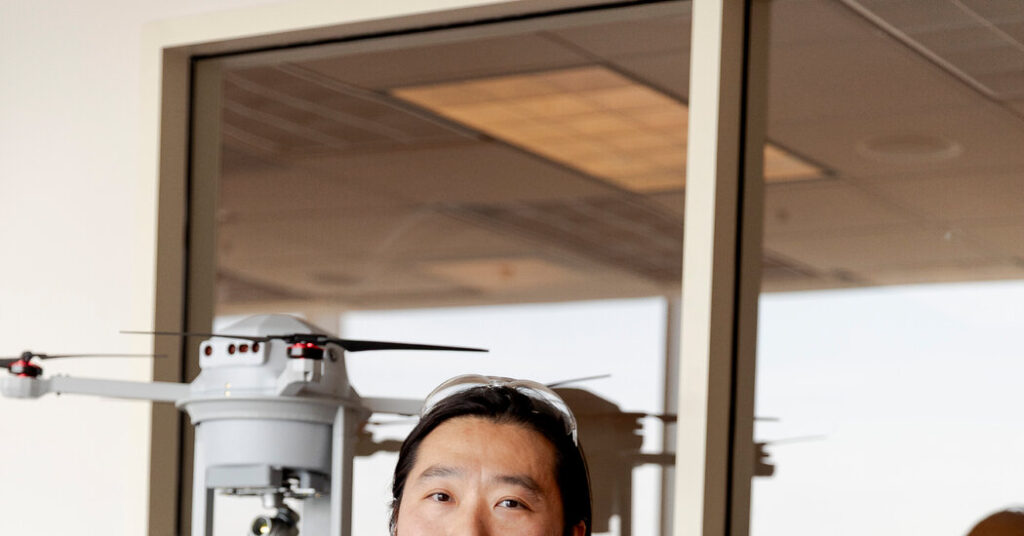
Today, drones buzz from its rooftop like bumblebees circling a hive.
Birdstop, a start-up that makes drones that monitor electrical wires and other infrastructure, moved in six months ago. Its three dozen employees don’t fill the complex, which includes a garage with 900 parking spaces and a 375-seat auditorium. But room to grow was a key selling point when the company moved its manufacturing here from Alabama and its headquarters from California.
It was no accident that Birdstop’s founder, Keith Miao, landed in Detroit, a city he had never visited before last year. Leaders in Michigan courted him as part of a push to capture a slice of the rapidly growing drone industry.
“We were searching for a building that could become the epicenter of the U.S. drone industry,” he said. “Frankly, we wouldn’t be able to afford 420,000 square feet in downtown San Francisco.”
Thanks to ramped-up military spending on drones and their proliferation in civilian uses, the market for American-made unmanned aerial systems is expected to grow to more than $50 billion by 2030, from $5 billion this year, according to Austin Bohlig, a senior analyst who specializes in drones at Needham & Company, a Minnesota-based investment banking firm.
Recent federal restrictions on new models from DJI, the Chinese company that makes at least 80 percent of the hobbyist and commercial drones that Americans fly, have created an opening for domestic manufacturers.
Companies are scrambling to build a supply chain from scratch, and states are vying to be at the center of it. In July, Gov. Gretchen Whitmer of Michigan, a Democrat, issued an executive directive calling for a statewide effort to scale up “advanced air mobility” manufacturing, which includes drones and electric planes.
The state spent at least $14 million in 2025 to boost the drone industry, according to recent press statements. Projects included testing whether drones could be used to collect medical samples from rural patients, deliver auto parts to car dealerships and resupply ships on Lake Michigan, according to a recent report.
“The sky is no longer the limit,” said Justine Johnson, the state’s chief mobility officer, noting that Michigan’s goal is to host more high-growth drone companies than anywhere in the world.
That’s a heavy lift. Drone factories have already been built in Florida, California, Utah and Ohio, as well as Israel, Turkey and Ukraine. And a scandal involving a $20 million Michigan grant to a politically connected businesswoman has increased skepticism of government spending on businesses. The collapse of the electric vehicle battery boom, which received hefty incentives from the state, also contributed to the backlash.
Now state lawmakers from both parties are scrutinizing every dollar spent on economic development, said John Mozena, president of the Center for Economic Accountability, a Michigan-based organization that gives an annual award for “Worst Economic Development Deal of the Year.”
But it’s clear that drones have captured the imagination of many in Detroit’s business community, as the declining U.S. share of global vehicle production has caused anxiety and prompted a search for adjacent industries.
Detroit Manufacturing Systems, an automotive supplier that makes center consoles for Ford trucks, is hunting for drone contracts. Its smaller-scale arm, Kinetyc, scored just one: building docking stations for a drone interceptor for Ondas, a counterdrone technology firm.
Michigan offers drone companies grants for prototyping and industrial automation. The state has also funded testing grounds that make it easier for drone companies to undertake the arduous process of getting Federal Aviation Administration approval to fly autonomously.
“The biggest value that we’ve seen here is the ability to test,” said Andrew Zeimen, program manager for Blueflite, a company that makes cargo drones capable of delivering blood to crash sites and organs to hospitals.
On a recent day, Mr. Zeimen was the only person working out of a drone operations center being built on the 11th floor of Michigan Central, the iconic former train station in downtown Detroit, with the help of a $2.5 million grant from the state. The site is attractive because it is equipped with external sensors and radars that can keep track of the drones. The building’s large windows allow operators to observe the drones flying for miles.
Without this chance to test in an urban environment, Blueflite might not have caught and corrected an issue with cell towers interfering with a drone’s signals, Mr. Zeimen said.
State funding also supports NewLab, an innovation hub affiliated with Michigan Central where start-ups can use a variety of machines they may be unable to afford in their early stages. Birdstop uses NewLab’s CNC machines and laser cutters to build perches for its drones. Airspace Link, a company that sells software to cities and federal agencies, has its headquarters there.
Dan Gilbert, the billionaire founder of Rocket Mortgage, who is widely credited for reviving downtown Detroit, has played a key role in wooing drone companies. His venture capital firm, Detroit Venture Partners, provided Airspace Link seed money, and he serves on Birdstop’s board.
Mr. Gilbert’s real estate firm acquired the U.A.W. training facility from another developer after a corruption investigation forced the union to sell it. He met Mr. Miao, Birdstop’s founder, before the Reindustrialize conference last summer and offered Birdstop the space, Mr. Miao said.
Mr. Miao was intrigued by the possibility of moving to Detroit, but wanted to see if he would be able to procure the components he needed to build drones locally.
“If you are DJI and you are in Shenzhen, you walk downstairs and have 150 options for every single component,” he said. “In the United States, you walk downstairs and there are quite literally zero to one options.”
He sent his vice president of engineering, Jatin Kolekar, to scout auto suppliers to see if they might be able to make the components that Birdstop needed. Mr. Kolekar determined that backup cameras for cars and small electric motors and batteries for systems like windshield wipers could be repurposed for the drone industry.
With help from a $100,000 Make It in Michigan grant, Birdstop is developing a high-resolution camera for drones that will be one-tenth the cost of options currently available in the United States, Mr. Miao said. He intends to make it in-house until demand is large enough to interest an auto supplier.
The last piece that needed to fall into place was a customer to offer feedback. Here, too, Michigan came through. Birdstop was connected with Truck Specialized Parking Services, a Detroit-based company that manages truck yards across the country and wanted to use drones to make them safer and more efficient.
For now, Birdstop assembles about 150 drones per month by hand in cubicles that once belonged to U.A.W. clerical workers. But Mr. Miao has big plans to set up automated production lines to build not only drones but drone components.
“We want to see a future that’s 12 to 18 months away where there are maybe not 150 but 15 options” for components, he said.
Farah Stockman is a Times business reporter writing about manufacturing and the government policies that influence companies that make things in the United States.
The post Can Michigan Become the U.S. Drone Capital? appeared first on New York Times.