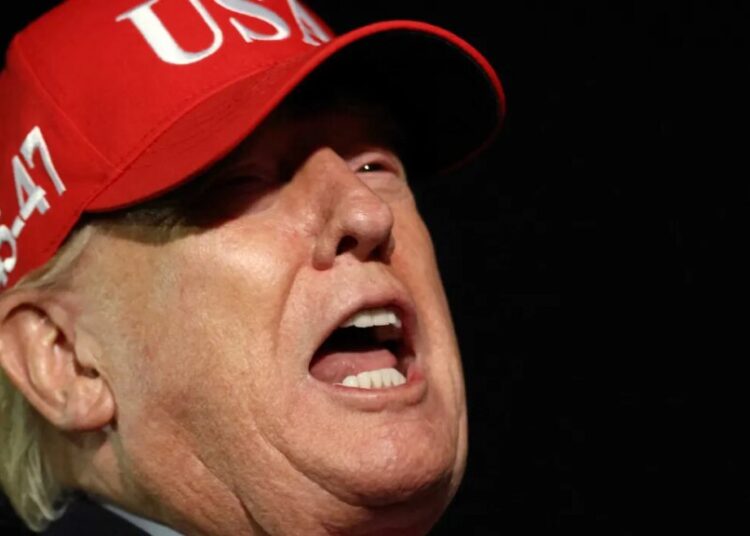
In 2022, the Biden administration tried to arrest China’s development of artificial intelligence by denying it cutting-edge semiconductors. President Trump has relaxed that policy a bit without a clear plan to replace it.
But the chip export controls have failed. China’s tech sector is too sophisticated to be stopped from building powerful A.I. In pursuing an impossible objective, the United States is missing an opportunity to try for one that sounds fanciful but which, after a recent reporting trip to China, I believe is more realistic: America should negotiate with China a global pact on A.I. safety, which would impose universal limits on a technology that can do much good — but, in the wrong hands, would do much harm.
The premise of the export restrictions was that the United States would be able to successfully block China’s access to powerful A.I. chips. The premium chip sets used in A.I. data centers are the size of skateboards and can’t be smuggled in a simple suitcase, and it’s hard to put them to use without hands-on support from the chipmakers’ engineering teams. But Chinese developers circumvented controls by training their A.I. models on chips located in other countries. A Chinese model builder needs only to rent capacity on an A.I. data center in one of China’s Southeast Asian neighbors. Concealing the model’s Chinese origin is straightforward.
Partly thanks to this loophole, China has rolled out a series of excellent A.I. models. China’s ability to skirt U.S. controls will not change, even if the Senate follows the House in passing a bill to restrict China’s access to outside data centers. China is learning how to do without cutting-edge chips by stacking less powerful chips together. Its model builders also take full advantage of a process known as distillation. Every time a U.S. lab produces a cutting-edge model, Chinese rivals quickly reverse-engineer its capabilities and build a copycat version. The follower has the advantage.
American A.I. scientists used to say that competitors’ being able to follow fast would not matter. An “intelligence explosion” was approaching, the argument went. A.I. systems would soon become capable enough to write upgrades into their own code: A.I. would create better A.I.; better A.I. would create even better A.I.; recursive self-improvement would drive performance skyward. The nation that reached this so-called singularity first would be the winner of the A.I. race, even if the fast follower were just a few months behind the leader. Three and a half years after the Biden administration’s chip controls, A.I. is generating code to upgrade itself. The promised feedback loop has started.
But the accelerating power of the leading models won’t determine who wins the A.I. race. It’s A.I. deployment that will matter. To transform economies and armies, A.I. must be embedded in business processes and weapons systems. The raw power of the cutting-edge models must be turned into applications.
The upshot is that China and the United States are roughly level in the A.I. contest. Top Chinese models may be a few months behind American ones, and the relative position on military applications is difficult to ascertain as so much is classified. But on industrial applications, China seems to be leading. U.S.-sanctioned companies such as Huawei and Hikvision are rolling out A.I. systems that perform maintenance checks on high-speed trains, manage mining operations and scan water samples to assess pollution. At Huawei’s campus near Shenzhen, I recently took a ride in an autonomous car. A device in the passenger seat massaged my back, and the steering was immaculate.
Fans of chip controls continue to insist that even a modest slowing of China’s A.I. advance is worth pursuing. If China is a formidable adversary, imagine how much more formidable it might be if the chip controls were lifted. But the controls are failing to deliver the prize of a China with limited A.I., so it is worth considering their cost. My China trip persuaded me that the cost is too high.
The Biden administration made a strategic choice to prioritize the slowing of China rather than addressing other worries. The alternative would have been to say to China: You are a tech superpower. We are a tech superpower. Let’s work together to make sure A.I. doesn’t fall into the hands of rogue states and terrorists. The goal would have been an A.I. equivalent of the 1968 Nuclear Nonproliferation Treaty, a regime that would require all countries using A.I. to sign up for safeguards on it.
The Biden team did not think China would collaborate on something like that. But over a dozen conversations with A.I. leaders in Beijing, Shanghai, Shenzhen and Hangzhou made it clear to me that China’s elite does care about A.I. safety.
I visited a prominent tech company that builds and distributes an A.I. foundation model. For now, that model is open source, meaning that users can download and modify it at will. If a user prompts the A.I. to conduct cyberattacks, there’s nothing anyone can do to stop that person. But the chief executive of this tech company made a striking admission: As A.I. becomes more powerful, it would be crazy to continue making it open source, he said. You wouldn’t open-source a nuclear weapon, he added.
During my trip, the controversy surrounding the advanced model OpenClaw illustrated the rising concern for A.I. safety. Throngs of ordinary Chinese downloaded the digital assistant, eager to experiment with a capable A.I. agent. The enthusiasm apparently confirmed that China loves innovation more than it fears it. But researchers and industry leaders told me that they were appalled. OpenClaw makes your computer “naked,” an eminent business school professor told me. Soon after he said that, China’s leaders firmly discouraged the use of OpenClaw on government systems and warned citizens that the agent might wreak havoc with their data.
For now, China’s instinct to race for powerful A.I. overwhelms any caution. This is a rational response to a U.S. administration that is equally determined to put speed ahead of safety. But if a U.S. leader went to China and offered to scrap chip controls in exchange for collaboration on A.I. nonproliferation, there would be at least some chance of the proposal succeeding.
This presumes that U.S.-Chinese dialogue is even possible. But the West should not succumb to self-fulfilling fatalism. At times during the Cold War, the United States pursued its interests by switching from confrontation to détente: the Nuclear Nonproliferation Treaty came just six years after the Cuban missile crisis. Now is a good time to recall that history.
Sebastian Mallaby is a senior fellow at the Council on Foreign Relations and the author of “The Infinity Machine: Demis Hassabis, DeepMind, and the Quest for Superintelligence.” He co-hosts the CFR podcast, “The Spillover.”
The Times is committed to publishing a diversity of letters to the editor. We’d like to hear what you think about this or any of our articles. Here are some tips. And here’s our email: [email protected].
Follow the New York Times Opinion section on Facebook, Instagram, TikTok, Bluesky, WhatsApp and Threads.
The post We Can’t Stop China From Building Powerful A.I. Here’s What We Can Do. appeared first on New York Times.