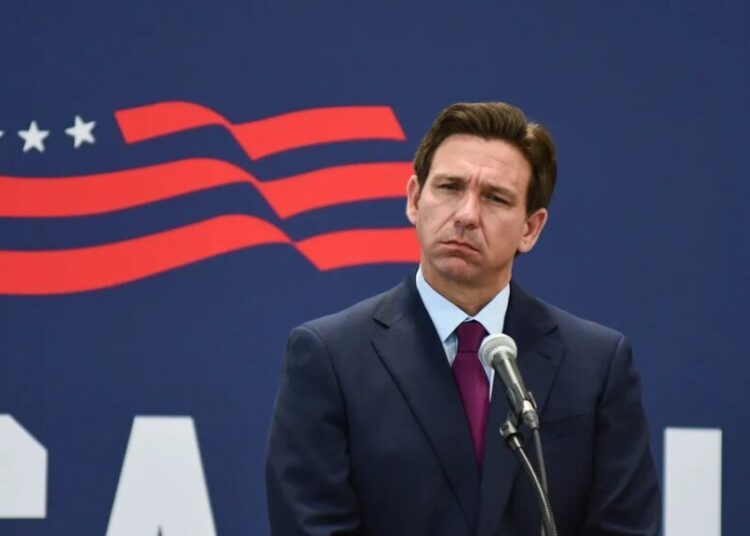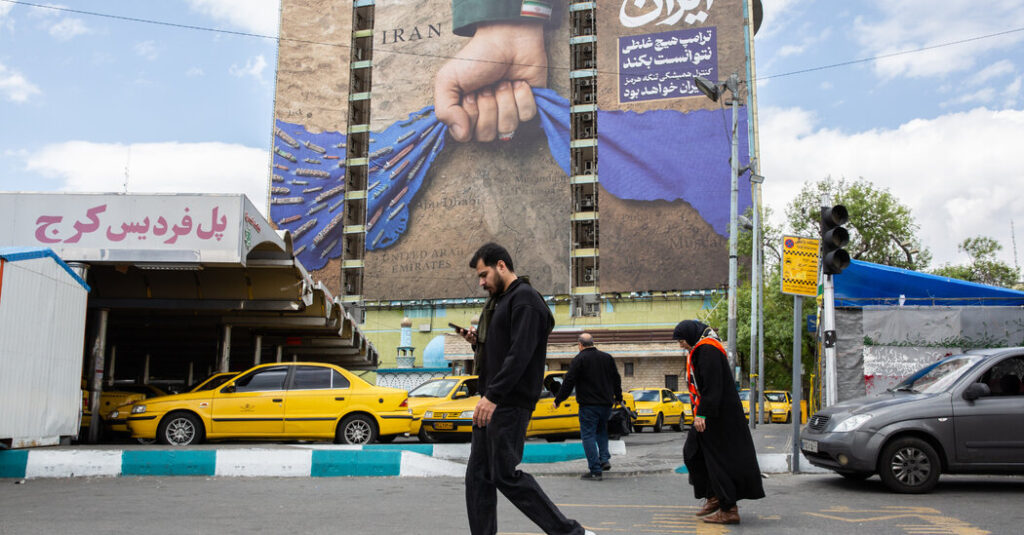
In announcing a complete U.S. blockade of Iranian ports, President Trump took a drastically new approach to trying to achieve what he has wanted for weeks — opening the Strait of Hormuz to global traffic.
The president seems to be hoping that the blockade will heap new pressure on Iran after direct talks between U.S. and Iranian officials in Pakistan over the weekend failed to end the war, and he suggested that other countries would join the effort.
But on Monday, there were few volunteers, with only Prime Minister Benjamin Netanyahu of Israel publicly supporting the idea.
Mr. Trump’s proposed blockade “makes no sense,” Spain’s defense minister, Margarita Robles, said in a television interview. “Since this war started, nothing makes sense,” she added. “This is another episode in the downward spiral the world has been dragged into.”
Experts said they doubted that the blockade would get Mr. Trump any closer to an endgame that he could sell as an American victory.
“I’ll save you the waiting period: Iran is not going to capitulate,” said Danny Citrinowicz, a senior researcher at the Institute for National Security Studies in Israel who studies Iran and its proxies. “This regime believes that the damage that will be sustained by this act will be bigger for the U.S. and the international economy than for Iran.”
Imposing a blockade entailed risks for the U.S., he said. It could further increase oil prices, deepening the drag on the global economy. The U.S. interdiction of ships belonging to, say, India or China could cause diplomatic clashes. It will also bring U.S. ships into striking distance of Iran’s missiles and drones, putting American military personnel in harm’s way.
“I don’t see the Iranians raising the white flag,” Mr. Citrinowicz said, suggesting that the United States would be better off seeking a compromise that Iran’s leaders could accept.
So far, it appears that the blockade will largely belong to the United States alone. Most countries stayed mum on the issue on Monday. A few, in addition to Spain, voiced their opposition.
Prime Minister Keir Starmer of Britain said his country would not support such a move. His Australian counterpart, Anthony Albanese, said his government had not been consulted and instead called for “de-escalation” of the conflict.
In a video posted by his office, Mr. Netanyahu of Israel said his country backed the blockade and was “in constant coordination” with the United States. He did not say whether Israel would be directly involved in enforcing the blockade.
The American-Israeli war on Iran, now in its seventh week, has scrambled global trade, roiled energy markets and inflicted economic distress on countries across the world, harming American friends and foes alike.
Intensive airstrikes by the United States and Israel have decimated Iran’s navy, military and missile launch sites, and Iranian activists say that more than 1,700 civilians were killed during the attacks.
Yet, the damage failed to make Iran more pliable during the weekend’s negotiations.
Nor did Mr. Trump’s sudden announcement of the blockade brighten an increasingly gloomy sentiment about the war’s impact on the global economy. Oil prices surged on Monday and stocks fell, suggesting that investors did not expect the blockade to be a quick fix.
Mr. Trump could be overestimating how effective the economic pain of a blockade would be in changing Iran’s position, said Ahmet Kasim Han, a professor of international relations at TED University in Ankara, Turkey.
“Iran is already hurting, and they have shown that they are willing to take more than a couple of hits,” he said. “The Iranian regime is not one that cares for the well-being of its citizens, and there is no civil society that can raise its voice against the regime in the face of economic calamity.”
Mr. Han added that Mr. Trump’s message was undermined by his announcement that other countries would help impose the blockade without saying which ones.
“This habit of saying that people are on board with him while not naming them diminishes his credibility, and that does not work well for U.S. standing internationally,” he said.
In announcing the blockade on Sunday, Mr. Trump’s said it would prevent Iran from selling its oil to select countries.
“It’s going to be all or none and that’s the way it is,” he wrote on social media.
In the same post, Mr. Trump said the U.S. military would intercept in international waters any ships that paid Iran for safe passage, an apparent attempt to shut down Iran’s efforts to charge tolls.
In a statement, U.S. Central Command said the blockade would begin at 10 a.m. Eastern time and apply to all ships navigating near Iran’s ports and coastal areas. U.S. forces would not stop ships passing through the strait and using other countries’ ports. But the deadline passed without any apparent attempt by the U.S. Navy to enforce the blockade.
The naval arm of Iran’s Islamic Revolutionary Guards said in a statement on state-run media on Sunday that any military vessel approaching the strait would meet a “severe response,” raising the prospect of direct attacks on U.S. ships and personnel.
It was not clear whether the United States had previously discussed the blockade with its Arab partners in the Persian Gulf, or any of its other allies.
As part of its retaliation for the U.S.-Israeli attacks, Iran has fired drones and missiles at oil facilities and some civilian infrastructure in these countries — including Saudi Arabia, Qatar, Bahrain and the United Arab Emirates — disrupting their production and export of oil and gas.
“For the time being, it is complicating things,” Abdulkhaliq Abdulla, a professor of political science in the Emirates, said of the blockade. “Things were already complicated, and this adds another complication to a very difficult situation.”
He blamed Iran for the turmoil in the Gulf, he said, “because they are the ones who hijacked the Strait of Hormuz and don’t want to relent.”
Among the governments that responded to Mr. Trump’s announced blockade, most called for a return to negotiations.
“It is, in my view, vital that we get the strait open and fully open, and that’s where we’ve put all of our efforts,” Mr. Starmer told BBC Radio 5.
“We want to see de-escalation, and we want to see those negotiations resumed,” said Mr. Albanese of Australia, who was preparing to embark on a diplomatic tour across Asia aimed at securing fuel and fertilizer supplies. He called the lack of progress in the talks between Iran and the United States over the weekend “disappointing.”
In Beijing on Monday, Guo Jiakun, a spokesman for China’s Foreign Ministry, called for a cease-fire and for all parties to show restraint.
“China is willing to continue to play a positive and constructive role,” he said.
China is a major recipient of fuel through the Strait of Hormuz.
Reporting was contributed by Michael D. Shear in London, Laura Chung in Sydney, Australia, Carlos Barragán in Madrid and Lily Kuo in Taipei, Taiwan.
Ben Hubbard is the Istanbul bureau chief for The Times, covering Turkey and the surrounding region.
The post To Open the Strait of Hormuz, Trump Wants to Blockade Iran. Experts Are Skeptical. appeared first on New York Times.