Daniil, a Russian student, took a medical leave from his studies in St. Petersburg, Russia, and ultimately lost his place at university.
Then this February, more than a year later, an email from the university arrived in his inbox with a surprise offer: He could be reinstated as a student. All he needed to do was sign a contract to serve for a year in the Russian military’s drone force.
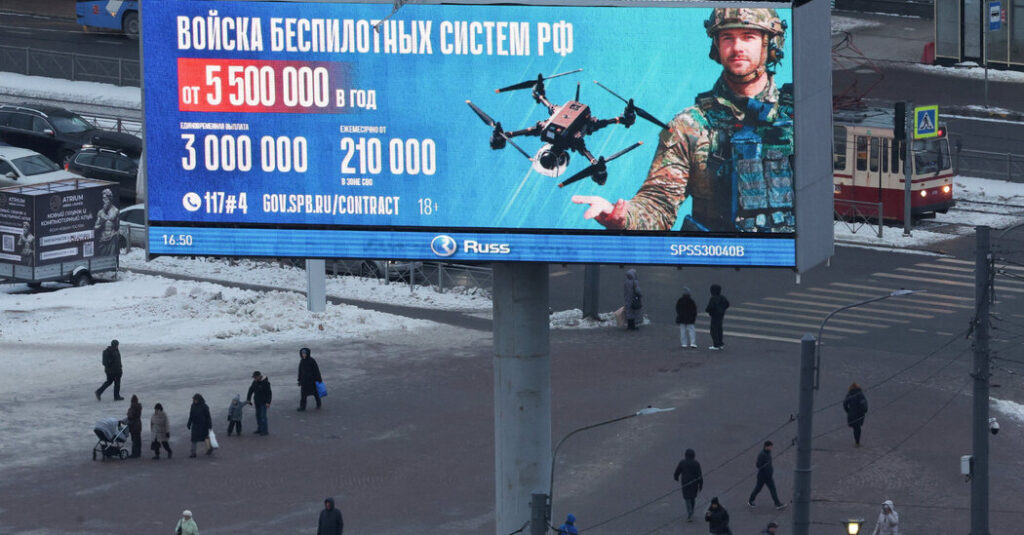
The incentives did not end there. Upon his return to university after serving, he would receive free tuition, a place in a campus dormitory and admission to a paid-for master’s program. He would also get at least 6.52 million rubles ($84,500) for his year of service, 4.5 times the average St. Petersburg salary.
“It is absurd and horrifying,” said Daniil, who, like other students interviewed, asked that his surname be withheld for fear of retribution. The appeal, a “twisted scheme for recruiting,” he said, left him terrified.
In the fifth year of its war against Ukraine, President Vladimir V. Putin’s government is going to new lengths to keep the front lines supplied with men. As Moscow begins its spring offensive, military recruiters have been targeting a section of the population they had not pursued aggressively before: university students.
Since 2022, the Russian leader has pushed through an unpopular mobilization, recruited mercenaries, prisoners and debtors, and offered lavish, life-changing payments to attract men in need of money. But with Russian troop casualties estimated at more than one million, it has not been enough, and the Kremlin wants to avoid another draft.
Recruiters have been approaching students with a pitch for the drone force, which critics say deceives the young men into thinking they can serve in relative safety and easily leave after only a year, even though drone operators regularly come under fire, and all military contracts are by default indefinite.
Russia launched its Unmanned System Forces as a separate branch of the military in November, after Ukraine did the same, and wants to double its size, to 165,500 personnel, by the end of the year, the Ukrainian military warned in January.
The ambitions show how dominant drones have become on the battlefield in Ukraine, posing a lethal threat to any soldiers who emerge from hiding.
The Russian defense minister, Andrei R. Belousov, said during an appearance in Moscow this month that recruitment of contract soldiers was “ahead of schedule” but did not give numbers. The current emphasis, he said, is on “training and cohesion,” especially in drone units.
Mr. Belousov is widely credited with the 2024 establishment of Rubicon, an elite Russian military drone unit, which harnessed new technology and advanced training to help Russia take the initiative on the battlefield last year. That paved the way for creation of an entirely new branch of the military for drones.
The Kremlin spokesman, Dmitri S. Peskov, told reporters this month that he was unaware of the campaign to recruit university students, but said that the newly established drone force was indeed “looking for new personnel.”
“The offer is on the market,” Mr. Peskov said. “And it’s open to everyone — to workers, to students, anyone.”
Beginning in February, the Russian military fanned out across hundreds of universities to hold recruiting sessions. Posters and promotional videos started filling the walls in academic buildings. The student publication Groza reported that 269 universities and colleges had hosted drone force recruitment efforts, including those in the occupied areas of Ukraine.
A leaked memo published by an exiled Russian lawyer detailed the talking points. Recruiters are expected to make a clear distinction between the Russian infantry, where the risk of death or serious injury is high, and the drone forces, which offer enviably high pay, a “low risk of getting into the line of fire” and a chance to acquire “unique knowledge and skills.”
The authorities have also zeroed in on struggling students like Daniil, who have gone on leave or are at risk of expulsion owing to bad grades.
In one talk that leaked online, a university director from the city of Kazan, about 525 miles east of Moscow, told students facing the threat of expulsion that it was their “duty” to fight in Ukraine.
“A new army is going to be created from the students who won’t be students any longer,” the director said. “This is you.”
Last month, male students at a university in Siberia were asked to attend a recruitment session where attendance was taken. It began with a promotional video that asked whether they wanted to be the type of men who pierced their ears and wore makeup, or real men.
“The underlying message is that if you aren’t fighting, you aren’t really a man,” said Mikhail, 20, a student. “The video ends with the thought: ‘Stop and think: What kind of person are you?’”
During a subsequent presentation, a military recruiter emphasized that joining the drone force would be a good way to get out of the mandatory year of military service, which lacks high pay or any specialized training. The recruiter underscored the financial benefits and the opportunity to learn about a rapidly advancing drone industry.
“The experience that you receive there you can’t get anywhere else,” he told the students, according to an audio recording reviewed by The New York Times. “It will be very in demand in the future.”
At the end, he asked the students to think about joining and “simply decide for yourselves.”
But after the session, a message went out ordering students with failing grades or insufficient credits to report to a specific room. If students failed to clear their “academic arrears,” then “other options” would be considered, according to the message, which was reviewed by The Times.
Recruitment efforts appear to vary from school to school, but such war-related events are becoming more common even at places like the prestigious Higher School of Economics in Moscow, known for its staunchly opposition-minded student body.
Young people are already jaded by the pro-war rhetoric, so recruitment talks did not raise any eyebrows, said Ilya, a second-year student at the economics school.
Still, Ilya said, many students were outraged when the university marked the fourth anniversary of the war in February by hosting a “festival of drones.” A post announcing the event on the official university Telegram channel was flooded with disparaging replies.
Ilya found a swarm of drones buzzing overhead as he walked to the cafeteria that day through a covered courtyard.
“This was quite an uneasy feeling,” he said.
Two of his friends studying in Moscow were called in to speak with top university officials and encouraged to sign up for the drone force after failing their exams, he said. Both transferred to other universities instead.
Artyom Klyga, a lawyer living in exile with the Movement of Conscientious Objectors, a nonprofit that advises Russians on evading military service, called the recruitment the next step in Moscow’s effort to avoid another unpopular round of drafting people across age groups, as the Kremlin did in 2022.
“Authorities keep coming up with new ways to avoid that: introducing sign-up bonuses, creating a mobilization reserve, and now they’re recruiting students,” Mr. Klyga said.
Russia also appears to have stepped up recruitment of foreign fighters, bringing in men from Central Asia, South Asia and Africa to populate the front lines.
Fyodor, a student in St. Petersburg, had the impression during a recruitment session this year that his university treated the presentation as little more than a box-ticking exercise. Still, he was put off by how the pitch seemed devised to de-emphasize the danger.
“It is as if they are trying to suggest that the situation is supposedly safe,” he said. “Of course, it is not.”
Milana Mazaeva is a reporter and researcher, helping to cover Russian society.
The post To Fill Drone Force Ranks, Russia Targets a New Demographic: Students appeared first on New York Times.