One of the hottest beverages these days is the refresher.
At Caribou Coffee, one can pick up a Strawberry Coconutmilk Refresher. Taco Bell’s take on the trend includes a Dragonfruit Berry Aqua Refresca. The restaurant chain Sonic released its line in March, which has a Mango Peach Sparkling Refresher.
The battle of the refreshers will intensify when McDonald’s jumps into the fray.
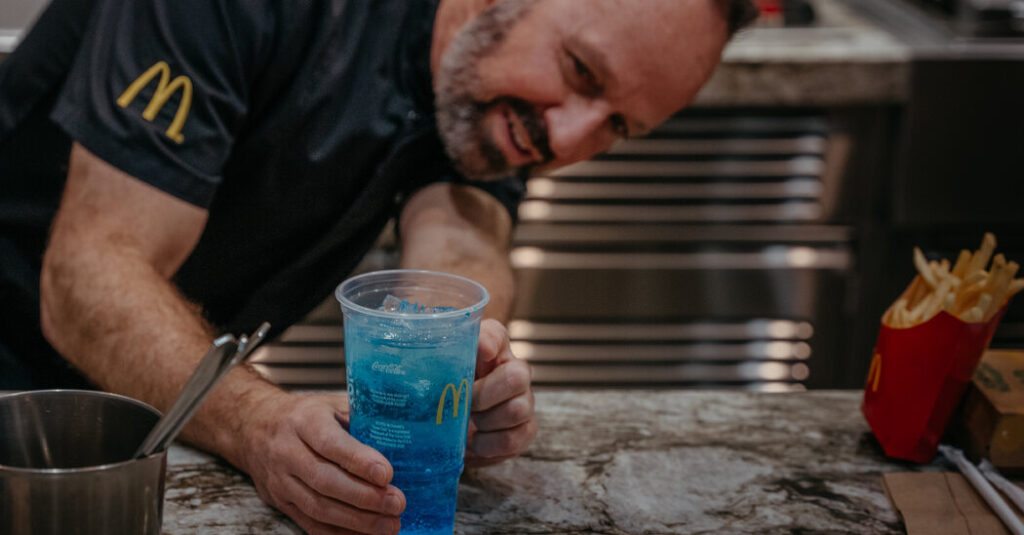
In May, the fast-food giant plans to release a line of brightly hued, fruit-flavored refreshers along with what is known as a crafted or dirty soda — like Sprite mixed with blueberry syrup and topped with whipped foam.
For the uninitiated, refreshers have two essential components: They are cold and bright. “They come in vibrant colors,” said Alyssa Buetikofer, the chief marketing and customer experience officer for the 14,000 McDonald’s locations in the United States. “They are very Instagrammable.”
After that, anything goes. They might contain a lemonade or green tea base. Or not. They could have sparkling water. Or not. They may contain coconut milk. Or not. And they may be caffeinated. Or not.
But for McDonald’s, refreshers are more than just a pretty drink. They are a way to lure customers, particularly members of Gen Z and Gen Alpha, into restaurants. It’s also a way to extend their menu options outside typical mealtimes.
“It’s clearly a very attractive category, and we’re not the only ones who see it,” said Charlie Newberger, the head of beverages and desserts at McDonald’s. “It is large and growing and appeals to younger consumers.”
But the bright beverages also serve another purpose. Drinks, in general, are more profitable than burgers or chicken nuggets, and refreshers are typically priced higher than fountain sodas. That’s important as restaurant profits across the entire industry are being squeezed. Many customers are trading down from premium, higher-priced burgers to value-meal deals as restaurant expenses — including beef, labor and supplies — continue to climb.
“Most beverages are high-margin products relative to food options for sure,” said Scott Murphy, the chief brand officer at Inspire Brands, which owns Dunkin’ and Sonic, as he sipped on a Dunkin’ Mango Pineapple Refresher on a recent Zoom call. “Refreshers have been the single largest contributor to our incremental sales growth over the last couple of years.”
Dunkin’ launched its line of bright citrus drinks in 2020. Two years ago, iced beverages — including refreshers and cold coffees — surpassed hot beverage sales at that chain.
Refreshers “have been a rocket ship in terms of growth for Dunkin’,” said Mr. Murphy, who is also the president of Dunkin’. “This product has seen double-digit sales growth in each of the last two years.”
For Dunkin’, that explosive growth came with a few logistical challenges. As iced beverages shifted from a summertime phenomenon to an all-year beverage, the chain increased the ice-making capacity at its stores. It also had to find additional manufacturers for its cold-drink cups, as the chain sells over a billion iced beverages a year, Mr. Murphy said.
Because there’s no hard and fast rule defining what a refresher is, quantifying the size of the market or its growth is tricky.
“We track lemonade sales and tea sales, but refreshers kind of fall within a lot of different categories,” said David Henkes, a senior principal at Technomic, a research and consulting firm for the food industry.
“It’s almost easier to say what a refresher is not. It is not a coffee or a tea. It is whatever we decide it to be,” echoed Claire Conaghan, a “trendologist” at Datassential, a market research firm in Chicago. “Brands will call a strawberry lemonade a refresher, but really it’s just a strawberry lemonade.”
Starbucks is broadly credited with “inventing” the refresher in 2012, even though it’s likely restaurants mixed fruit juice with lemonade or seltzer before then. The Very Berry Hibiscus refresher, which is no longer on the menu, was marketed as a low-calorie afternoon pick-me-up, containing blackberry juice, hibiscus, green coffee extract and whole blackberries.
Refreshers have become a $2-billion-a-year business for Starbucks. This spring, the company launched a line of energy refreshers with more caffeine. But the drinks can also be made with less caffeine or none at all.
McDonald’s executives have been eyeing opportunities in the broad beverage category for several years.
In 2023, the company opened a handful of space-themed drive-throughs called CosMc’s that focused largely on beverages. Starbucks had taught an entire generation of customers how to customize their coffees and iced lattes with a sometimes mind-boggling number of options. With CosMc’s, McDonald’s executives tried to determine whether customers really wanted all of those choices, and if the chain could compete with a much more limited menu.
“I think there’s decision fatigue out there,” Mr. Newberger said. “I think there are a group of folks who don’t want to recipe their drink, but maybe they want some control over the sweetness or the dairy preferences.”
The stand-alone CosMc’s closed last spring, and a pilot program for the refreshers and dirty sodas started in 500 restaurants in September.
Along the way, McDonald’s learned some key lessons. While removing the freeze-dried strawberries from the Strawberry Watermelon Refresher, for example, lowered the costs of the beverage, it also reduced its appeal with customers.
With another refresher, the boba pearls were too large to fit through existing McDonald’s straws. Instead of finding larger straws for the entire supply chain, McDonald’s worked with its supplier to reduce the size of the pearls, replacing them with smaller “bursties,” Mr. Newberger said.
Recently at a test kitchen in the McDonald’s headquarters in Chicago, Todd Manisco, a menu innovation and design manager, poured lemonade from a pitcher into the familiar McDonald’s plastic cup.
A onetime mechanical engineer who has culinary arts training and a food science degree, Mr. Manisco explained that the lemonade was less sweet than what customers get when they order a plain one at restaurants. To sweeten that tart base, he added four pumps of strawberry-watermelon syrup, a scoop of dried strawberries and then ice, before sliding the drink across the counter.
Standing a few feet away, Scott Rodrick, a franchisee, said the new beverage line required very little capital spending by store owners and didn’t take up much space in already tight kitchens.
And while individual franchisees will set prices on the drinks, Mr. Rodrick, who owns eight McDonald’s restaurants in California and worked on the development of the refreshers and crafted sodas, said he expected they would be “competitive on price” in the various markets compared with other big chains. There will be a big advertising push to help the beverages stand out in an already crowded market, he said.
“We may be late to the party,” Mr. Rodrick said, “but we are the most interesting guest.”
Julie Creswell is a business reporter covering the food industry for The Times, writing about all aspects of food, including farming, food inflation, supply-chain disruptions and climate change.
The post The Battle Over Refreshers Heats Up as McDonald’s Enters the Mix appeared first on New York Times.