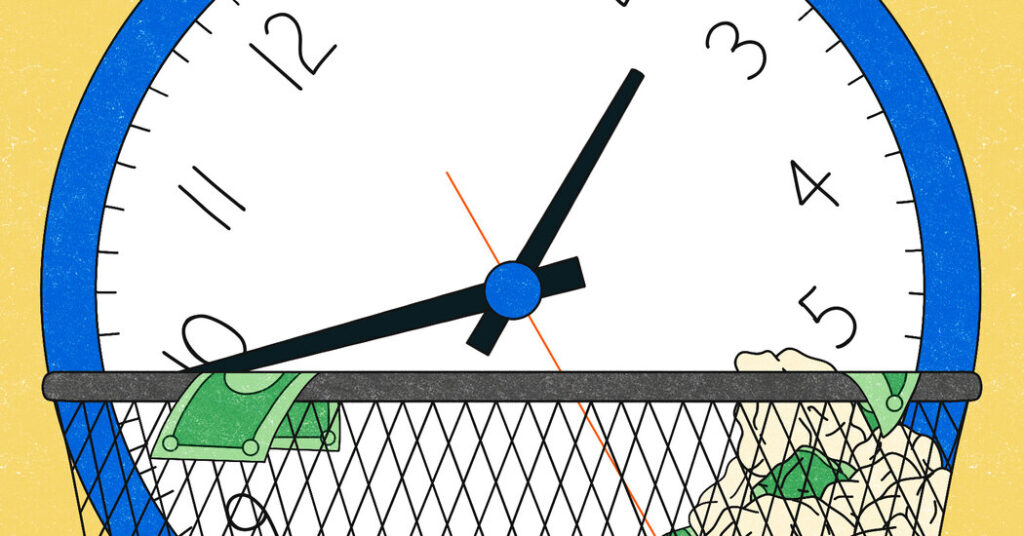
Everyone knows the feeling of being stuck on hold, or spending time clicking through an endless series of pages to cancel a subscription, or screening spam calls, or trying to change a flight. These inconveniences make life less pleasant, but they are easy enough to write off as small concerns, as the mere stuff of living a contemporary existence.
It turns out that such time-sucking, tedious tasks have a meaningful economic impact. The accumulated cost of what some refer to as the “annoyance economy” adds up to $165 billion a year in lost time and wasted money for American families, according to a new report from Neale Mahoney, a Stanford economist, and Chad Maisel, a policy fellow at Groundwork Collaborative, a progressive research organization.
The annoyance economy includes “the everyday interactions that should be simple but often turn into fraught ordeals,” Mr. Mahoney said in an interview, including dealing with hidden fees, spam, insurance claims or byzantine cancellation processes. The co-authors worked together in the Biden administration, including on efforts to crack down on junk fees. Once they left government service, Mr. Mahoney said, they started thinking about how to tackle what they saw as a “broader set of annoyances and tricks and traps and frustrations that turn simple things into things which are costly and complex.”
How it’s pronounced
/ə-nȯi-ən(t)s i-kä-nə-mē/
At first, the authors did not know what to call this group of consumer problems. But as they kept working on the project, they landed on the term “annoyance economy.” Once they did, Mr. Mahoney said, “it became obvious that it connected these different interactions people have.” (The term had appeared elsewhere, including in a 2023 Atlantic article about consumer frustrations.)
Some of the inconveniences plaguing American consumers are a result of clunky processes and outdated regulation. But some, Mr. Mahoney said, are “intentionally designed” to take advantage of people. And the rise of artificial intelligence chatbots that pose as real people is advancing the capacity for companies to mislead and target consumers.
“Scammers will be more adept at using A.I. to scam us than we will be at using it to detect scams,” he predicted.
Intentional or not, trapping consumers can pay off for corporations: Mr. Mahoney and his colleagues have found that companies that make it harder to cancel subscriptions see revenues tick up 14 to 200 percent. Beyond wasting money and time, logistical blocks can even affect health: A 2019 study found that almost a quarter of respondents had forgone or delayed health care because of administrative tasks like scheduling appointments and resolving insurance billing issues.
The annoyance economy is almost universally disliked. People, it turns out, hate being ripped off and resent having their time wasted. In a 2024 YouGov poll, 87 percent of respondents strongly or somewhat supported restrictions on telemarketers’ use of robocalling. In a 2025 poll from Groundwork and Data for Progress, two-thirds of likely voters said they wanted Congress to make addressing such issues a priority.
The consistent inconveniences that people face in their day-to-day lives “become a reminder about how the system is stacked against them,” Mr. Mahoney reflected. Public distaste could help spur lawmakers to mandate more consumer-friendly policies and companies to dial back fees and the like.
This will take some work, he suggested, but it is possible. “We put people on the moon 50 years ago,” he said. “We should be able to figure out spam texts and phone calls.”
The post The ‘Annoyance Economy’ Is More Than Just Annoying appeared first on New York Times.