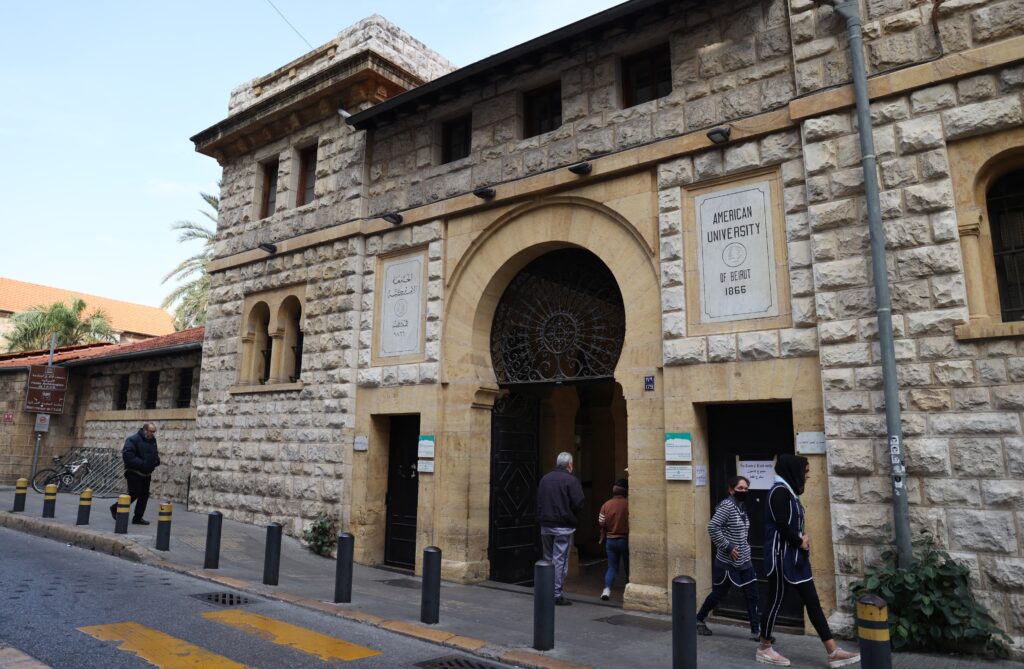
BEIRUT — The American University of Beirut restricted access to all but essential personnel. Education City in Doha, Qatar, where Georgetown, Cornell, Northwestern and other universities maintain campuses, closed their premises until further notice. New York University’s Abu Dhabi operation in the United Arab Emirates has done the same.
Each had shifted to some form of remote or hybrid learning after the United States and Israel launched their war on Iran in February. But after strikes on Iranian universities, these and other American schools in the Middle East are taking stricter measures.
Tehran, which for the first month of the conflict focused its retaliatory strikes on U.S. military bases and U.S. allies’ airports and oil facilities, is now threatening to target American universities operating in the region.
“Universities belonging to the U.S. and Israeli regime in the West Asia region are the legitimate targets of the Iranian military forces,” the Islamic Revolutionary Guard Corps warned last week. Faculty, students and neighbors, the force said, should stay “away from the aforementioned universities to protect their lives.”
The threat followed attacks on Isfahan University of Technology and the Iran University of Science and Technology in Tehran. The Iranian Ministry of Science said Saturday that more than 30 of the country’s universities have been struck.
“I’m definitely more nervous than usual,” said Joseph Yonkers, a 24-year-old from Connecticut who’s studying archaeology at the American University of Beirut, or AUB.
“My sleep schedule is messed up because of the sound of bombs.”
Lebanon has not only been reeling from from the war on Iran but also the revived conflict between Israel and Hezbollah, Tehran’s proxy in the country. Those sides agreed to a shaky ceasefire in 2024, but after an Israeli strike killed Ayatollah Ali Khamenei, Iran’s supreme leader, on Feb. 28, Hezbollah began firing missiles into Israel. Israel responded by pushing its troops deeper into Lebanon, warning residents to evacuate and attacking the militants.
The conflict has displaced more than 1 million people inside the country. Many of them are sheltering near the AUB campus.
“We have several hundred people that we’ve taken in quietly because they have nowhere else to go,” said Fadlo R. Khuri, the university’s president. He said AUB was providing meals to many in the neighborhood.
Although not directly named, AUB temporarily restricted access to all but essential personnel for two days.
Hezbollah supporters here have echoed Iran’s threats. “Just as there are children being killed by America and Israel,” journalist Fadi Boudaya said on the podcast LebanonON, “there are children at American institutions that will be targeted.”
On Friday, the U.S. Embassy in Beirut again urged citizens to leave the country and cautioned that “Iran and its aligned terrorist militias may intend to target universities in Lebanon.”
Khuri said AUB was checking bags at all campus gates and taking other precautions, but was still reaching out to its neighbors. “We are out in the communities, we’re helping the displaced,” he said. “We are giving free OB/GYN and family medical care, as well as pediatric care.”
American universities have a long history in the Middle East, from colleges in Beirut and Istanbul founded by New England missionaries in the 1860s to the more recently opened satellite campuses of schools such as Virginia Commonwealth, Carnegie Mellon and Texas A&M in the Persian Gulf.
The American universities of Beirut and Cairo are among the region’s best regarded institutions, drawing local and international students and producing presidents and prime ministers, professionals, business leaders and artists.
More American schools were lured to the Persian Gulf in the late 1990s and early 2000s to strengthen international ties and bring U.S. education to new generations of students. Qatar won praise from President Barack Obama, who said educational exchange benefits both countries.
Now Georgetown has closed its Doha premises “until further notice” and says decisions about campus operations will be made on an “ongoing basis.” Wiley Norvell, a spokesperson for NYU, said the Abu Dhabi campus had closed temporarily out of an “abundance of caution.”
“Our priority in every decision is the safety of our students, faculty and staff,” he said. Those who were living on campus were relocated in advance. NYU has taken similar steps at its study abroad site in Tel Aviv.
Classes at both campuses continue remotely.
Although the universities say the precautions they’re taking are temporary, analysts warn they could have long-term effects.
Iran’s threats could reinforce “the idea that hosting U.S.-linked institutions could pose security risks” similar to those of military bases, said Filippo Dionigi, a professor of international relations at the University of Bristol.
“These universities will also be less capable of attracting foreign staff, which is essential to run them and the same applies to students coming from abroad,” he said.
Some American schools in the region were already winding down operations amid the Israel-Gaza war. In 2024, Texas A&M announced it would close its satellite campus in Qatar by 2028 out of concern for “heightened regional instability.” The Qatari government called the move “misguided” and “influenced by a disinformation campaign.”
The risks aren’t new. During Lebanon’s long civil war, AUB’s American faculty were kidnapped. University President Malcolm Kerr, an American academic, was assassinated in 1984 by the Islamic Jihad Organization, one of the precursor groups of Hezbollah (Kerr was the father of NBA coach Steve Kerr.)
Now, Khuri said, “we’re continuing to try to protect AUB collectively.” The faculty and staff, he said, were “rallying to do their best to champion AUB.”
Dionigi said targeting universities could be counterproductive for Iran, too. Many of their students have been critical of U.S. foreign policy.
Yonkers, the AUB student, planned to stay in Beirut. “My mom is not really worried because it’s not the first time,” he said — he was a sophomore during the war between Israel and Hezbollah in 2024. But life on campus has quieted. Fellow students have been unable to attend class in person.
“The professor is giving the class online,” Yonkers said, “and I’m just sitting with him.”
The post American universities in Middle East brace for Iranian retaliation appeared first on Washington Post.