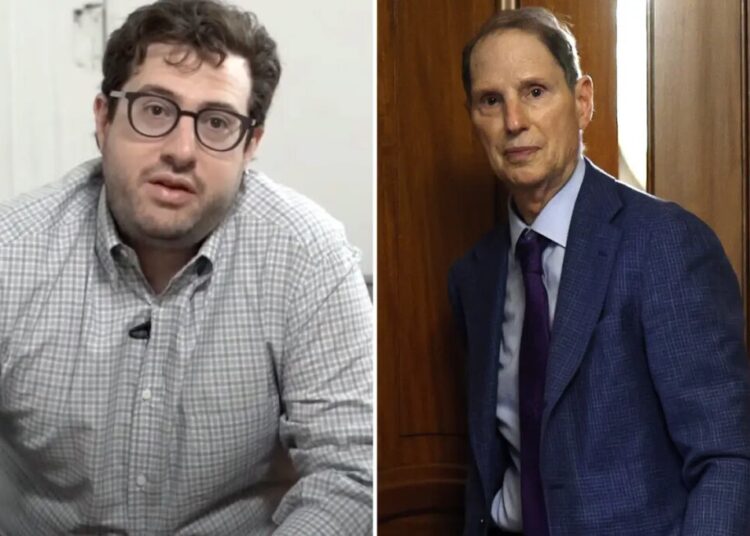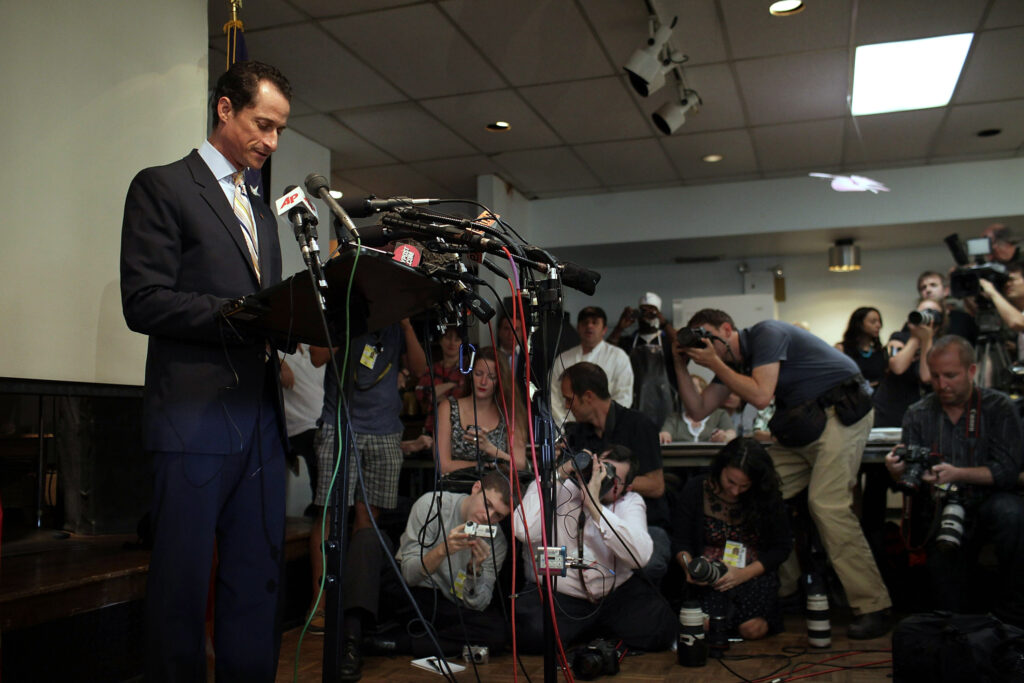
The Post asked an important question in the March 3 online Early Brief, “Do people not care about scandals anymore?” In 2010, I served as press secretary for Rep. Anthony Weiner (D-New York). After he accidentally posted a sexually explicit photo on social media, the controversy dominated headlines for weeks and ultimately forced his resignation from Congress.
Today, that same scandal might barely register. As The Post noted, Rep. Tony Gonzales (R-Texas) enjoyed initial support of party leadership despite facing allegations of having an affair with a staffer who later died after setting herself on fire. House Republican leaders previously said they would let the issue “play out,” but later called on Gonzales to resign over the scandal on Thursday.
In another political era, such a story would have consumed the national news cycle. If something as shocking as a self-immolation can barely command attention, it’s hard to imagine what will.
Instead, it’s just one more entry in an endless stream of outrages. Amid reading about the president sharing racist memes on social media, revelations from the Epstein files, immigration officers killing civilians and new conflicts in Venezuela and the Middle East, many Americans probably missed the Gonzales scandal. This is the defining feature of the Trump era: so many controversies happening simultaneously that no single one breaks through. Scandal fatigue is understandable. But when the public tunes out, accountability disappears, and politicians learn they can act with impunity.
Ben Fishel, Washington
Let students think for themselves
Regarding the Feb. 23 news article “Teachers ask AI to help students write better.”
I was a classroom English teacher for 33 years, and I also taught English education for four years at George Mason University. The rush to adopt AI technology into classroom instruction and for some systems or administrators to require use of AI bots in classrooms is shortsighted. Educators must remember that the claim of artificial intelligence improving learning has not yet been verified.
AI’s potential use in the adult world to help productivity and efficiency is not what students need. They are not in school to be efficient producers but to learn and become adept in a variety of literacies and to able to think deeply, critically and independently. And they have to practice these skills repeatedly for themselves, not cut short by algorithms, so they will know later whether a shortcut is a good idea.
The article provided a peek into how a few English teachers are struggling to make the best of this new technology, primarily as a way to outdo the onslaught of “help” and outright cheating that AI technology often provides students. But the ways the AI chatbot could work are already found in the classroom and are much better.
We adults, especially those of us who work in education, must use our own critical thinking about evaluating AI use in the classroom. Falling uncritically for the marketing propaganda of the tech world is unwise at best, considering serious, long-term effects that using AI is having already on our students and their future.
Carol Blauvelt, Manassas
The benefits of dual enrollment
The Feb. 24 news article “High-schoolers taking college courses have lessons to teach” highlighted the growth of dual enrollment of high-schoolers in college courses. Home-schoolers have been leveraging the benefits of dual enrollment for years.
Having home-schooled my six children over the past 22 years, I can attest to the fact that dual enrollment, called concurrent enrollment in Maryland, has been and continues to be an integral part of the home-school experience. Additionally, a number of academic home-school programs, such as eXtend Homeschool Tutorial, which I co-founded in 2017, have a core goal of preparing students to successfully enroll in community college classes during their junior and senior years of high school.
After reading the article, I reached out to the parent of Torrington Ford, a former home-school student of mine and classmate of one of my daughters. In 2018, Torrington simultaneously graduated from high school and Anne Arundel Community College, where he earned his associate’s degree at the age of 15. Torrington was later admitted to Ohio State University. Though Torrington’s story is unique because of his age, his path of dual enrollment is common within the home-school community. Home-schoolers have long utilized the power of dual enrollment to fulfill graduation requirements, often graduating with more credits than needed, to graduate early, and to save on the cost of college by earning transferrable credits.
So while some may view the uptick in college enrollment by traditional high-schoolers as a noteworthy phenomenon, many home-schoolers view it as the norm and an important opportunity to get ahead in reaching their college and career goals.
Kymberly Kent, Bowie
The bare minimum
As a fellow Gen Xer, I was disappointed to read Theodore R. Johnson’s March 5 op-ed, “I was a Gen X ‘man cave’ dad. Then I learned better.” The headline suggested a real reckoning with what it meant to retreat from family life while leaving the emotional and practical labor of raising children largely to one’s spouse. Instead, the takeaway seemed to be that fathers should participate in their children’s lives. That realization may feel profound, but to many women it read more like: duh.
For generations, women have carried the invisible work of running households and raising children, often while also working outside the home. There was no option to disappear into a “man cave” night after night.
Showing up isn’t a breakthrough for fathers, it’s the minimum.
Robyn Buchsbaum, Gaithersburg
A reason for the ‘God Gap’
Regarding Ryan Burge’s March 1 Sunday Opinion essay, “The ‘God Gap’ in politics is a symptom of a deeper problem”:
It appears to me that talking publicly about religion has only widened our areas of disagreement. I was told, repeatedly, that one was not to speak of money, politics or religion outside one’s family. I wish the rule still held. The hate I hear in much of modern religious discourse is palpable. I don’t like hearing it, and it’s not helpful.
Carroll Aberg, Fort Valley, Virginia
The post The insidious danger of scandal fatigue appeared first on Washington Post.