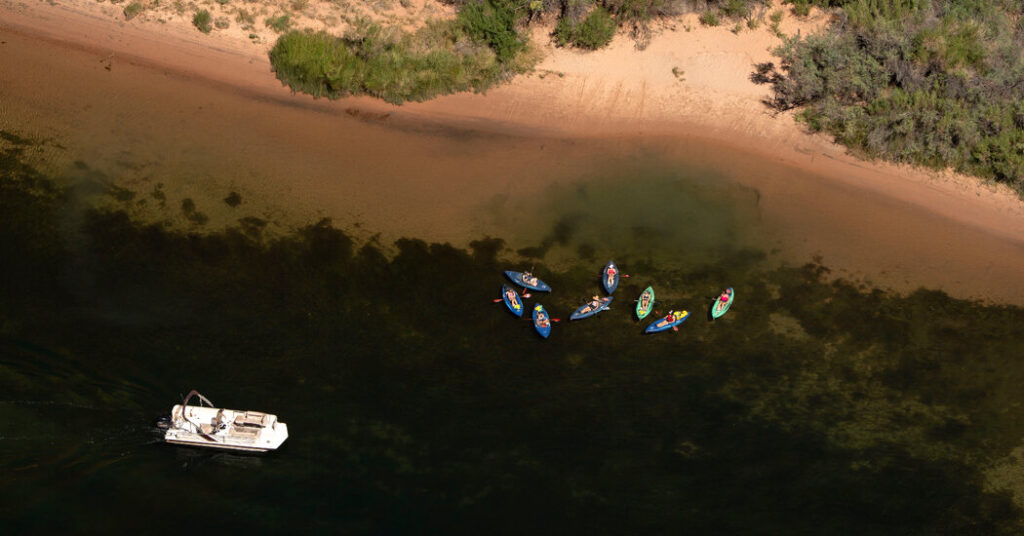
The National Park Service is warning visitors to beware of areas of quicksand near the shoreline and at drainages throughout the Glen Canyon National Recreation Area, which straddles southern Utah and northern Arizona.
“It can appear dry and firm on the surface but may suddenly give way,” the Park Service said in a March 3 safety alert on social media and on its website. “Recognize unstable, shifting or unusually soft ground, and use caution when entering through these areas.”
The recreation area, which covers more than 1.25 million acres from Lees Ferry in Arizona to the Orange Cliffs of southern Utah, is known for its water-based and backcountry recreational activities as well the iconic Horseshoe Bend on the Colorado River.
The Park Service noted in its safety guidelines that visitors can identify quicksand by looking for “wet, loose or unusually smooth ground.”
The agency noted that “flattened, uniform, or freshly leveled surfaces may indicate soft or saturated sediment beneath a thin surface layer.”
And when someone steps near that type of ground, it “may move, ripple, or subtly vibrate, indicating insufficient support below the surface.”
It was not clear how many pockets of quicksand may be in the recreation area or what prompted the warning. The Park Service could not immediately be reached on Sunday.
Quicksand may sound like the legend of pop culture, where it has been depicted in Looney Tunes cartoons, television shows, such as “Gilligan’s Island,” and movies, including “Tarzan and the Amazons” and “Indiana Jones and the Kingdom of the Crystal Skull.”
Nevertheless, the mixture of sand and water or sand and air that appears solid but becomes unsteady when disturbed is very much real.
Although scientists have said it is nearly impossible to drown in quicksand, it can still be dangerous and difficult for people to extricate themselves from it.
In December, a hiker stepped into quicksand in a remote canyon in Arches National Park in Utah where he was trapped for hours in subfreezing temperatures until rescue workers arrived.
Last year, a Michigan man was stuck waist-deep in quicksand on an unstable beach on the northeastern shore of Lake Michigan where he tried to dig himself out before firefighters arrived.
And in 2023, a man who was walking on tidal mud flats in an Alaska estuary got stuck up to his waist in “quicksand-like silt” and drowned after the tide came in before he could be rescued, The Associated Press reported.
If someone comes across quicksand, the Park Service recommends staying calm and avoiding sudden movements because panicked motion can cause the body “to sink deeper and mixes more water into the sediment, reducing buoyancy.”
The Park Service also suggests that a person should also “lean back to spread out body weight” and that “shifting into a reclined or sitting‑back position increases surface area, helping the body float.”
This move also reduces downward pressure and prevents further sinking, the service said.
Johnny Diaz is a reporter for The Times covering breaking news from Miami.
The post Park Service Warns of Quicksand at a Recreation Area in Arizona and Utah appeared first on New York Times.