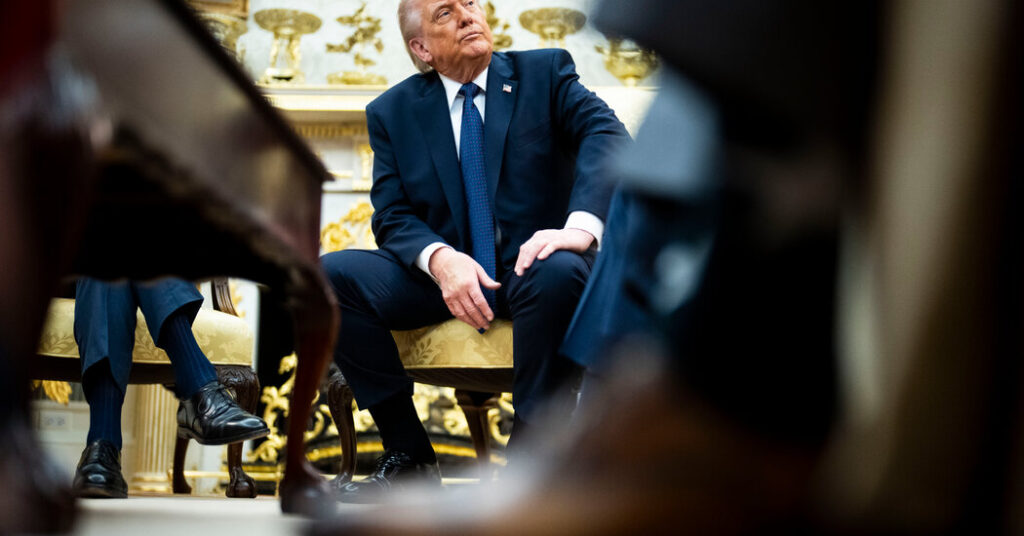
President Trump on Tuesday expressed outrage with Spain, threatening to cut off all trade with the country and to defy a Spanish ban on American aircraft involved in the attack on Iran from using its military bases. The president’s broadside against Spain and its left-wing prime minister, Pedro Sánchez, prompted a defiant response from Spain, which argued that no change could happen unilaterally, and that they could weather the hit.
The Spanish government had over the weekend denied the use of its military bases to U.S. forces involved in the attack on Iran, including key refueling aircraft, because it considered the operation a violation of international law. Mr. Sánchez called the attack an “unjustified and dangerous military intervention.”
This apparently enraged Mr. Trump.
“And now Spain actually said we can’t use their bases. And that’s all right, we don’t want to do it. We could use the base if we want,” the president told reporters during a freewheeling news conference in the Oval Office “We could just fly in and use it, nobody is going to tell us not to use it. But we don’t have to.”
He had other gripes.
“Spain has been terrible, in fact I told Scott to cut off all dealings with Spain,” Mr. Trump said referring to Scott Bessent, the secretary of the Treasury. He went into a familiar complaint about Spain not increasing its defense spending for NATO to 5 percent of its gross domestic product, as he had requested and other European nations obliged. “Spain didn’t to it.”
He then said that the Supreme Court, while restricting his tariff powers, had given him “the right to license them,” meaning Spain, and that “as of tomorrow or today even better I could stop everything to do with Spain.” He added: “We are going to cut off all trade with Spain. We don’t want anything to do with Spain.”
Mr. Sánchez has scheduled remarks on Wednesday morning about the issue. On Tuesday evening, his government replied with a sharp retort.
“Our country has the necessary resources to contain potential impacts, assist sectors that may be affected, and diversify supply chains,” the government statement said.
But Spanish government officials have often shrugged at the threats, noting that trade policy is handled by the European Union, and that Spain, which runs a trade deficit with the United States, is more insulated than other European countries from American reprisals. And Mr. Sánchez has recently visited China and India, making it clear he is open to more trade with new partners.
On Tuesday evening, the European Commission also defended Spain. “A deal is a deal,” The European Union deputy chief spokesman, Olof Gill, told the Spanish newspaper El Mundo. “The Commission will always ensure that the interests of the European Union are fully protected.”
All in all, Mr. Trump’s attention, however heated, was perhaps not necessarily unwelcome by Mr. Sánchez.
“This is exactly what Sánchez wanted,” said Ramón González Férriz, a prominent author of political books and a columnist at the newspaper El Confidencial “He has been looking to create an open confrontation with Donald Trump since last January. He knows Donald Trump is very unpopular in Spain.”
Analysts said that Mr. Sánchez was seizing on the contretemps with Mr. Trump to raise his international profile as Europe’s progressive anti-Trump after standing up to him on issues ranging from NATO spending to immigration policy, to Israel’s war in the Gaza Strip and the abduction of the Venezuelan president Nicolás Maduro, which he said set a terrible precedent of violating international law. That reputation has helped him make a case to left-wing voters he needs to mobilize to stay in power.
But the conservative opposition also sought to make the most of the back and forth.
“In trying to win a few votes at home,” said Alberto Núñez Feijóo, the leader of the Popular Party, “we cannot put at risk our security, our stability and our position in the world.”
Jason Horowitz is the Madrid bureau chief for The Times, covering Spain, Portugal and the way people live throughout Europe.
The post Trump Threatens to End Trade With Spain appeared first on New York Times.