President Trump’s whipsawing trade policy last year destabilized many American businesses. His new push to replace the system with a different batch of duties has bewildered companies all over again.
Since the Supreme Court invalidated many of Mr. Trump’s tariffs last month, his administration has vowed to use other legal authorities to rebuild the program. Almost immediately, Mr. Trump wielded an unproven legal provision to enact a 10 percent across-the-board tariff on U.S. trading partners and threatened to raise the rate.
The haphazard rollout has introduced a tangle of unknowns for companies. A new tariff system could upend months of business decisions, and many companies are bracing for prolonged uncertainty.
They are also considering whether and how to seek refunds on tariffs they paid — and, if they receive them, whether they would return any money to customers.
Peter Furth, whose company, FFF Associates in Stamford, Conn., imports fig paste from Turkey and Spain, said Mr. Trump’s tariffs had driven up costs and destroyed his cash flow. Mr. Furth has been passing on the additional costs to his customers, which include Mondelez, the maker of Fig Newtons; Nature’s Bakery; and J&J Snack Foods. He said he believed he had a contractual, and moral, obligation to return any tariff refund to customers.
“I owe it back to them,” he said. “It’s very simple.”
Smaller businesses like his have been particularly unmoored by the latest shifts in trade policy because, as during last year’s tariff chaos, they lack the legal and financial resources to weather unpredictability smoothly.
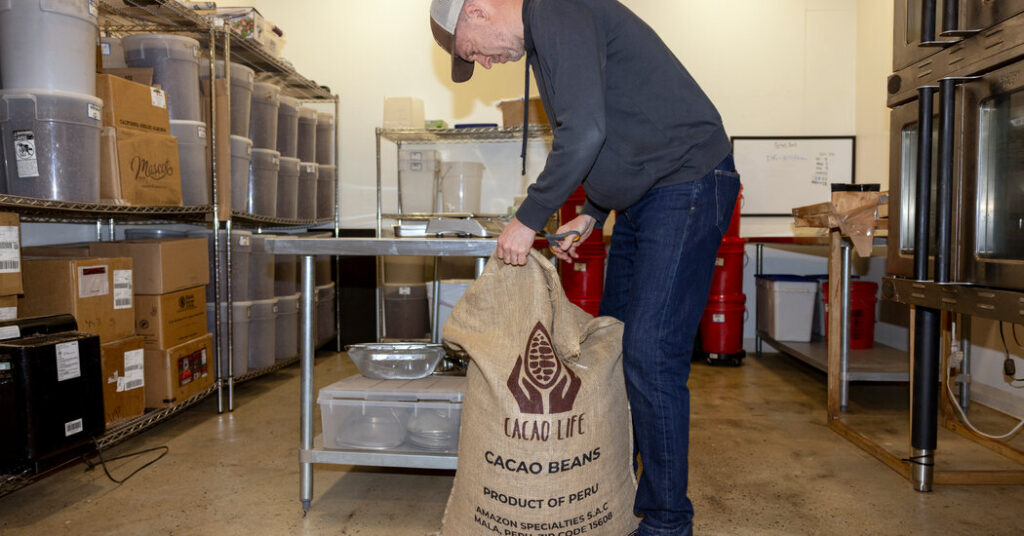
“The level of uncertainty is crazy,” said Matt Weyandt, a co-founder of Xocolatl Chocolate, a craft chocolate maker in Atlanta.
Mr. Weyandt, whose company sources cacao beans from countries including Peru, Nicaragua and Tanzania, is trying to establish whether exemptions on foreign agricultural products previously enacted by the Trump administration still stood, to no avail, he said. He was intrigued by the prospect of seeking a tariff refund, he said, but had no idea how to go about it.
“We just don’t have teams of lawyers to go out and sort through this stuff for us,” he said. “It’s going to be us stopping everything that we’re doing to spend however long it takes to sort through it.”
Richard A. Mojica, a lawyer at the firm Miller & Chevalier Chartered in Washington, said he was fielding a barrage of questions from clients about what tariffs would look like, and the possibility of refunds for levies that had already been paid. He said it felt similar to the period after “Liberation Day” in April, when Mr. Trump announced broad tariffs that unleashed a flood of uncertainty.
Mr. Trump ordered the blanket 10 percent tariffs in February using Section 122 of the 1974 Trade Act, which allows the administration to impose tariffs of up to 15 percent for 150 days without congressional approval. A day later, Mr. Trump said on social media that he would raise that 10 percent tariff to 15 percent. But the change never materialized, and the White House has said it is not clear when it will happen.
Mr. Trump has a variety of other tariff authorities at his disposal. The administration has signaled that it will move forward with new tariffs using Section 232 of the Trade Expansion Act of 1962 and Section 301 of the 1974 Trade Act.
Those tariffs would take months to carry out, as the administration completes the investigations and hearings those statutes require. Companies are likely to try to influence the process, because if issued, these tariffs would be less vulnerable to legal challenges.
Mr. Mojica said he expected some clients to accelerate their shipments out of concern that tariffs could rise further once the administration figured out how to replace them.
“I think we’re going to see a surge in imports in the short term within this 150-day window because the rates are going to be comparatively lower than what they had before, and because they don’t know what the rates will be after the fact,” he said. If the 10 percent rate rose to 25 or 50 percent, he said, then 10 percent would be “comparatively speaking a pretty manageable rate.”
Braxten Wilding, the vice president of finance at Wilding Wallbeds, a manufacturer of Murphy beds in St. George, Utah, said his company rushed to stockpile inventory last year in response to the tariffs, tying up money that would otherwise have gone toward new machines and buildings.
He welcomed the possibility that the new tariffs would include a lower rate on China, where the company sources metal components and mechanisms, and was supportive of tariffs in general. But the lack of clarity had put the company on pause.
“We’re in a little bit of a wait-and-see mode,” he said, adding, “We still feel like we need to be on guard.”
Money Back
Refunds are another open question. The federal government has collected more than $100 billion in revenue on tariffs that the Supreme Court struck down, and the Trump administration indicated last year that it would provide repayment if the tariffs, issued under the International Emergency Economic Powers Act, were deemed unlawful.
After the Supreme Court’s ruling, Treasury Secretary Scott Bessent said refund payments could take months and would be determined by lower courts.
“It is not up to the administration,” Mr. Bessent said.
The administration moved late last week to try to slow refund proceedings, arguing that it needed more time to determine the path forward.
Decisions about whether, and how, the government would refund tariff revenue could lead to contractual disputes between companies that paid tariffs and their customers, who may have had that tariff cost passed on to them. Companies including FedEx, Dyson and L’Oreal have filed lawsuits since the Supreme Court’s ruling.
Small and midsize U.S. importers might not understand the procedural requirements for securing refunds, said Matthew Seligman, a fellow at the Stanford Constitutional Law Center, whose law firm specializes in tariff refunds.
“Most people thought they would automatically get their money back, kind of like a tax refund, and that is decidedly not how it works,” he said.
He said he believed that once the tariff assessment was final, companies would have no more than 180 days to challenge the U.S. Customs and Border Protection agency. If the challenge is denied, he said, “every single importer will have to file a lawsuit.” He is advising his clients to both petition the customs agency and file lawsuits with the Court of International Trade to speed the process.
Jeremy DeFilippis, chief executive of Jetty, a clothing company in Manahawkin, N.J., said any refund would be a financial boon.
Jetty buys board shorts, shirts and other apparel from suppliers in China, India, Vietnam and Guatemala, and Mr. DeFilippis estimated that the company paid $250,000 to $300,000 in additional tariffs last year.
To help alleviate the extra tariff burden on imports from China, Jetty had moved some production to Vietnam last April, which Mr. DeFilippis said had resulted in lower quality and delayed shipments. It decided not to raise prices for retail customers, taking a hit to its profit margin.
If he received a tariff refund, he said, he would use the money to shore up his company’s finances. “It would really help in the short term with operating expenses and labor,” he said. “It’s not like we’re going to give out vouchers to customers.”
But he also said he had not tried to get a refund and did not know how long the process would take. “It’s just a complete mess,” he said.
Sydney Ember is a Times business reporter, covering the U.S. economy and the labor market.
The post Tariffs Confound Small Businesses Again appeared first on New York Times.