If there were theater awards for calmest storytelling, for gentlest musical, for most placid atmosphere, “Night Side Songs” would win in a sweep. An intimate and extremely pretty song cycle about illness and mortality by the brothers Daniel and Patrick Lazour, it may also be the most benevolently nonthreatening audience-participation show out there.
As ticket holders settle in at the Claire Tow Theater, upstairs at Lincoln Center Theater, they are handed slender songbooks containing lyrics for the parts of songs in which the spectators serve as chorus. “Sing along, no pressure,” we are told once the performance starts, and here’s the twist: There really is none. Join in or don’t. In either case, you will be surrounded by people who do, and the effect will be warm, rich and enveloping.
Taibi Magar’s production for LCT3 is, for the audience, a cocoon of comfort and safety. Inside it unfolds the story of a woman named Yasmine (Brooke Ishibashi), who is 41 and on the phone with her mother — ordinary day, regular conversation — when she discovers a bump beneath her skin.
This, we are told by our narrators, is the moment when Yasmine “enters the night side,” becoming an inhabitant of what Susan Sontag called “the kingdom of the sick.” The Lazours have borrowed the title of their show from the opening assertion of Sontag’s landmark essay “Illness as Metaphor” (1978): “Illness is the night-side of life.”
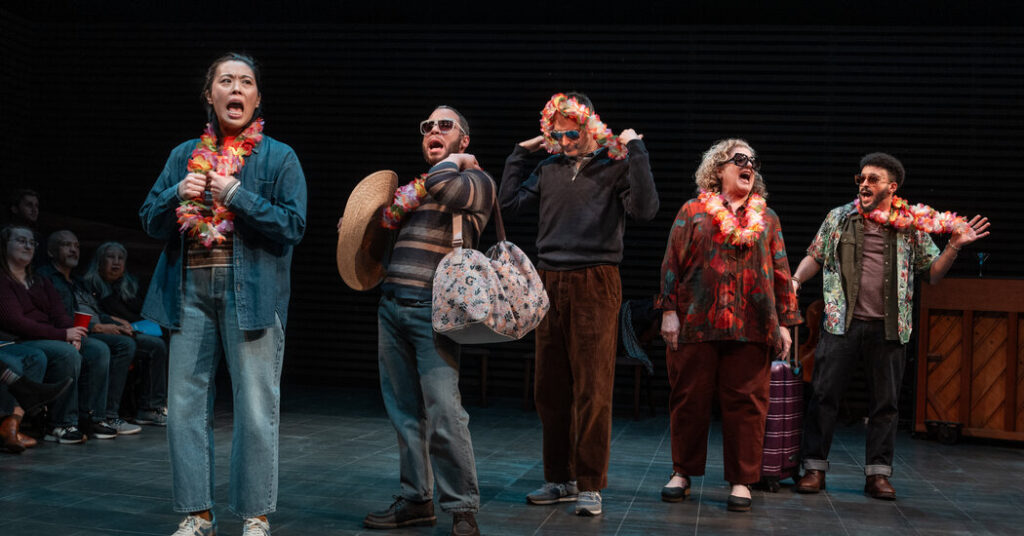
That patina of intellectualism aside, this is a down-to-earth, folk-flavored musical, played mainly on an upright piano (by Alex Bechtel, the music director), with occasional guitar (played by Bechtel and one of the actors, Kris Saint-Louis) and a spot of cello (also Saint-Louis). A very fine cast of five step in and out of roles: as characters, narrators and chorus leaders for the audience, whose 112 seats surround the stage on three sides.
At the show’s center are Yasmine; her widowed mother, Desirée (Mary Testa); Yasmine’s doctor, Henry (Robin de Jesús); and Frank (Jonathan Raviv), the ex who, at Desirée’s suggestion, re-enters Yasmine’s orbit after she gets sick and turns out to be the love of her life. The exact nature of Yasmine’s disease is not spelled out, but we gather that it is a form of cancer.
The production achieves a remarkable tonal balance of kindness and unsentimentality. That gives a gut-punch force to certain lines — like the omniscient one that tells us, just after Yasmine has gone into remission, how long it will last. This is shattering to learn, not because the amount of time is minuscule (it arguably isn’t) but rather because it’s finite. Humans want, always, the hope that illness vanquished has been vanquished forever.
Yet within Yasmine’s capsule of allotted years is such pleasure and relative normalcy — not only her wedding to Frank, with its joyous, communally sung song, “Into the Sky,” but also their quotidian, long-term coupledom. The calculatedly repetitive “When You…” finds them dancing slowly center stage, so entwined and undefended that they’re practically melting into each other, lulled by a simple choral melody.
The show takes a messy detour, though, with “Miracle Song,” which is both notably beautiful and lamentably unpersuasive. To illustrate how much cruder chemotherapy used to be — how much less hope there was — the show flashes back to a hospital in 1962, where we meet a mother, Lillian (de Jesús), who appears to be unconnected to Yasmine and Desirée. Lillian sings that song at her ailing daughter’s bedside, ostensibly to calm the child. But many of the lyrics are about when the child’s father fought in World War II — not terribly soothing. And de Jesús, who is otherwise lovely, is miscast as Lillian, never disappearing into the role.
A far more potent number is Desirée’s “My Stuff,” about her possessions and what she wants to happen to them after her death. Testa may break you here, standing forlorn with an open cardboard box. But I’m not convinced that the Lazours, who wrote the Off Broadway musical “We Live in Cairo,” see Desirée as a whole person. I sense a bit of a sneer around her gender, age and (she does like a bargain) class.
Those elements aside, this is an unusually solacing musical about the isolation of illness, the comfort of other people and the refuge of art. Not for an instant is “Night Side Songs” emotionally overwrought. But by the end, some of its audience is quite likely to be overcome.
Night Side Songs
Through March 29 at the Claire Tow Theater, Manhattan; lct.org. Running time: 1 hour and 35 minutes.
The post ‘Night Side Songs’ Review: Feel Free to Sing Along appeared first on New York Times.