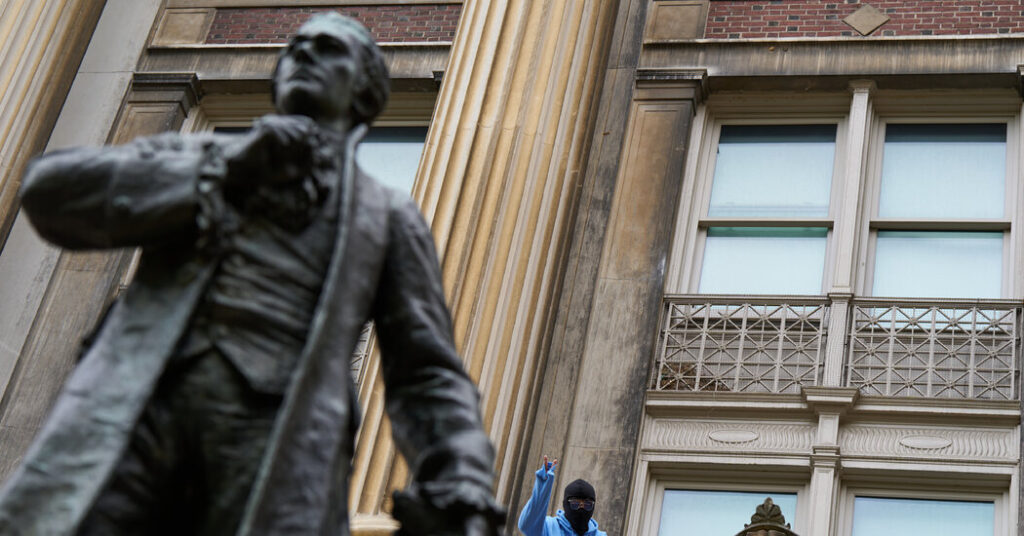
It was the most dramatic moment of the pro-Palestinian demonstrations at Columbia University in the spring of 2024. Protesters took over Hamilton Hall, a campus classroom building, renaming it for a child killed in Gaza. The next day, a phalanx of Police Department officers entered through a window and made arrests.
After a long disciplinary process and under pressure from the Trump administration, Columbia issued serious punishments to 22 current and former students who had been involved in the occupation, including expulsions, suspensions and the revocation of their degrees.
Now, those punishments have been vacated by a state judge, meaning that at least some of the students may be able to return to campus. Judge Gerald Lebovits ruled on Friday that the manner in which Columbia had issued the punishments was “arbitrary and capricious,” violating university rules and state law.
“The sanctions imposed,” Judge Lebovits wrote in his 46-page ruling, “cannot stand.”
The judge provided a 30-day window before his order goes into effect. Columbia is weighing what to do next.
The university said in a statement on Monday that “no student who was disciplined for the occupation of Hamilton Hall can return to campus at this time.”
“Columbia is considering all of its options, including seeking a stay of the order and appealing the decision,” the university said.
The ruling is yet another twist in the ongoing saga of how Columbia deals with one of the most fractious events in its recent history. Some saw the Hamilton Hall takeover as the culmination of a pro-Palestinian protest movement that had become destructive, antisemitic and out of control. Others viewed the occupation as an acceptable form of civil disobedience against the war in Gaza that echoed other protests that had taken place in past years.
A total of 109 people were arrested during a police sweep of the campus on the night of April 30, 2024, and of those, 44 were arrested in Hamilton Hall, according to information released by the police at the time.
The police charged those arrested inside the building with misdemeanor trespass. But in June 2024, the Manhattan district attorney’s office dismissed those charges, in part because of a lack of evidence, and in part on the understanding that Columbia would bring its own disciplinary proceedings. The records were then sealed under criminal procedure law, as is typical, to protect the accused, the judge wrote.
Despite the seal, when Columbia brought its disciplinary charges against the 22 current and former students said to be in the hall, the sole evidence it used was the sealed police investigatory information, Judge Lebovits wrote. The use of that material violated state law, he ruled.
In addition, Columbia offered no evidence of actions that any individual student had taken inside Hamilton Hall, as opposed to the actions of the group of occupiers as a whole. This broke Columbia’s own rules, which require individuals to be charged for their own actions, not the actions of a group, the judge determined.
The judge’s decision supported arguments that faculty members defending the students had been making to Columbia’s legal team from the start, said Katherine Franke, a retired law faculty member who helped advise the students.
“The hearings were a travesty, because they had no evidence other than these arrest records,” she said in an interview. “And for some of them, this changed their lives entirely, these students who were expelled or had their diplomas revoked.”
The Hamilton Hall occupiers had sneaked into the building, set up barricades, smashed the glass panes of doors and briefly detained several janitors before allowing them to leave, the judge found. But they also wore masks and covered security cameras, making identifying them as individuals difficult for law enforcement.
Columbia can try the students again under its disciplinary procedures, with its own evidence, or the university can appeal, Judge Lebovits wrote. However, given the time that has elapsed, restarting a process with new evidence may be difficult, and would risk inflaming tensions over an episode now almost two years old.
Ms. Franke argued that the university should make some kind of reparative gesture to the students for what they have lost. “As a moral matter, if they had other evidence, they should have introduced it then, and then we would have dealt with it,” she said.
Lawyers for the students, Tahanie A. Aboushi and Cheryl E. Forchilli, declined to comment on Tuesday. The 22 students involved, who had been both undergraduates and graduates, were anonymous in the legal proceedings.
Sharon Otterman is a Times reporter covering higher education, public health and other issues facing New York City.
The post Judge Vacates Punishments of Columbia Students Who Occupied a Building appeared first on New York Times.