Millions of Democrats cast primary votes for him, envisioning him as America’s first Black president.
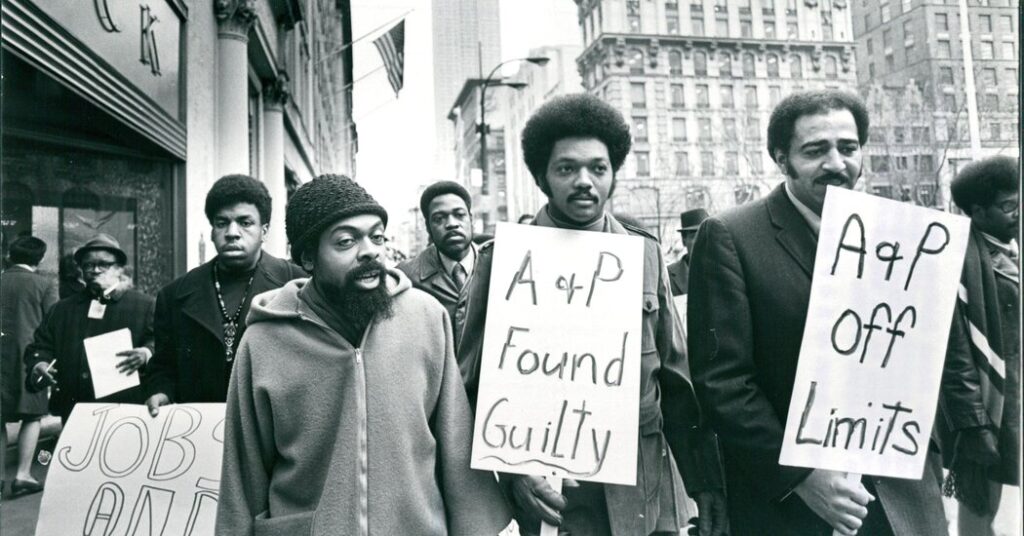
Along the way, there would be convention keynote speeches and, at times, self-inflicted controversy for the Rev. Jesse Jackson, who died on Tuesday at 84. His life ran in parallel to the successes of the civil rights era, but it was at the movement’s lowest moment that he came to wider national attention: the 1968 assassination of the Rev. Dr. Martin Luther King Jr., which he witnessed at the Lorraine Motel in Memphis.
Here are seven key moments in his life.
Martin Luther King Jr.’s assassination
On April 4, 1968, Mr. Jackson was in the motel parking lot, speaking with Dr. King, who was on the second-floor balcony above him, when Dr. King was shot by James Earl Ray.
“We hoped it was his arm, but the bullet hit him in the neck,” Mr. Jackson told reporters while visiting the motel, now a civil rights landmark, before Tennessee’s Democratic presidential primary in 1984.
At the time of the assassination, Mr. Jackson was 26 years old and a protégé of Dr. King.
“This is the scene of the crucifixion,” he said, taking reporters on a tour of Room 306, where the civil rights leader had been staying.
1984 presidential campaign
With his entry into the 1984 Democratic primary race, Mr. Jackson became the first Black candidate to seek a major party’s nomination for president since Shirley Chisholm, the trailblazing Brooklyn congresswoman who ran unsuccessfully in 1972.
At a campaign kickoff rally, Ms. Chisholm introduced Mr. Jackson, who was then 42 and had criticized Democrats for what he described as their lackluster opposition to President Ronald Reagan.
Mr. Jackson viewed his candidacy as inspirational to a rainbow coalition — Black, white and Hispanic citizens, women, American Indians and “the voiceless and downtrodden.”.
He finished third to the eventual nominee, Walter Mondale, the former vice president, who lost the general election in a landslide.
The ‘Hymietown’ controversy
Just as Democrats were preparing to cast their primary votes for president in 1984, Mr. Jackson was swept up in a political maelstrom involving his use of an antisemitic slur.
On several occasions when speaking to reporters, he had referred to Jews as “Hymies” and to New York as “Hymietown,” according to The Washington Post.
“Hymie” is a shortened version of the name Hyman, which is relatively common among Jews, and many consider the term offensive.
After initially seeking to discredit the report, Mr. Jackson apologized.
But the controversy sowed further misgivings about Mr. Jackson’s candidacy among Jewish voters, as he had supported the creation of an independent Palestinian state and called for recognition of the Palestine Liberation Organization. Mr. Jackson had also drawn criticism when he embraced Yasir Arafat, the P.L.O. leader, during a visit to the Middle East in 1979 and for his previous political ties with Louis Farrakhan, the Black Muslim leader who had called Hitler “a great man” and Judaism “a gutter religion.”
1984 D.N.C. keynote
Democrats entered their national convention in San Francisco a fractured party, with some divisions exacerbated by Mr. Jackson’s candidacy.
But on the second night of the gathering, Mr. Jackson called for unity and sought to put questions about his loyalty to the party behind him in a speech that was evangelical in its tone and filled with biblical references.
“If I have caused anyone discomfort, created pain or revived someone’s fears, that was not my truest self,” he said. “Charge it to my head, not to my heart.”
Mr. Jackson likened America to a quilt, a patchwork of disparate constituencies that deserved a voice.
1988 presidential campaign
Building on his name recognition and base of support in the South, Mr. Jackson returned to the campaign trail emboldened in 1988. The clergyman from Chicago and founder of the Rainbow PUSH Coalition made inroads with white voters, winning three times as many votes from them as he did four years earlier.
Nearly seven million people voted for Mr. Jackson in the primaries and caucuses that year, delivering him victories in 13 contests.
He finished a solid second to Michael Dukakis, the Massachusetts governor, who eventually lost the general election to George H.W. Bush, the vice president.
1988 D.N.C. keynote
In the spotlight of the Democratic National Convention, Mr. Jackson brought delegates to tears with his retelling of his upbringing in poverty and segregation in Greenville, S.C. He said he could identify with people watching his speech on television in poor neighborhoods.
“They don’t see the house I’m running from,” he said. “I have a story. I wasn’t always on television.”
He used his speech to press for social justice and action by Democrats in the general election, when he became a key surrogate for Mr. Dukakis, particularly with Black voters.
He closed his remarks with a sermon-like chant, one that would echo in future campaigns, including Barack Obama’s in 2008, when Americans elected him as the first Black president.
“Keep hope alive! Keep hope alive! Keep hope alive!”
An apology to Obama
Not long after Mr. Obama clinched the Democratic nomination in 2008, Mr. Jackson created an awkward distraction for the party’s next standard-bearer.
During a Fox News interview, Mr. Jackson criticized Mr. Obama for how he had been referring to African Americans and his singling out Black men for failing to uphold their responsibilities as fathers.
Mr. Jackson accused Mr. Obama, whom he had earlier endorsed, of “talking down to Black people.”
He later apologized for his remarks, which drew an unusually stern rebuke from Jesse Jackson Jr., a Democratic congressman from Illinois at the time who was a national co-chairman of Mr. Obama’s campaign.
“Reverend Jackson is my dad, and I’ll always love him,” he said. He added, “He should keep hope alive and any personal attacks and insults to himself.”
Neil Vigdor covers breaking news for The Times, with a focus on politics.
The post Seven Pivotal Moments in Jesse Jackson’s Life appeared first on New York Times.