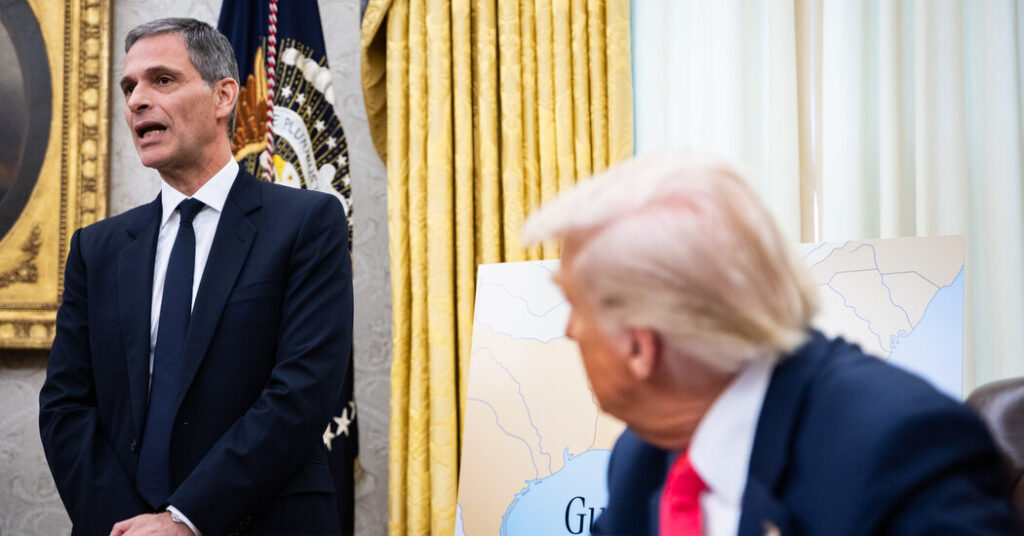
President Trump sounded pleased when the chief executive of a giant French logistics company came to the White House nearly a year ago to announce a large investment in American ports and shipping.
“He’s going to be investing $20 billion into the United States because of the election,” Mr. Trump said last March.
CMA CGM, a family-owned company based in Marseille, France, is little known in the United States. As the world’s third-largest shipping line, it plays a crucial role in global supply chains and has billions in revenue. But since the announcement last year, only a fraction of its promised funds have made it to America.
“So far, CMA CGM has shown little sign that it will fulfill its $20 billion investment pledge into the U.S. maritime sector,” said James Lightbourn, founder of Cavalier Shipping, a shipping financing advisory.
Several companies have made commitments to invest in the United States since Mr. Trump began his second term, and it remains to be seen how many follow through. But the United States’ depleted shipping industry is in urgent need of big investments, and a cash infusion would help Mr. Trump achieve his aim of bolstering the industry to counter China’s rise as a commercial shipping power.
In an executive order issued in April, Mr. Trump called for a maritime action plan and other support for the industry. “We’re going to be spending a lot of money on shipbuilding,” he said when announcing the order. “We’re way, way, way behind.”
But the plan is months late, and Congress has yet to advance bipartisan legislation that would create new subsidies that many say are needed to entice new investment.
Hanwha, a South Korean conglomerate, has said it intends to build more vessels at the shipyard in Philadelphia that it bought during the Biden administration. In August, it announced that it planned to spend $5 billion on expanding the yard.
CMA CGM’s $20 billion promise stood out because of its size. Rival ocean carriers, like Maersk and MSC, did not make multibillion-dollar investment promises in the past year. CMA CGM said in its March announcement that it intended to make its investments over four years, so there is time for it to reach its $20 billion target.
A spokeswoman for Maersk said that North America was a “critical market” for the company and that it would continue to expand its operations in the United States. MSC did not respond to requests for comment.
At the White House in March, CMA CGM’s chief executive, Rodolphe Saadé, said the company was planning to invest in American-made container vessels, adding that it would offer details “in the next coming weeks.”
But CMA CGM hasn’t announced any orders from American shipyards.And the costs of American shipping — building a commercial vessel in the United States can be five times as expensive as in Asia — have been a deterrent.
CMA CGM looked into ordering American-made container ships last year, but concluded that the price of such a vessel made a purchase unfeasible, according to a person familiar with the company’s operations. Three container ships being made at Hanwha’s Philadelphia shipyard, ordered before Hanwha bought the yard, cost $330 million each. Similar vessels bought from an Asian shipyard would cost $75 million at the most, said Mr. Lightbourn of Cavalier Shipping.
CMA CGM hasn’t done much to fulfill another commitment: putting some 20 additional vessels under the American maritime flag, a move that would create jobs for scores of American mariners. Since March, CMA CGM has put just one additional ship in its American-flagged fleet. The high costs of running American-flagged ships are holding CMA CGM back from bringing more vessels into its U.S.-flagged fleet, the person familiar with CMA CGM’s operations said.
Mariners in the United States earn more than those from other countries, and insurance on the vessels is more expensive. Government subsidies help shipping companies avoid big losses on the American-flagged vessels currently in service, but the subsidy programs are limited.
Trump Administration: Live Updates
Updated
- Vance deletes post recognizing Armenian genocide.
- Prosecutors fail to bring charges against Democrats involved in illegal orders video.
- The Pentagon is send 200 troops to Nigeria.
Colin Grabow, an associate director at the Cato Institute, a research organization that favors less government regulation of business, said he immediately had doubts about CMA CGM’s plan to add some 20 vessels to its American-flagged fleet.
“I was thinking: ‘How are you going to make money? Presumably, you’re a profit-driven enterprise, so what’s the business case for that?’” Mr. Grabow said.
Part of CMA CGM’s investment program is focused on ports, which are much more likely to produce strong investment returns than buying American ships and hiring mariners.
In a statement to The New York Times, CMA CGM said it had “committed” some $1 billion to increasing the capacity of its terminals at the Port of New York and New Jersey as well as the Port of Los Angeles.
CMA CGM also said a joint venture it was setting up with Stonepeak, an American investment firm, intended to make new port investments in the United States and other countries.
“This partnership is fully consistent with CMA CGM’s $20 billion commitment to the United States, and supports our long-term, phased investments in ports, logistics, shipping and air cargo,” the company said. “The partnership will support up to $3.6 billion of future terminal development investments worldwide, with a particular focus on the United States.”
Still, CMA CGM did not name any new projects planned in the United States by the joint venture, and in doing the deal, the company actually reduced its ownership in American ports and others, by selling a 25 percent stake in them to Stonepeak.
“This looks like a divestment to free up capital for other purposes, but also to create a vehicle for future investment that doesn’t have to be 100 percent CMA CGM capital,” said Matt Leech, the chief executive of Ports America, a large port operator.
Mr. Saadé and his family have a majority stake in CMA CGM, which his father, Jacques, founded in 1978 with one ship sailing between Beirut, Lebanon, and Marseille. He made his investment pledge soon after the Trump administration said it was considering imposing penalty fees on Chinese-built and Chinese-owned vessels.
CMA CGM owns 281 Chinese-made ships, according to Alphaliner, a maritime data company, and it is in alliance with COSCO, China’s state-owned shipping company. (Mr. Trump imposed but then suspended the fees for a year as part of his trade truce with China.)
CMA CGM was investingin the United States before Mr. Trump’s second term. It acquired its terminal at the Port of Los Angeles in 2021 in a $2 billion deal. It also purchased the two terminals at the Port of New York and New Jersey in 2023, saying it would invest in both.
CMA CGM now expects to invest around $500 million to expand the capacity of its Los Angeles terminal, according to the person familiar with the company’s operations.
Gene Seroka, the executive director of the Port of Los Angeles, said it was a “much-needed and significant project.”
A spokesman for the Port of New York and New Jersey said CMA CGM had begun a $486 million investment at its terminal in Bayonne, N.J. Bethann Rooney, the port director, said CMA CGM had been “an enthusiastic, collaborative partner.”
The White House promotes its own tally of the investment promises, which includes the $20 billion from CMA CGM.
“President Trump has leveraged his diplomatic prowess to secure trillions of dollars of investments into our country, which will reshore manufacturing and create American jobs,” said Anna Kelly, a White House spokeswoman. “The president expects all partners to abide by their commitments.”
Peter Eavis reports on the business of moving stuff around the world.
The post Trump Wants to Revive Shipping. Investors Are Slow to Back Him. appeared first on New York Times.