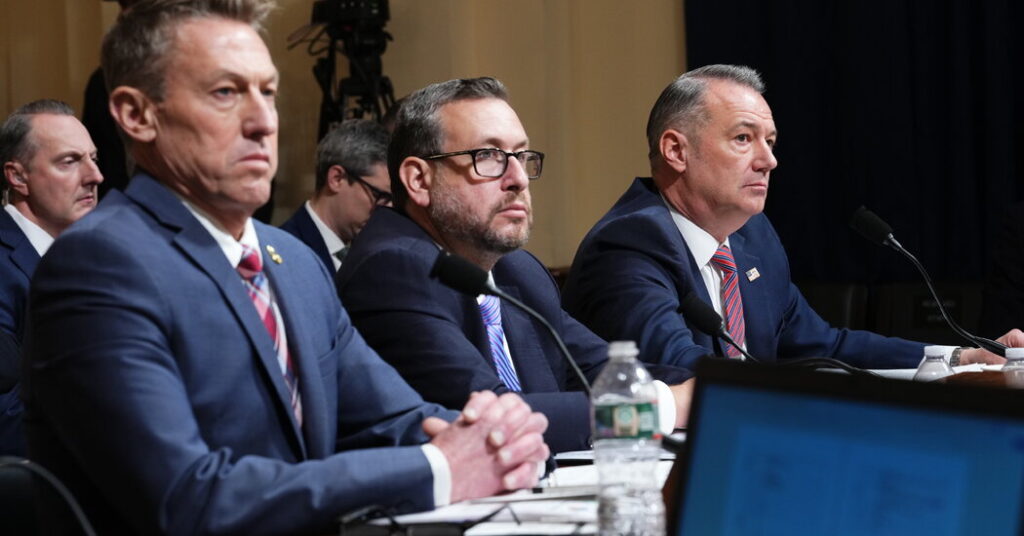
Top immigration officials defended the Trump administration’s mass deportation campaign during a congressional hearing on Tuesday and repeatedly declined to answer questions about the fatal shootings of two U.S. citizens in Minneapolis.
Pressed by Democrats at the hearing to apologize to the families of two Americans killed in Minneapolis by federal agents — Alex Pretti and Renee Good — Todd Lyons, the acting director of Immigration and Customs Enforcement, said he welcomed the opportunity to speak with their families in private. But he said he would not apologize or comment on the shootings.
“The loss of any life is unacceptable,” Mr. Lyons said. “But I’m not going to comment on an ongoing investigation.”
Asked whether he thought Mr. Pretti deserved to die, Rodney S. Scott, the commissioner of Customs and Border Protection, also said he would not comment on open investigations. Witness videos of the encounter appeared to show Mr. Pretti recording immigration officers on his phone and helping a civilian stand back up before several officers wrestled him to the ground. He was fatally shot by Customs and Border Protection officers.
The hearing, held by the House Homeland Security Committee, highlighted how entrenched both parties’ positions have become as Congress negotiates possible restrictions on immigration enforcement efforts. Despite bipartisan outrage last month after federal agents killed Mr. Pretti, House Republicans have largely returned to a staunch defense of federal immigration enforcement.
Democrats on the panel condemned the Trump administration’s immigration crackdown for sweeping up people who were in the country lawfully or who had no criminal records. They also criticized the administration’s aggressive tactics, saying that immigration officers were using excessive force and carrying out “lawless actions.”
Few Republicans mentioned Mr. Pretti in their questions, instead focusing on an increase in threats against immigration officers and what they said were the dangers posed by unauthorized immigrants.
Clashes between protesters and immigration officers have been frequent in the Minneapolis-St. Paul region since the Trump administration began its deportation drive. Protesters have blown whistles, honked car horns and shouted profanities at immigration agents. Federal officers have deployed pepper spray and responded violently at times, shattering car windows and tackling people to the ground.
Representative Michael R. McCaul of Texas, who is set to retire after his term ends, was one of the few Republicans to criticize the administration’s enforcement operation in Minnesota. He said he believed that “roving patrols” of immigration agents should not be in major American cities. Democrats have demanded restrictions on such patrols as a condition of funding the Department of Homeland Security.
Still, Mr. McCaul laid blame entirely on Gregory Bovino, a top Border Patrol official and a leader of the Minnesota operation, and he suggested the Trump administration had since moved in the right direction by pulling Mr. Bovino out of the state.
After federal officers killed Mr. Pretti, Democrats withdrew their support for a spending bill that was needed to keep the Department of Homeland Security running. They are now negotiating with the White House over what restrictions, if any, should be placed on immigration enforcement operations. Democrats have said they will not support any more funding for the department unless it imposes new limits and guardrails on federal immigration agents.
But the talks appear stalemated. Democrats submitted a proposal on Saturday with their demands, most of which Republicans have already rejected. The White House sent a counterproposal on Monday that Democratic leaders dismissed as lacking substance.
If Congress does not reach a deal, funding for the department will lapse on Saturday. Senator John Thune, Republican of South Dakota and the majority leader, has suggested he could put forward a stopgap spending measure to keep it running temporarily while talks continue, but Democrats seem hesitant so far to agree to one.
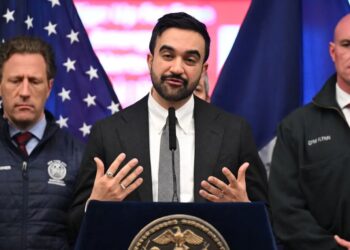
The hearing comes after the Trump administration scaled back its Minnesota operation and pulled 700 officers from the state last week, leaving about 2,000 officers. On Tuesday, Gov. Tim Walz of Minnesota said that he had recently met with Tom Homan, the White House border czar, and that he hoped federal immigration enforcement agents would exit the state in the coming days.
“We are talking days, not weeks and months of this occupation,” Mr. Walz said at a news conference. He added that he was operating in a “trust but verify mode” with federal officials.
The Department of Homeland Security said the operation had resulted in more than 4,000 arrests, which it said included murderers, gang members and sex offenders. The department has not detailed how many of those people had criminal convictions.
During the hearing, Mr. Lyons vowed that ICE would continue its work despite an increase in threats against officers.
“Let me send a message to anyone who thinks they can intimidate us: You will fail,” Mr. Lyons said. “We are only getting started.”
He also declined to say how many ICE agents had been fired or dismissed for misconduct on the job. When pressed by Representative Eric Swalwell, Democrat of California, about whether at least one agent had been fired, Mr. Lyons said that he would get the data but that he could not disclose personnel information.
Mr. Scott similarly declined to tell lawmakers how many agents had been disciplined for misconduct in recent immigration crackdowns.
Democrats have pushed for more accountability of federal immigration officers, calling for requirements that immigration agents remove their masks and wear body cameras. Lawmakers from both parties have said they are open to providing additional funds for body cameras.
On Tuesday, Mr. Lyons said that about 3,000 officers, out of roughly 13,000 in the field, were currently equipped with body cameras. Last week, Kristi Noem, the homeland security secretary, said that all immigration officers in Minneapolis would be given body cameras and that the program would be expanded nationwide “as funding is available.”
Joseph Edlow, the director of U.S. Citizenship and Immigration Services, also testified and underscored the administration’s efforts to tighten legal pathways for migrants to enter or remain in the country. But lawmakers directed most questions to the heads of ICE and Customs and Border Protection.
Representative Andrew Garbarino, the New York Republican who is the chairman of the committee, called Tuesday’s hearing in response to the conflict in Minnesota. But Democrats, who are in the minority and therefore cannot force officials to testify, seized on the hearing as an opportunity to assertively press agency heads and register their anger over President Trump’s immigration policies.
In one heated exchange, Representative LaMonica McIver, Democrat of New Jersey, asked Mr. Lyons whether he was a religious person and how he thought “judgment day will work for you with so much blood on your hands.”
“I’m not going to entertain that question,” Mr. Lyons responded.
Ms. McIver, who is facing federal charges after a clash with agents at a New Jersey detention center, also asked whether Mr. Lyons thought he was “going to hell” before Mr. Garbarino shut down the line of questioning.
Mr. Garbarino called for “complete and impartial investigations” into the Minnesota shootings, and secured commitments from Mr. Lyons and Mr. Scott that they would send members of Congress the full reports from their agencies’ investigations into the shootings of Ms. Good and Mr. Pretti.
Mr. Lyons, Mr. Scott and Mr. Edlow are also set to testify before the Senate on Thursday.
Ernesto Londoño and Pooja Salhotra contributed reporting.
Madeleine Ngo covers immigration and economic policy for The Times.
The post Top Immigration Officials Refuse to Discuss Minnesota Shootings at Hearing appeared first on New York Times.