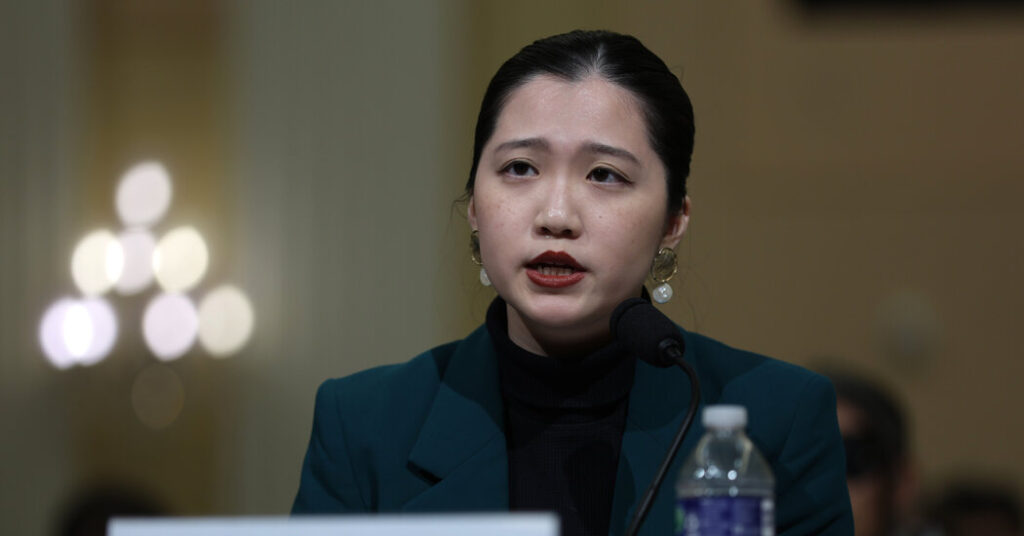
For years, the authorities in Hong Kong have pursued Anna Kwok, a political activist, across oceans, placing a bounty on her and branding her an “absconder” from her home. With the activist out of reach in Washington, they turned to a target they can still touch: her father.
On Thursday, a Hong Kong court convicted Kwok Yin-sang, her father, of a national security crime, in what rights groups have said is an escalation of the city’s campaign to silence activists living abroad by targeting their relatives at home. In her first interview about the case, Ms. Kwok denounced the authorities for going after her family to try to get to her.
“They really want this to be a source of pain for my family. I have to remind myself it is not my fault, it’s not my family’s fault,” she said. “The government is trying to destroy my values and the people I love.”
Mr. Kwok has been accused of dealing with funds linked to Ms. Kwok, an act the authorities say is forbidden because they have deemed her an “absconder,” someone accused of a national security crime who has fled Hong Kong.
Mr. Kwok, 68, faces up to seven years in prison; the court said he would be sentenced on Feb. 26.
Ms. Kwok has had no contact with her father, who owns a construction company, since he was released on bail in May and ordered not communicate with her. She said she looks at photographs of him in local media and tries to piece together what he may be thinking. In court on Wednesday, Mr. Kwok’s face was obscured by a face mask and he displayed no outward signs of emotion. He waved to his wife when he was led away by court officers.
“I believe he’s a tough person,” Ms. Kwok said. “My resilience has to come from somewhere.”
His conviction was met with criticism by human rights groups.
“Punishing a 68-year-old father for his daughter’s peaceful activism is an alarming act of collective punishment that has no place under international human rights law,” said Elaine Pearson, the Asia director for Human Rights Watch. She called the conviction “cruel and vindictive.”
Trump Administration: Live Updates
Updated
- Vance deletes post recognizing Armenian genocide.
- Prosecutors fail to bring charges against Democrats involved in illegal orders video.
- The Pentagon is send 200 troops to Nigeria.
Ms. Kwok is one of dozens of overseas dissidents the Hong Kong government has targeted with bounties and promised to pursue “for life.” She helped raise hundreds of thousands of dollars anonymously as part of a crowdfunding campaign to pay for front-page newspaper advertisements criticizing the government during the 2019 pro-democracy protests.
She fled Hong Kong in 2020 and became director of the Hong Kong Democracy Council, a nonprofit advocacy group. She called on the U.S. government to bar John Lee, Hong Kong’s leader, from attending the Asia-Pacific Economic Cooperation meeting in San Francisco in 2023. She traveled to that summit to protest the attendance of China’s top leader, Xi Jinping.
Mr. Kwok’s case is a first for Hong Kong, unlike in mainland China, where family members of political dissidents are routinely punished for their relatives’ perceived crimes. Since China imposed a national security law on Hong Kong, the city has seemingly applied mainland-style norms to political cases, activists and scholars say.
Earlier this week, a national security court handed down harsh prison sentences for the former media mogul and democracy activist, Jimmy Lai, and his deputies at the now-shuttered Apple Daily newspaper.
In Mr. Kwok’s case, the authorities have focused on his attempt last year to terminate a life insurance policy he had bought for Ms. Kwok when she was 2.
Mr. Kwok’s lawyers argued that he did not violate the law because the insurance policy technically did not belong to Anna Kwok. They say she had not signed any forms to take over ownership of the policy from her father. The prosecution argued that the policy had been transferred to Ms. Kwok automatically when she turned 18. The policy is worth less than $12,000.
The relatives of other exiled Hong Kong activists have come under similar pressure. The police have called in for questioning the parents of Frances Hui, a democracy activist who now lives in the United States, Ms. Hui said on X. Last February, the police interviewed the aunts and an uncle of Carmen Lau, an activist and former elected official now living in exile in Britain, Human Rights Watch said.
“It imposes a psychological burden on political dissent to those in exile,” said Eric Lai, a senior fellow at the Georgetown Center for Asian Law. “It is not just a tactic of the Hong Kong government, but a widely adopted tactic for autocratic regimes like China to silence dissidents abroad.”
Ms. Kwok said she hoped that the Trump administration would take action in response to her father’s prosecution and help free Mr. Lai, the pro-democracy media tycoon, who was sentenced to 20 years in prison on Monday. Last March, the United States levied sanctions on six local and mainland officials in response to what it called attempts to “intimidate, silence, and harass” pro-democracy activists living overseas.
Berry Wang contributed reporting.
David Pierson covers Chinese foreign policy and China’s economic and cultural engagement with the world. He has been a journalist for more than two decades.
The post Hong Kong Convicts a Political Exile’s Father, a First for the City appeared first on New York Times.