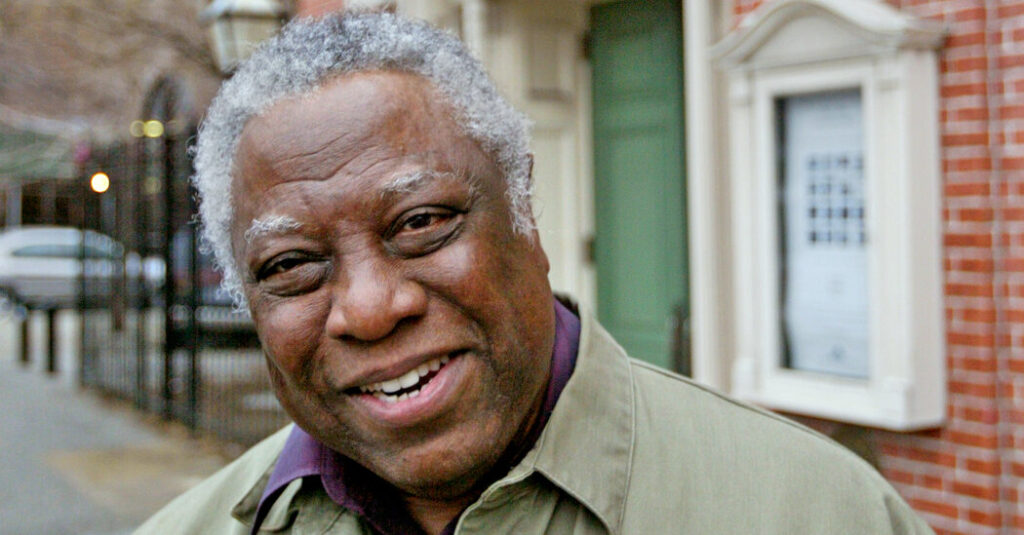
Woodie King Jr., a talent-spotting impresario and proponent of Black drama whose New Federal Theater in New York lent a stage to a profusion of future stars, including Denzel Washington, Phylicia Rashad and Chadwick Boseman, and who put Ntozake Shange’s acclaimed play “For Colored Girls” on the map, died on Thursday in Manhattan. He was 88.
His death, at Weill Cornell Medical Center, was from complications of heart surgery, his wife, the director and actor Elizabeth Van Dyke, said.
New Federal Theater, which Mr. King founded in 1970 during the heyday of the Black Arts Movement, was tucked away on Manhattan’s Lower East Side, at the Henry Street Settlement. But Mr. King quickly made it a cultural hot spot, with plays by writers like Amiri Baraka, Ed Bullins and Charles Fuller, and a roll call of actors who later found fame, including Debbie Allen, Laurence Fishburne, Morgan Freeman, Jackée Harry, S. Epatha Merkerson, Garrett Morris and Leslie Uggams.
Inspired by the Works Progress Administration’s artist-centered, drama-for-the-masses Federal Theater Project of the 1930s, Mr. King knew whom he wanted to champion with his company, and whose work he wanted to channel toward the mainstream.
“People of color and women was what we were after,” he said in an interview with The New York Times in 2021.
In 1976, the year that Mr. King plucked Ms. Shange’s play “For Colored Girls Who Have Considered Suicide/When the Rainbow Is Enuf” out of a nearby bar and put it on his stage — from which it would travel to the Public Theater, to Broadway, into the canon and onto movie screens — Mel Gussow of The Times wrote that Mr. King had made his company “a prime generator of new Black plays.”
And, he added, an exciting one: “I have never been bored at Henry Street, and, almost always, I have been stimulated.”
In 1981, Mr. Washington and Ms. Rashad shared a New Federal double bill of the playwright Laurence Holder’s one-acts. More than a decade before Mr. Washington played the title role in the Spike Lee biopic “Malcolm X,” he played Malcolm X (in a “firm, likable performance,” Frank Rich wrote in The Times) in “When the Chickens Came Home to Roost.” Ms Rashad (“a fiery young actress,” Mr. Rich reported) played Zora Neale Hurston in “Zora.”
The Broadway actor and director LaTanya Richardson Jackson and her husband, Samuel L. Jackson, also acted there early on, in an era when stage jobs were scarce for Black artists outside the Negro Ensemble Company and the New Federal Theater.
“It was a refuge and our bridge over troubled waters of not being able to necessarily be in mainstream theater,” Ms. Jackson said by phone from Kenya, where she was on safari. Mr. King, she noted, “created mainstream theater himself, which gave the opportunity for a lot of actors to work. And we will forever be grateful for him for that.”
The paychecks, less so. As Mr. Gussow’s article detailed, actors in 1976 were paid $65 a week, and only for performances, not rehearsals. (A mitigating factor: For several years, before funding tightened, tickets to New Federal Theater shows were free of charge.)
“Woodie was a good guy; everybody liked him,” Ms. Jackson said. “You weren’t gonna make any money, but at least you got to work. He showed you the benefit of the art, of doing it. You did it so that you could learn and study and be a part of the greater good of creativity — of just being able to help playwrights see their work by getting good actors to do it, and really art for art’s sake. He was that guy.”
The New Federal Theater wasn’t a place only for emerging artists. Even in its first years, it attracted established stars, too, like Ossie Davis and Ruby Dee, a married couple who acted together in “Take It From the Top,” a play that she wrote and he directed.
Ms. Allen, the actress and dancer who is Ms. Rashad’s sister, performed and choreographed work at the New Federal Theater in the 1970s. She described the company as “an oasis” for Black artists, and Mr. King as “a force of nature.”
“He pushed and plowed and pushed and plowed to give more space for the African American voice in the theater and film community,” Ms. Allen said by phone, adding: “And Woodie nurtured all of us. He gave us opportunities. He would just say, ‘Come on, you need to do this. Let’s go.’ And there you were.”
Woodie King Jr. was born on July 27, 1937, in Bladon Springs, in southwest Alabama, the only child of Woodie Sr., a truck driver who hauled groceries, and Ruby (Jones) King, a domestic worker. During World War II, she moved to Mobile, Ala., to work in a shipyard, leaving young Woodie in the care of relatives.
After his parents split up, he and his mother moved to Detroit to join her family there. As he recounted in Juney Smith’s documentary film, “King of Stage: The Woodie King Jr. Story” (2018), he was 11 when they arrived but was enrolled in the first grade, “because schools in the South were supposed to be so bad.” It took him several years, with the help of supportive Black teachers, to catch up to his peers.
Drawn to movies, libraries and art museums as a child, Woodie was never a theater kid. After graduation, he got a job as an arc welder at Ford Motor Company and later worked as a draftsman for the city of Detroit.
His sense of professional possibility shifted when he saw two Black actors in starring roles in movies: Sidney Poitier in “The Defiant Ones” (1958) and Sammy Davis Jr. in “Porgy and Bess” (1959). When the Broadway touring production of Lorraine Hansberry’s “A Raisin in the Sun” stopped in Detroit in the fall of 1960, Mr. King went to the Cass Theater night after night and waited around after the show to talk to the cast.
Wanting to be an actor, he won a scholarship to the Will-O-Way Apprentice Theater in suburban Bloomfield Hills, Mich., where he was one of just a few Black participants in an overwhelmingly white program.
“But the one thing you couldn’t do, you couldn’t act in no plays with no white girls,” he recalled in the documentary. “In Bloomfield Hills, Michigan, you couldn’t even come on the stage with white girls. That’s how racist it was in that time.”
So he remained in the program, but pivoted, deciding to learn stage management and other skills to make himself indispensable. By the time he moved to New York City in the mid-1960s, he had already co-founded his first Black theater company, the Concept East Theater, in Detroit.
Decades later, in 1996, he earned a bachelor’s degree from Lehman College, in the Bronx, followed in 1999 by an M.F.A. in directing from Brooklyn College. In between, in 1997, he won an Obie Award for sustained achievement.
Evan Yionoulis, now dean of the drama division at the Juilliard School, was one of Mr. King’s graduate school instructors. She remembers “how open he was both to learning new things and also to sharing things that he already knew,” she said in an interview.
“He was a real legend by then,” she added. “I have to say, I was a little in awe of him.”
Issa Rae, the co-creator and star of the HBO comedy “Insecure,” worked as an office assistant at the New Federal Theater from 2007 to 2009, helping with fund-raising when she was just out of college. In an interview, she said Mr. King was “funny as hell” and had maintained “a high bar for Black talent and taste.”
“It was an education for me,” she said. “To see him at the center of it, and to also see that he was in touch with so many people who would still send in donations and who had credited him so much with their start, it was just really cool to witness.”
The first time she ever heard Mr. Boseman’s name was when she held that job, she said. Long before Mr. Boseman played James Brown and the Black Panther in movies, he performed in the New Federal Theater’s 2002 production of Ron Milner’s play “Urban Transition: Loose Blossoms,” which Mr. King directed.
The Tony Award-winning director Kenny Leon said that he and Mr. King, whom he last spoke with just weeks ago, were connected from the beginning of Mr. Leon’s career.
“Everything I have in theater, I have to trace it back to him,” Mr. Leon said. “When I was even trying to run a theater, and there was no Black Americans running theaters in the country, except Lloyd Richards at Yale Repertory and Woodie King at New Federal, I’d sought them out and sat down with them, and Woodie embraced me and gave me guidance.”
As a member of the administration committee for the 2020 Tony Awards, Mr. Leon successfully argued for giving the New Federal Theater a Tony Honor for Excellence in Theater.
Mr. King stepped down as the New Federals’s producing director in 2021 but remained on its board. Since 2020, Ms. Van Dyke has been artistic director of the company, whose full name will remain Woodie King Jr.’s New Federal Theater.
The last play Mr. King directed, Ms. Van Dyke said, was the 2023 world premiere of Wesley Brown’s “Telling Tales Out of School,” about women from the Harlem Renaissance.
“He had a major stroke, and he came out on a walker and directed a four-character play,” said Ms. Van Dyke, who was in the cast.
Mr. King’s first marriage, to Willie Mae Washington, ended in divorce. In addition to Ms. Van Dyke, his survivors include three children from his first marriage, Michael and Woodie Geoffrey King and Michelle King-Huger; and five grandchildren.
He leaves behind, too, a theatrical landscape reshaped to make more space for Black art and Black artists.
“There was no place for us,” Ms. Van Dyke said. “He made a place for us.”
The post Woodie King Jr., Impresario of Black Theater, Dies at 88 appeared first on New York Times.