Some of the largest U.S. manufacturers are avoiding the financial pain of President Trump’s tariffs through a series of business maneuvers and personal appeals to the president himself.
American manufacturers made $249.2 billion after taxes in the third quarter of 2025, up $73.1 billion from the same quarter in 2024, according to the latest data from the Census Bureau. The emerging picture suggests a bifurcated industrial landscape. Many small businesses are struggling with soaring component costs while multinational firms are reporting an increase in sales and profits.
“Large companies are all talking about how they are mitigating tariffs,” Todd Dubner, industrials deal advisory leader at KPMG. “Small companies are all talking about how tariffs are impacting their bottom line.”
Businesses with easy access to capital and a large number of international suppliers have shifted to lower-tariff jurisdictions and hired lobbyists, lawyers and consultants to try to carve out exemptions with Trump administration officials.
“When I think about some of our big clients, they literally set up war rooms where our tax, customs and tariff teams are working with them on a daily or weekly basis to navigate the changing landscape of tariffs,” Mr. Dubner said. “If you are a small company, setting up a war room in itself may be hard.”
Proximity to the Trump administration is helpful. Eli Lilly’s chief executive, Dave Ricks, appeared at the White House with Mr. Trump in November to announce a deal to expand access to the company’s blockbuster weight-loss drugs the same month it became the first trillion-dollar health care company on the New York Stock Exchange. Mr. Ricks has cultivated a close relationship with the president, who has invited him to Mar-a-Lago and described him as “a friend of mine.”
Eli Lilly is one of 16 pharmaceutical companies that have struck agreements with the Trump administration to delay tariffs for three years in exchange for price discounts on some drugs and pledges to invest in American manufacturing.
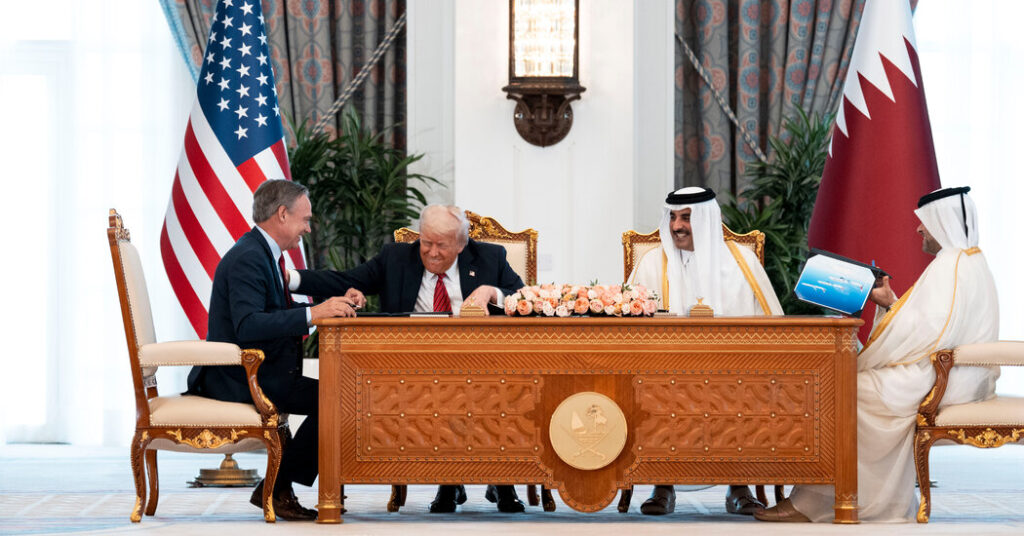
Last year, Boeing outsold its European rival, Airbus, for the first time since 2018, despite ongoing scrutiny over past crashes. The company received the largest order in its 109-year history in May when Qatar Airways agreed to buy up to 210 planes. The deal was announced during a visit by Mr. Trump and Boeing’s chief executive, Kelly Ortberg, to Qatar’s capital, Doha. Last week, Boeing reported a 34 percent rise in annual revenue in 2025, to $89.46 billion.
Aerospace companies like Boeing have largely enjoyed zero tariffs on aircraft parts for decades. Mr. Ortberg and Larry Culp, the chief executive of GE Aerospace, which makes engines for Boeing planes, helped persuade Mr. Trump to continue that in the deal the administration struck with the European Union in July.
Mr. Trump has taken an interest in boosting Boeing sales during strategic negotiations with partners abroad. Last month, at a retreat of Republican lawmakers, he boasted that he had “sold more Boeings than any human being on Earth.”
“I am the king,” he said, adding that the company had given him a “Salesman of the Year” award.
Defense contractors have also been insulated from the full burden of tariffs because of special rules that guarantee duty-free treatment for military hardware and cost-plus contracts that reimburse the company for its costs. RTX, the parent of Raytheon, said its net income rose 41 percent in 2025. The company reported $600 million in tariff-related costs last year for its nonmilitary businesses, well below the $850 million it had expected to pay.
Yet Mr. Trump lashed out at the company last month on social media, accusing it of failing to increase production quickly enough and threatening to ban dividends and stock buybacks. On RTX’s earnings call last week, executives pledged to invest $3.1 billion this year in boosting production.
Automakers have benefited from a special program that allows them to recoup some of the cost of tariffs paid on imported parts for domestically manufactured vehicles. Smaller manufacturers that supply auto parts to Ford Motor and General Motors aren’t automatically eligible for the program.
The chief executives of Ford and G.M. thanked Mr. Trump on earnings calls last year for the program, which led to lower-than-expected tariff bills.
The trend isn’t absolute. Some big companies are struggling with the rising cost of parts. The equipment manufacturer Caterpillar, for instance, reported a 9 percent decrease in profit in 2025 even though sales and revenue were up, saying it was largely due to higher costs related to tariffs.
Some small American manufacturers with highly differentiated products have been booming, able to pass on the full cost of tariffs while enjoying a surge in orders as customers seek out domestic suppliers.
Apple reduced its tariff bill by shifting the assembly of some iPhones to India from China and by making more Apple Watches in Vietnam. The company’s chief executive, Tim Cook, also personally lobbied Mr. Trump for tariff exemptions, presenting him with a plaque and a pledge to invest an additional $100 billion in American factories. Although some of that investment had been in the works for years, Mr. Trump backed off a threat to place a 25 percent tariff on iPhones.
Apple paid about $3 billion in tariffs in 2025, far less than some analysts had initially predicted. Last week, Mr. Cook reported that the company had just experienced its “best-ever quarter,” with a 23 percent increase in revenue from a year earlier.
Most small companies can’t use the same playbook. Sari Wiaz, founder of Baby Paper, an Illinois toy manufacturer of crinkly-sounding paper for infants, has been unable to find an affordable alternative to the Chinese factory she has used for the last 15 years. She doesn’t have the capital to make a splashy pledge to invest in U.S. manufacturing. Nor does she have the political clout to get a meeting with Mr. Trump. She has been lobbying in Washington with 10,000 Small Businesses Voices, a group assembled by Goldman Sachs, but has seen little progress.
“I can’t go give him a golden piece of baby paper and have him waive my tariffs for me,” Ms. Wiaz said of Mr. Trump.
To stay in business, she has started ordering 5,000 pieces at a time — instead of 20,000 — to keep her tariff bill manageable. She has raised her prices and cut back on trade shows to save money. A support group of about 43 small toy manufacturers that she convenes monthly has lost several members who went out of business, she said.
Senator Edward J. Markey, a Democrat from Massachusetts, has sponsored a bill to exempt small businesses from tariffs and secure refunds for tariff bills they have already paid, but it is unclear if the legislation will get traction. His staff estimated that small businesses accounted for a third of the $195 billion that the United States collected in tariffs during the 2025 fiscal year.
Jacob Jensen, a trade policy analyst with the American Action Forum, a center-right think tank, said small manufacturers suffered because they had very concentrated supply chains and because they could not get the same attention for their problems.
“On a practical and logistical level, it is hard for them to reach out to the administration,” he said. “It is much easier for one Nvidia C.E.O. to stop by the White House and lay out his concerns.”
Farah Stockman is a Times business reporter writing about manufacturing and the government policies that influence companies that make things in the United States.
The post The Key to Managing Tariffs: Be Big and Have the President’s Ear appeared first on New York Times.