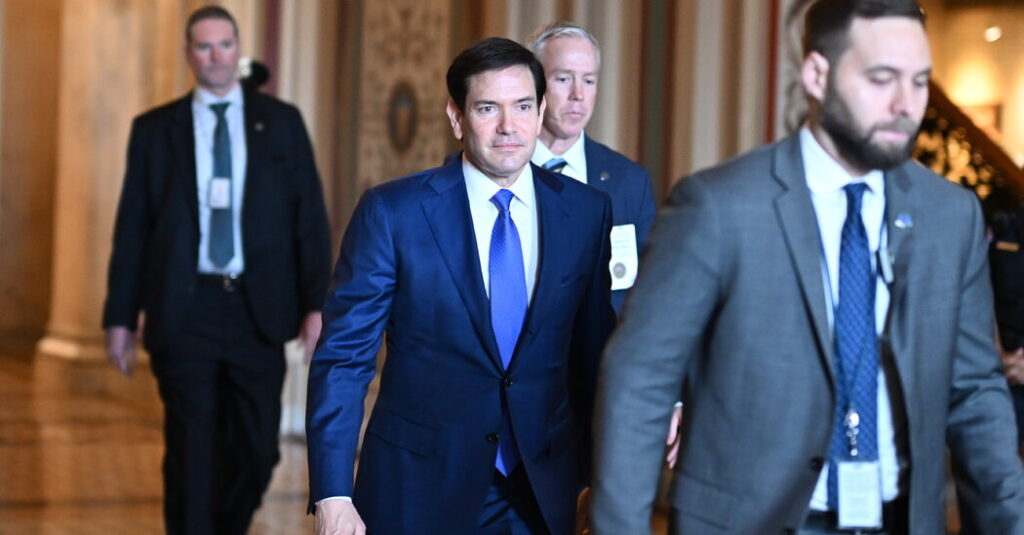
A group of American citizens, immigration nonprofits and legal organizations on Monday sued Secretary of State Marco Rubio and the State Department, asking a judge to block a visa ban that they said attempted to “eviscerate decades of settled immigration law.”
The suit, filed in Manhattan federal court, is the first major attempt to stop the State Department policy announced and implemented last month that suspended the approval of visas for people from 75 countries. More than 85 percent of the countries are non-European and have significant nonwhite populations.
The State Department said in a social media post last month that the policy, which it has characterized as a pause, was necessary to prevent migration of those who “take welfare from the American people at unacceptable rates.”
It added that immigrants from the countries in question “often become public charges,” meaning that they become reliant on the government for subsistence.
The lawsuit filed on Monday by the National Immigration Law Center and five other legal organizations, calls that an “unsupported and demonstrably false claim,” noting that most people who apply for immigrant visas are not eligible for cash welfare for years.
Joanna Cuevas Ingram, a senior staff attorney at the law center, said that the regions and countries from which immigration was banned under the new policy bore an eerie resemblance to quotas enforced by 1920 statutes that were abolished during the civil rights era.
She said that her concern was that the justifications in the executive order were a pretext “to limit legal immigration under the actual statute passed by Congress, and to reinstate those old racial quotas.”
The State Department did not immediately respond to a request for comment.
The State Department policy, which was announced on Jan. 14 and went into effect the following week, is the latest in a string of policies stretching back to the first Trump administration in which President Trump has sought to restrict immigration from countries that he and other top officials have cast as undesirable.
In 2018, the Supreme Court upheld his ban on travel from several predominantly Muslim countries, saying that as president, Mr. Trump had the authority to secure the country’s borders.
The ban implemented last month makes a different argument. The State Department said it was meant to ensure that immigrants from “high-risk countries do not utilize welfare in the United States.” Experts have said that the policy would block close to half of all legal immigration.
Trump Administration: Live Updates
Updated
- Here’s what to know about the partial government shutdown.
- Here’s what to know about the Kennedy Center.
- Trump assails the Grammys and threatens to sue Trevor Noah over an Epstein joke.
The lawsuit on Monday demonstrates the way that the new ban has already begun to separate families.
One of the plaintiffs is a Long Island man and American citizen who has been separated from his young daughter and wife. The man, Cesar Andred Aguirre, returned to Guatemala with his wife, Dania Mariela Escobar, for her visa interview, where the family was informed that Ms. Escobar could not return.
Their younger daughter is still nursing and remains in Guatemala with her mother even though she has a disease, Turner syndrome, requiring medical care that is not available there.
Another plaintiff is a Rochester man and American citizen, Munthaz Mahmud Hassen, who has been separated from his two adolescent children, whose visa petitions and fees were approved and paid but who cannot travel to the United States.
And a third, Fernando Lizcano Losada, is a renowned Colombian doctor and endocrinologist who had expected to continue his research at Harvard Medical School. In an interview, Mr. Losada said that with the resources available to him in the United States, he had expected to contribute to meaningful advances in the understanding and treatment of several cancers, including breast cancer.
The suit asks a judge to find that the ban is unlawful and to set it aside. It argues, “Congress has never authorized categorical bans, wealth tests or nationality-based presumptions regarding public charge risk.”
As the suit notes, in 2019, the Homeland Security Department tried to change its definition of “public charge” to encompass benefits like food stamps, housing vouchers and Medicaid. The administration was sued, and five separate federal courts blocked the implementation of the rule.
But in Mr. Trump’s second term, his administration has taken advantage of the lag time between the challenge to a given rule and a judge’s finding it to be unlawful to implement its policy choices, regardless of whether they are expected to stand up to judicial scrutiny.
Along with the blanket ban on visas, the administration has restored an extensive definition of “public charge,” which the lawsuit is also challenging.
Ms. Ingram said that the administration was flagrantly violating the law and relying on the likelihood that the resultant litigation would be arduous and time-consuming.
She said that it would leave “families and working people who’ve gone through the process and followed all the laws in limbo in a way that is patently discriminatory and insulting to their dignity.”
Jonah E. Bromwich covers criminal justice in the New York region for The Times. He is focused on political influence and its effect on the rule of law in the area’s federal and state courts.
The post Lawsuit Challenges Trump Ban on Immigration From 75 Countries appeared first on New York Times.