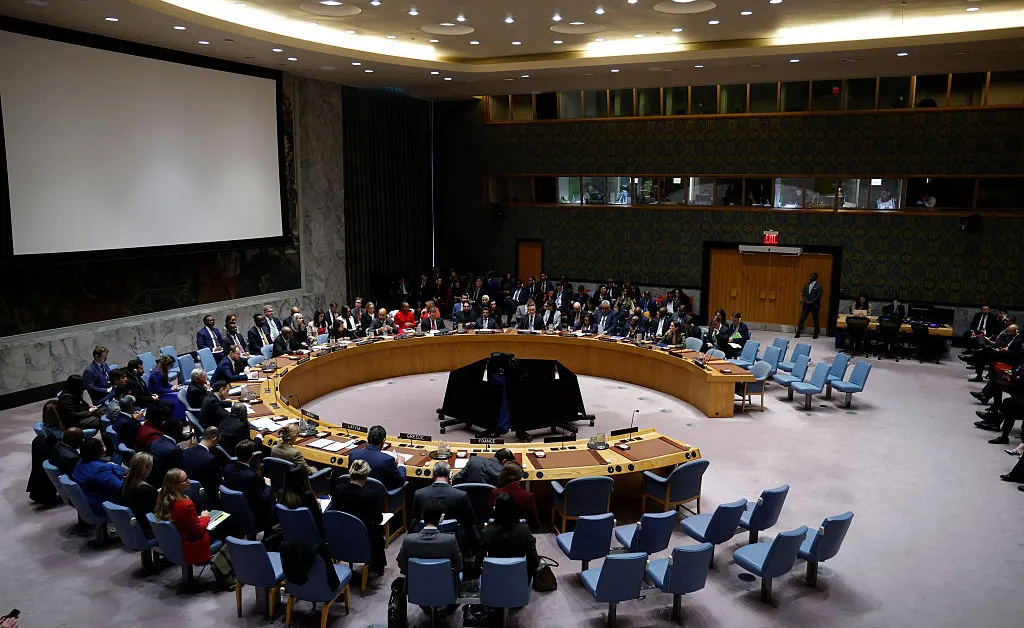
The Trump Administration’s military intervention in Venezuela drew condemnations from both U.S. allies and adversaries at an emergency meeting of the United Nations Security Council on Monday following the capture of Venezuelan leader Nicolás Maduro.
French U.N. envoy Jay Dharmadhikari said that the U.S.-led operation to seize Maduro “chips away at the very foundation of international order.”
[time-brightcove not-tgx=”true”]
“The military operation that has led to the capture of Maduro runs counter to the principle of peace dispute resolution and runs counter to the principle of non-use of force,” Dharmadhikari said.
U.N. Secretary General António Guterres, the intergovernmental organization’s top official, said the U.S. had violated the U.N. charter, which says that member countries “shall refrain in their international relations from the threat or use of force against the territorial integrity or political independence of any state,” and called for diplomacy.
“I am deeply concerned about the possible intensification of instability in the country, the potential impact on the region, and the precedent it may set for how relations between and among states are conducted,” Guterres said.
Danish ambassador to the U.N. Christina Markus Lassen also spoke in defense of Venezuelan sovereignty, noting that “no state should seek to influence political outcomes in Venezuela through the use of threat of force or through other means inconsistent with international law.”
Following Maduro’s apprehension, Trump again said he wanted to annex Greenland, an autonomous territory within the Kingdom of Denmark. Lassen did not specifically reference the threat during the U.N. meeting, but stressed, “The inviolability of borders is not up for negotiation.”
Russia and China, historical allies of Venezuela and prominent critics of U.S. foreign policy, denounced the actions as well.
“We cannot allow the United States to proclaim itself as some kind of a supreme judge, which alone bears the right to invade any country, to label culprits, to hand down and to enforce punishments irrespective of notions of international law, sovereignty and nonintervention,” said Russian ambassador Vassily Nebenzia.
Both countries demanded the release of Maduro and his wife, Cilia Flores, who was also arrested on Saturday, and called for a stop to any further military action in Venezuela.
“Where are the foundations of international peace and security?” Colombia’s U.N. ambassador Zalabata Torres asked at the Monday meeting. “It reminds us of the worst interference in our area, in our zone of peace.”
Trump has also threatened U.S. action in Colombia, as well as Mexico, following the operations in Venezuela, saying Colombia is “run by a sick man who likes making cocaine and selling it to the United States” and that drugs are “pouring” through Mexico.
Venezuelan ambassador Samuel Moncada warned that the impact of U.S. intervention could reach beyond his country.
“If the kidnapping of a head of state and bombing are tolerated or downplayed, the message sent to the world is a devastating one, mainly that the law is optional and force is the true arbiter of international order,” Moncada said.
Mike Waltz, the U.S. envoy to the U.N., pushed back against the criticism, calling Maduro’s capture a “surgical law enforcement operation.”
“If the United Nations in this body confers legitimacy on an illegitimate narco-terrorist with the same treatment in this charter of a democratically elected president or head of state, what kind of organization is this?” Waltz said.
Read more: How the World Is Reacting to the U.S. Capture of Nicolas Maduro
Along with suggesting potential U.S. intervention in Colombia and Mexico and renewing threats to annex Greenland, Trump also said that “if Iran shoots and violently kills peaceful protesters, which is their custom, the United States of America will come to their rescue.”
Iran requested to speak at the meeting as well as the council members and Venezuela, as did several other Latin American countries, including Argentina, Brazil, Mexico, Chile, Nicaragua, and Cuba, indicating widespread opposition to the U.S. actions in the region.
Monday’s meeting marked the second time the council has convened over the U.S.’s actions against Venezuela since October, when it met to discuss deadly strikes carried out by the U.S. against Venezuelan vessels that the Trump Administration alleged were transporting drugs.
Maduro and Flores were taken to their arraignments in New York as the Security Council met. Both pleaded not guilty to their respective charges.
Also on Monday afternoon, Delcy Rodríguez, who served for years as Venezuela’s vice president during Maduro’s tenure, was sworn in as the country’s interim president.
At the formal swearing-in ceremony Rodríguez, too, condemned what she called the U.S.’s “illegitimate military aggression” in Venezuela.
“I come with sorrow for the suffering inflicted upon the Venezuelan people,” she said, adding, “I come with sorrow for the kidnapping of two heroes.”
The post U.S. Criticized Over Venezuela by Allies and Adversaries Alike at U.N. Meeting appeared first on TIME.