Mayor Zohran Mamdani on Tuesday brought the power of his office to bear on an early priority for his administration: a 43-inch-wide pit at the foot of the Williamsburg Bridge.
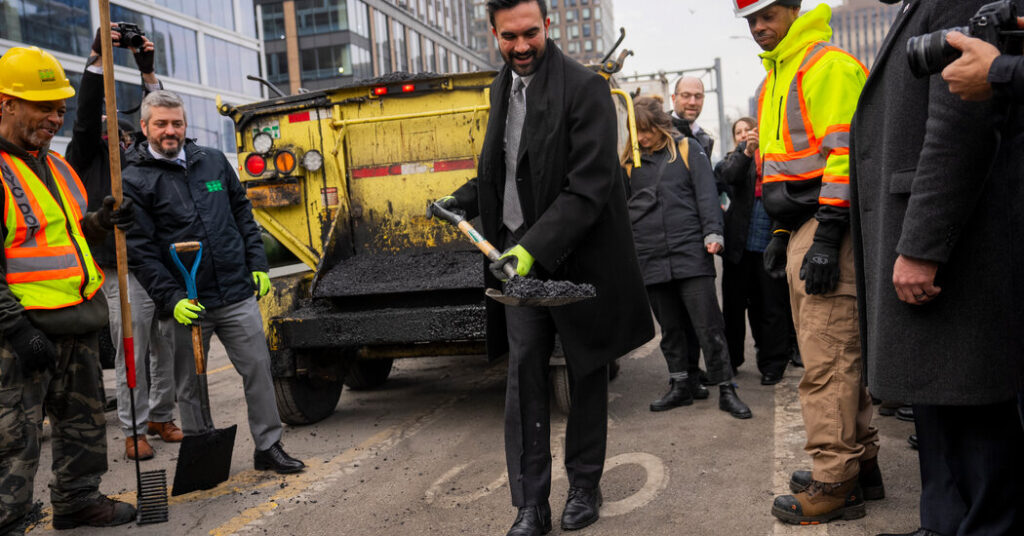
With a heave of a shovel, the new mayor spread a steaming heap of asphalt on top of “the bump” — the name frustrated cyclists have given to a short ramp near the Manhattan side of the bridge. Because of a steep drop, some unsuspecting rider has gone head over handlebar at the spot.
The mayor’s gesture reflected broader goals of repairing the city’s disjointed infrastructure for cyclists and pedestrians, and signaled to voters that he would undertake long-ignored street improvements — the kind of meat-and-potatoes issue that some previous mayors have struggled to deliver on.
“There will be no problem too big for us to take on, and no issue too small,” Mr. Mamdani said, surrounded by workers in hard hats and his new transportation commissioner, Michael Flynn.
As photo-ops go, the appearance was hardly groundbreaking. Former Mayor Eric Adams’s Transportation Department celebrated the filling of its 500,000th pothole last year. In 2016, Mr. Adams’s predecessor, Bill de Blasio, personally filled the one-millionth pothole of his administration.
But Mr. Flynn, who worked for years at the Transportation Department, said fixing the bump was a prelude to more ambitious work.
He said his department plans to complete a $70 million redesign of the stretch of Delancey Street, from the bridge to the Bowery, that will help untangle the crowded mix of bike, pedestrian and car traffic that swarms the area.
The Williamsburg Bridge carries an average of 8,600 cyclists a day, more than any other bridge over the East River.
Work on the bump was completed on Tuesday afternoon, leaving some New Yorkers more excited than others.
“This is like our Super Bowl,” said Charlie Baker, an associate director at Transportation Alternatives, a cycling and safe-streets advocacy group. He said he rushed over to the site, after hearing that the bump — which skateboarders sometimes use to catch air, because of its steep slope — would finally be fixed.
Nicolas Pryor, 29, a sous-chef and frequent cyclist, said it was a small but meaningful gesture.
“I’ve seen people fall on it before,” usually head first, he said.
Dan Yafet, who said he has been biking since before the city had bike lanes, was unimpressed.
“It seems pretty trivial,” he said, but he was hopeful that City Hall would soon refocus on other street projects, like redesigning the flow of traffic on Flushing Avenue in Brooklyn, where a woman getting off a bus was killed last year by the driver of an electric bike.
The bridge bump was the latest instance in the mayor’s first week in office of highlighting his promises to deliver better public transportation and street safety.
Mr. Adams was frequently criticized for falling short of implementing an ambitious, and legally mandated, plan to create 150 miles of bus lanes with barriers or camera enforcement, and 250 miles of protected bike lanes over five years.
In the last four years, the city only installed about 28 miles of bus lanes and 95 miles of protected bike lanes, according to the Transportation Department.
Mr. Mamdani, a frequent bike rider, had one of his most memorable moments on the campaign trail when an irate protester repeatedly called him a communist.
“It’s pronounced cyclist,” he said, as he rode off on a Citi Bike.
On Saturday, Mr. Mamdani promised to restore a more robust plan for bike lanes on Brooklyn’s McGuinness Boulevard, a project that the Manhattan district attorney said was stalled by corruption and bribery during the Adams administration.
Mr. Mamdani distanced himself further from his predecessor on Monday by fully embracing congestion pricing, the Manhattan street tolling program that Gov. Kathy Hochul and the Metropolitan Transportation Authority have defended from a range of critics, including President Trump.
Mr. Mamdani’s willingness to tackle street redesign projects so soon in his mayoralty also suggests his administration’s eagerness to make good on one of his central campaign planks: making the city’s buses fast and free.
While his Department of Transportation controls the city’s streets, Mr. Mamdani will need to broker a deal with Ms. Hochul if he hopes to fully subsidize the cost of buses for all riders. The plan is likely to require tax increases that Ms. Hochul has not committed to making.
After the bump was repaved and extended a few feet to ease the angle of the slope, few stopped to admire the work.
But Aslan Poindexter, a 17-year-old cyclist who lives nearby, rushed to film the new slope for his YouTube channel. The bump has been a scourge for riders at least since he was a little boy.
“I immediately came down and said, ‘Oh, my God, I need to get my camera.’”
Stefanos Chen is a Times reporter covering New York City’s transit system.
The post Mamdani Takes the Bite Out of ‘the Bump,’ Paving Over Hated Road Hazard appeared first on New York Times.