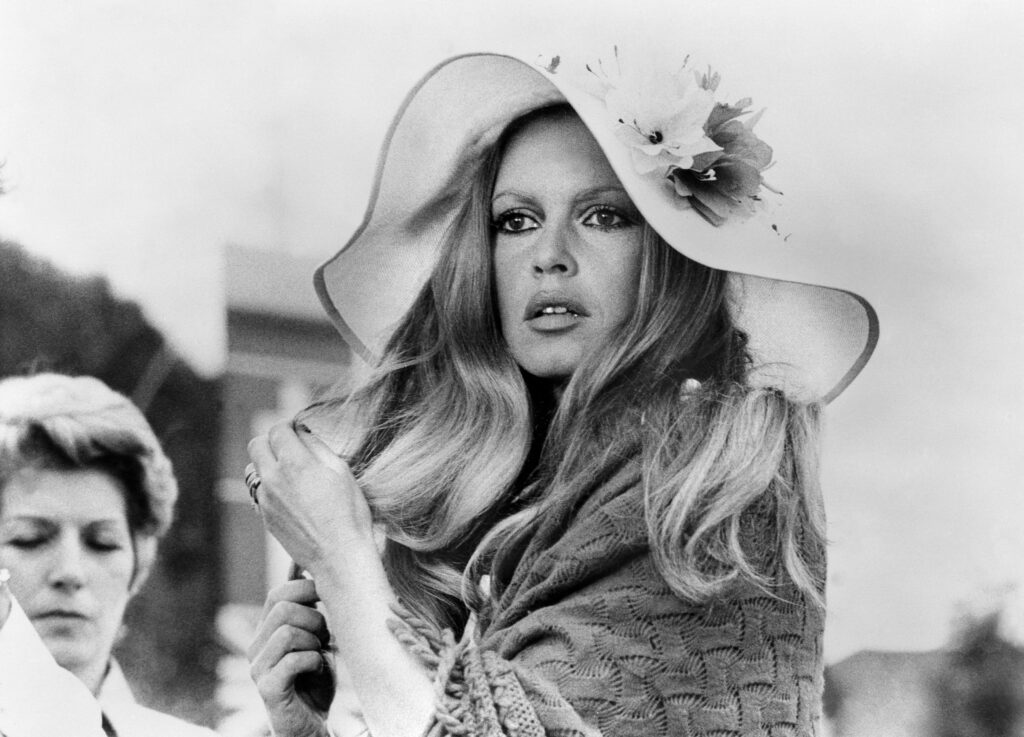
The first indelible image of her: sunbathing on the French Riviera.
Her figure, from her tawny hair to her golden feet, stretches the width of the movie screen in languid sensuality. A dapper older suitor stops by, and he is not the last to be captivated and shattered by her bemused smile and insolent pout. Later, barefoot in a nightclub, she performs a mambo of such erotic exhibitionism that it drives her movie husband, gun in hand and cuckolded by his virile brother, to the brink of insanity.
Never had a femme been so fatale.
The brazen carnality she projected made French actress Brigitte Bardot, then 21, an international sensation and emblem of female sexual emancipation. The film, “And God Created Woman” (1956), heralded the arrival of a personality who would scandalize, tantalize and hypnotize the public long after she declared herself done with movies and her parade of lovers and retired from the screen in 1973 to pursue animal rights activism.
In a life as unsettled as it was unsettling, Ms. Bardot turned politically to the far right and became an incendiary commenter on Muslims, immigrants and gays.
The Brigitte Bardot Foundation said in a statement Sunday that she died at 91, with no reference to time or cause of death. She had been hospitalized last month, the Associated Press reported.
Hollywood had voluptuous but fragile Marilyn Monroe, and Italy had earthy but dignified Sophia Loren, but Ms. Bardot’s unapologetic hedonism made her a singular phenomenon. One of the most photographed women in the world, she triggered a million fantasies and think pieces. In an Esquire essay, Simone de Beauvoir found existential meaning in Ms. Bardot’s physical allure and dubbed her a “locomotive of women’s history.”
On the other end of the spectrum, Raymond Cartier, the editor of Paris Match magazine, blamed Ms. Bardot for the breakdown of social mores and declared her “immoral, from head to toe.” He concurred with puritanical American censors and morality leagues when “And God Created Woman” was banned in cinemas from Philadelphia to Abilene, Texas.
Made for a relatively modest $40,000, “And God Created Woman” — directed and co-written by Ms. Bardot’s then-husband, director Roger Vadim — grossed $8.5 million worldwide and became, at the time, the most commercially successful foreign film ever released in the United States. And it made Ms. Bardot — a former Parisian ballerina and cover girl, and the rebellious daughter of a proper and prosperous Catholic family — a global movie star.
The very initials “B.B.” (pronounced bébé) inspired a cultlike devotion — Bardolatrie, it was called — and French President Charles de Gaulle declared her a “French export as important as Renault cars.” She became a model for official statues of Marianne, the national symbol of the French Republic. English-speaking audiences flocked to art-house cinemas to see what the Gallic fuss was about.
Ms. Bardot maintained a frenzied offscreen schedule that reinforced her wild-child image. She embarked on dozens of affairs and frolicked on sun-dappled Saint-Tropez, embodying a lifestyle of loose morals and tight bikinis. “Nobody has any security in loving me,” she once declared. When a reporter asked her to name the most memorable day of her life, she corrected him: “It was a night.”
With a few exceptions, notably Jean-Luc Godard’s “Contempt” (1963), her more than 40 films were forgettable attempts to cash in on the Bardot craze. To reviewers, she was decidedly less than met the eye. “Unlike her American opposite number, Miss Monroe, she has no lightness, no verve, no womanly softness, no change of pace, nothing but the petulant defiance of a depraved child,” culture critic Dwight Macdonald observed.
Ms. Bardot made a few halfhearted attempts to broaden her range, among them courtroom dramas and slapstick comedies. Her own estimation of her talents — “I started out as a lousy actress and have remained one” — was not widely disputed.
Even after her film career waned, she remained well known as a fashion boundary pusher, with her smoky eye makeup and thigh-high boots. She walked barefoot into chic restaurants and, in 1967, met de Gaulle at the Élysée Palace clad in a Napoleonic-style outfit at a time when women did not wear trousers to formal events at the French president’s residence.
Ms. Bardot spun her modest vocal talents into French pop-music hits. While married to German-born industrialist and playboy Gunter Sachs in the late 1960s, she took the scruffy, hard-living singer-songwriter Serge Gainsbourg as her lover and accomplice in the recording studio.
Their eccentric “Comic Strip” featured Ms. Bardot vocalizing sounds such as “pow” and “bam.” Their recordings “Bonnie and Clyde” and “Harley-Davidson” played up her sultry appeal, but no song did so more notoriously than “Je t’aime … moi non plus” (“I love you … neither do I”), replete with risque lyrics and moans to simulate lovemaking. At her husband’s urging, Ms. Bardot managed to block its release. Gainsbourg then remade the record with his new girlfriend, English actress Jane Birkin, and it soared to the top of European charts in the few countries where it was not banned.
Gainsbourg’s song “Initials B.B.” conveyed Ms. Bardot’s ravishing glamour: “All the way to her thighs, she is booted, and it’s like a chalice to her beauty; she wears nothing other than some essence of Guerlain in her hair.” (The piece was later used in a commercial for Guerlain, a French cosmetics and fragrance house.)
Ms. Bardot later confessed that she was miserable living up to the expectations of a full-time siren, quaffing champagne — up to two bottles a day — and being immortalized in song and by camera flashbulbs. A mercurial personality prone to tantrums and suicidal moods, she abandoned her only child, Nicolas — a son she had with her actor husband Jacques Charrier in 1960 — and later likened the boy’s existence to a “cancerous tumor.”
“I was not made to be a mother,” she said.
Animals ‘have never betrayed me’
After leaving show business, Ms. Bardot made a radical shift to animal rights activism. Animals, unlike men, “have never betrayed me,” she once said. “They are an easy prey, as I have been throughout my career. So we feel the same. I love them.” She sold off jewels to fund the animal-welfare foundation that bears her name.
Near her seaside villa in Saint-Tropez, she housed a menagerie of stray and rescued animals (among them, cats, donkeys and wolves). She used her celebrity to draw attention to the plight of baby harp seals, which are hunted for their pelts.
Reporters trekked to Canadian ice fields to document her crusade, which led the French government in 1977 to prohibit the importation of sealskin. More than three decades later, she generated publicity by threatening to move to Russia if French authorities euthanized two circus elephants suspected of having tuberculosis; she was credited with helping save the pachyderms.
Over the years, Ms. Bardot aggressively downplayed her looks. As an older woman, she shunned makeup and barely managed to pull her graying hair into a grandmotherly bun. Slowed by arthritis, she became increasingly reclusive. Her means of communication with the outside world became a fax machine. She berated world leaders and other high-profile figures for what she considered their lack of support for the finned or four-legged that were being slaughtered and tortured in every corner of the planet.
A committed vegetarian since the 1960s — making her a rarity in France for that era — she likened meat eaters to cannibals. She once accused Loren, who appeared in fur for an advertisement, of “wearing a cemetery” on her back.
Ms. Bardot had long hectored the French meat industry to employ more humane ways to raise and slaughter animals, but she cast her argument in racist tones in the 1990s when she denounced the ritual slaughter of sheep during a Muslim feast. She warned of the “Islamization” of France, called Muslims “invaders” with a “mania for throat-cutting” and declared that they were as likely to slit the gullets of French people as sheep.
Between 1997 and 2008, she was convicted five times of violating France’s anti-racism laws and was fined thousands of euros for anti-Muslim slurs. She also made inflammatory comments about gay people and thundered against contemporary France for “its decadence, moral and physical filth, the loss of essential values.”
She described Jean-Marie Le Pen, who long headed the far-right National Front party and was known for antisemitic outbursts, as “pleasant and learned.” Her fourth and final marriage, to a businessman and close associate of Le Pen’s, brought further scrutiny of her sympathies.
Ms. Bardot’s verbal eruptions at times coincided with the release of one of her books about cruelty to animals. They became bestsellers amid the outrage. She also was a master of infusing the political with the titillating. In 2018, giving interviews for the latest volume, she revealed that her husband, Bernard d’Ormale, “accepts three or four animals sleeping on our big bed. If he refused, he would not be my companion.”
‘Sex on legs’
Brigitte Anne-Marie Bardot was born in Paris on Sept. 28, 1934. Her father was an industrial engineer; her mother, a former dancer and actress, ran a dress shop near their large apartment close to the Eiffel Tower.
Her parents, whom she recalled as emotionally distant and socially conservative, entrusted her to governesses, and she grew up wearing wire-rimmed glasses, Victorian-era hair ribbons and braces.
“What is the name when you are not pretty? Ugly?” she once asked British journalist Peter Evans. “I knew I was ugly as a child. I said to myself: ‘Well, I am ugly, so I must at least be bright and funny and have other things to compensate.’ I knew I had to be the best at something, otherwise I would be nothing. I knew I wanted the world to know about Brigitte Bardot.”
After years of classical-ballet study, she was invited at 13 to join the Paris Conservatory. She eventually chafed under the discipline, but her posture and physique attracted the attention of magazine photographers who presented her as the quintessential jeune fille, a young girl on the cusp of womanhood.
Film director Marc Allégret dispatched his assistant, Vadim, to meet with the teenage cover girl. A planned film fell through, but Vadim was captivated and romanced her over the objections of her parents. Ms. Bardot threatened suicide when they tried to prevent their marriage.
Vadim became her Svengali, publicizing their nuptials in 1952 by arranging for a 10-page photo spread in Paris Match. He put her through acting classes, shaped her image as what he called “sex on legs,” and had her go blond.
She was soon on her way, winning her first lead role — as the temptress in the hit British comedy “Doctor at Sea” (1955), opposite Dirk Bogarde — even though her English was strictly phonetic. The next year, Vadim directed her in “And God Created Woman,” as she carried on a torrid public romance with married co-star Jean-Louis Trintignant. Both marriages ruptured, but Vadim took the affair in stride and continued making films with her.
Ms. Bardot worked with Henri-Georges Clouzot, among other topflight directors, playing a woman on trial for murder in his 1960 film “The Truth.” In “Contempt,” Godard cast her as the capricious wife of a scriptwriter and gave her a rare chance to show her grit. Under pressure from producers, he tacked on a nude bedroom sequence in which she asks her husband to comment on every part of her body. The scene was over-the-top absurd and sexy — a subversive riposte to “And God Created Woman.”
Mostly she played to type. In “Love Is My Profession” (1958), she was a streetwalker who unravels a middle-aged lawyer (Jean Gabin) by merely flashing her stocking tops. In “Babette Goes to War” (1959), co-starring her then-husband, Charrier, she mostly stayed dressed; audiences stayed away. (Charrier died in September.) She and Jeanne Moreau played strippers who find themselves caught up in the Mexican Revolution in director Louis Malle’s “Viva Maria!” (1965). In “The Novices” (1970), she was a bored, sexy nun who turns to prostitution.
Indifferent about English-language movies, Ms. Bardot did a cameo as herself in “Dear Brigitte,” (1965) a James Stewart comedy about his son writing a fan letter to the actress, and co-starred in the forgettable “Shalako” (1968), a Sean Connery adventure film about European aristocrats on safari.
One of her final films, Vadim’s “Don Juan, or If Don Juan Were a Woman” (1973), relied on Ms. Bardot’s image as an impetuous heartbreaker. Seven years earlier, she had failed to inform her longtime companion, Brazilian businessman Bob Zaguri, that she was marrying the industrialist Sachs, who had proposed weeks into their relationship by showering her home with rose petals tossed from a helicopter.
In addition to d’Ormale and her son, survivors include a sister, Mijanou Bardot, who had a brief acting career.
Long after exiting the screen, Ms. Bardot remained an object of fascination and desire as a woman who lived life on her terms.
“The past doesn’t exist for me,” she told the Guardian in 1994. “I live my life day by day. The only thing that matters to me is what I am doing now at this moment. … The future, will I walk out of here and have a heart attack? I don’t care.”
“The cinema means nothing to me, I cannot remember it,” she added. “My first husband. I don’t give a damn about my first husband. The only husband who has ever existed for me is the one that I am married to now.”
The post Brigitte Bardot, French femme fatale and cultural phenomenon, dies at 91 appeared first on Washington Post.