Maintaining clean air ducts in your home seems like something you should do. But although air ducts do get dirty, air-quality experts consistently agree that ductwork cleanings provide no measurable benefit, including for people who suffer from allergies or asthma.
Even if your ducts are filthy, cleaning them likely won’t lower dust levels throughout your home. That’s because dust that settles in your ventilation system generally stays put, unlikely to become airborne unless disturbed. Under most circumstances, having it removed provides little benefit, and it may create a bigger problem.
How duct cleaners work
To clean ducts, a company places the system under negative pressure — essentially connecting a very large, powerful vacuum cleaner to one or more openings in the ductwork and sucking out loose dust and other debris. Because a vacuum isn’t powerful enough to loosen and remove all particles, duct cleaners must agitate the dust inside the ducts using brushes and compressed air nozzles.
Duct-cleaning companies may also clean your home’s heating and cooling equipment (heat exchangers, cooling coils, condensate drain pans, fan motors, fan blades and fan housings), but these tasks aren’t always included as part of their basic service. This maintenance is generally worth doing; consider having an HVAC contractor take care of it every few years, or when you need repairs. Until Jan. 20, readers of The Washington Post can access nonprofit Washington Consumers’ Checkbook’s ratings of HVAC service providers, and all Checkbook’s other ratings and advice, free via Checkbook.org/WashingtonPost/ducts.
Why you don’t need it
“Are your air ducts making you sick?” “Breathe cleaner, fresher air.” Duct-cleaning operations often advertise that their services are essential for your health and home sanitation. But the evidence doesn’t support their claims, and you don’t need to spend money on it. Here’s why:
- Although many companies promote health benefits from their service, experts don’t recommend regular duct cleanings. The official advisory of the U.S. Environmental Protection Agency concludes that: “Duct cleaning has never been shown to actually prevent health problems. Neither do studies conclusively demonstrate that particle (e.g., dust) levels in homes increase because of dirty air ducts. This is because much of the dirt in air ducts adheres to duct surfaces and does not necessarily enter the living space … Moreover, there is no evidence that a light amount of household dust or other particulate matter in air ducts poses any risk to your health.”
- No U.S. public health group or government entity focusing on air-quality issues — the EPA, National Institutes of Health, American Lung Association, Asthma and Allergy Foundation of America, or World Asthma Foundation — recommends regular duct cleaning.
- Little research has been done on duct cleaning’s effects. One of the only independent studies was done in the 1990s by the Canada Mortgage and Housing Corporation (CMHC), when it tested 33 homes in Montreal before and after duct cleaning. It found no significant improvement in air quality, and concluded that duct cleaning alone did not improve airflow or energy efficiency. In some cases, measured particle levels increased immediately after a cleaning. In other cases, particle levels decreased immediately after cleaning but returned to previous levels within weeks. While the duct-cleaning industry argues that CMHC’s study is old and has flaws, no other independent research has challenged its findings. And although the equipment and methods used by these companies have changed since CMHC’s study was conducted, the air ducts in homes and the dust are the same.
- Cleaners might damage your ducts. Many homes now have flexible coil-style ducts — the kind that look like a Slinky — which are vulnerable to being punctured by duct cleaning work. Ductwork fabricated from fiberglass-insulated material has also become more common in new homes. The fiberglass surface is sealed, but if a duct-cleaning company is not careful, the cleaning can damage the insulation, loosening fibers that can become airborne.
- Many duct cleaning outfits say that dirt and contaminants cause your HVAC system to waste energy and work harder. But that’s misleading. While the U.S. Department of Energy estimates that 25 to 40 percent of energy used for heating or cooling a home is wasted, that’s primarily due to inefficient equipment, leaks and passive air escape (for example, leakage around doors and windows and from open fireplace flues). Any savings attained by cleaning ducts and HVAC equipment components is quite small. Here are 12 steps you can take to save energy at home.
Want to control dust? Here’s what works.
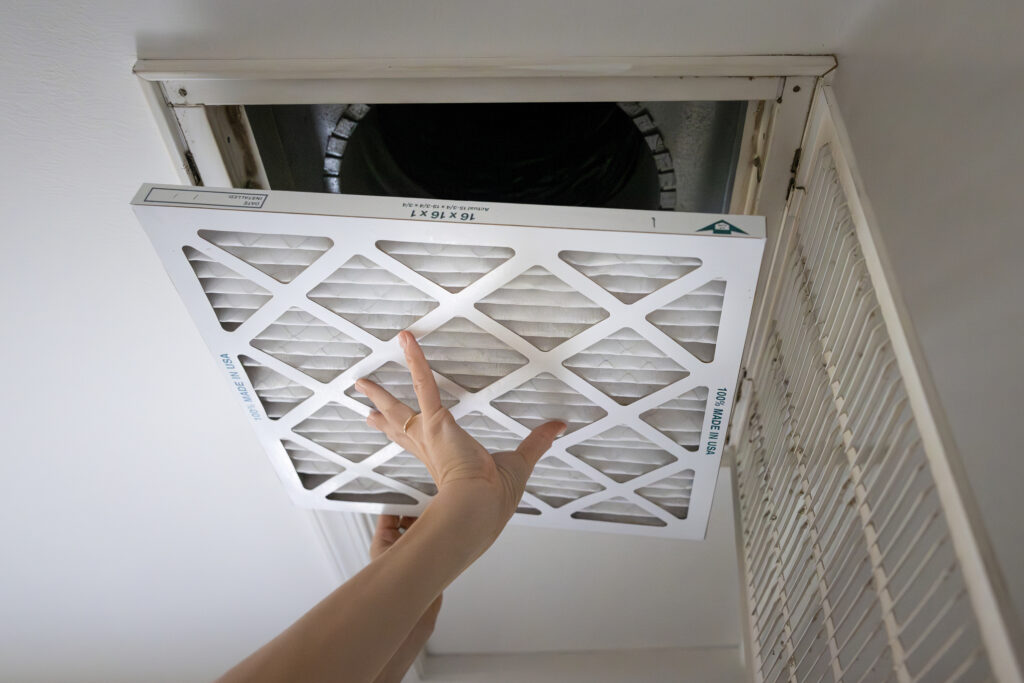
Frequently changing air filters is the best way to keep dust, allergens and other particles out of your home. With a newly installed system, or a system in a home you’ve just moved into, check your filter monthly to determine how quickly it gets dirty at different times of the year. Most filters should be replaced every two or three months.
To further reduce dust and other allergens throughout your home, the Asthma and Allergy Foundation of America recommends:
- Establishing regular cleaning routines.
- Keeping windows closed during peak pollen times or during times of high outdoor pollution.
- Removing strong scents like candles and avoiding harsh cleaners.
- Consider replacing carpet with solid-surface flooring.
- Washing bedding weekly.
If you have special concerns about mold
If you suspect mold, cleaning ducts won’t do much good. Mold always begins with moisture, and the ducts themselves are unlikely to be the source of the problem. The most likely culprits are the cooling system’s evaporator coils, which an HVAC contractor can inspect and maintain. Leaky return ducts can also introduce moisture.
When to consider using a duct cleaner
In general, consider duct cleaning only in response to specific identifiable problems. The EPA suggests doing it if there is visible evidence of:
- Substantial mold growth (but see above)
- Infestation of insects or rodents
- Substantial deposits of dust or debris (if registers were not sealed during a renovation project, for example, or if you’ve had a recent fire that spread smoke throughout your ductwork)
But the EPA also notes that hiring a duct cleaner to resolve one of these problems isn’t a permanent solution: “If any of the conditions above exists, it usually suggests one or more underlying causes. Prior to any cleaning, retrofitting, or replacing of your ducts, the cause or causes must be corrected or else the problem will likely recur.”
If you decide to have your ducts cleaned anyway, don’t hire a company that makes sweeping claims about health benefits or that it’s “EPA-certified” for duct cleaning. There’s no such certification.
Shop for a good price. Consumers’ Checkbook’s undercover shoppers collected price quotes from a handful of local companies for a straightforward duct-cleaning job, including equipment cleaning, and found huge company-to-company price differences: Quotes ranged from less than $300 to more than $750.
If you’re worried about specific contaminants (mold, dust), ask companies to inspect the job beforehand and to show you any contamination that would justify duct cleaning. Be very skeptical if a company issues dire warnings about mold, which is usually not found in ductwork.
Another red flag: companies that propose applying biocides to kill microorganisms. The EPA cautions against these chemicals. While some are approved for duct cleaning, the chemicals themselves can be irritants. Biocides should never be applied to fiberglass-lined ductwork.
Kevin Brasler is executive editor of Washington Consumers’ Checkbook and Checkbook.org, a nonprofit organization with a mission to help consumers get the best service and lowest prices. It is supported by consumers and takes no money from the service providers it evaluates.
The post You probably don’t need to have your HVAC ducts cleaned. Here’s why. appeared first on Washington Post.