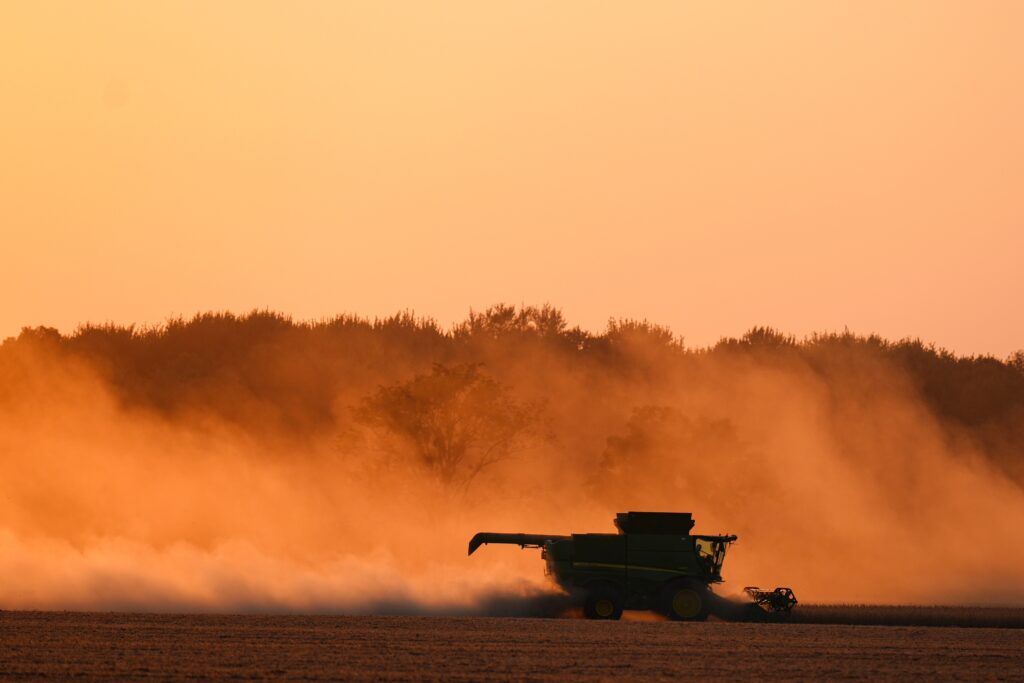
Mike Phillips has spent the past year reconciling his vote for Donald Trump with the uncertain future of his farm in central Iowa.
The 72-year-old has been farming for five decades and tills 2,000 acres of soybeans and corn. Trump’s tough talk on trade has always appealed to Phillips, who thinks China’s relationship with American farmers desperately needs a reset. He voted for Trump in each of the past three presidential elections. He believes in GOP farming policies because “we’ve been burned so bad by the Democrats.”
But the tariff war Trump started has been eating into Phillips’s bottom line and clouding his decisions about the best path forward. Thirteen months after Trump won a second term with wide support in farm-dependent parts of the country, Phillips wonders what will come first: Trump’s promised farm resurgence or his own retirement.
“For the most part, farmers — we’ve been willing to kind of go along. But I don’t know about now,” Phillips said. “I know [Trump is] a more practical person. He’s trying to do something. I’m not sure the tariffs were a good idea. I guess I still support him but hope he can get something done.”
Trump announced this month that he will use $11 billion to bail out farmers from “trade market disruptions and increased production costs that are still impacting farmers.” For farmers, trade groups and industry advocates, however, the bailout marked a tacit admission that a year’s worth of Trump policies have upended their industry and threatened their livelihoods. Still unclear is whether policies that have hurt farmers will also sour the relationship between the president and one of his most loyal and politically symbolic constituencies.
Trump won farm-dependent counties with an average of nearly 78 percent of the vote in 2024, according to Investigate Midwest. Discouraged by rising inflation during Joe Biden’s presidency, farmers hoped a second Trump term would usher in a more favorable climate, said Chad Hart, an agricultural economics professor at Iowa State University.
But Trump’s far-reaching tariffs on foreign imports — and reciprocal levies against some U.S. products — have blunted those hopes. Tariffs on countries including Canada and China, and on specific goods such as steel and aluminum, translated into rising costs for tractors, combines and fertilizer. Even more damaging for Phillips and farmers like him was the escalating trade war with China, a country American soybean producers have relied on to import the bulk of their crops. Reciprocal tariffs swelled well into the triple digits.
At the same time, Chinese leaders have worked to reduce their country’s reliance on American soybeans. China accounted for half — about $12.6 billion — of all U.S. soybean imports in 2024. In September, the country did not import American soybeans at all.
“For soybean farmers, market losses due to the ongoing trade conflict with China are only exacerbating financial problems,” Caleb Ragland, the president of the American Soybean Association, said during testimony before Congress in October. He pointed to estimates that soybean producers would lose $109 per acre on their crops this year. “It is likely that a quarter of U.S. soy production will need to find new customers.”
Aaron Lehman, a fifth-generation farmer who grows soybeans, corn, oats and hay in Iowa’s Polk County and heads the Iowa Farmers Union, said farmers have “a big dissatisfaction with how this has gone.”
“What we’re seeing right now is we’ve broken all of the trade structures without a real plan to put it back together in the right way,” Lehman said. “Farmers are willing to be a part of the solution, but I don’t think they’re willing just to be a pawn in a trade war that has no path or plan to get to true reform. That’s the disappointing part, because we’re not getting close to a fairer path.”
For some farmers, the White House aid package may come too late. About 181 farmers filed for bankruptcy protection in the first half of the year, The Washington Post reported in October, a 60 percent increase from 2024. It was the highest six-month reading since 2020, court records show. And some of the shifts may be permanent, Phillips and other soybean farmers fear. Chinese importers have strengthened relationships with crop competitors like Argentina, Uruguay, Russia and especially Brazil, the world’s largest exporter of soybeans.
“The hope for a quick turnaround is now gone,” said Hart, the economics professor. “If you’re holding out hope, that hope is now, at best, looking like it won’t come until a year to three years down the road.”
Sen. Chuck Grassley (R-Iowa) said farmers in his home state are experiencing a “not-so-perfect storm” of low grain prices, high input costs, industry consolidation and tariff uncertainty that mirrors the tumult of the 1980s, when more than 900 farmers killed themselves across six Midwestern states during what was dubbed the worst agricultural economic crisis since the Great Depression.
“It kind of crept up on us at that particular time,” he said. “And, Congress didn’t see it coming soon enough. Congress waited too long to act.”
During a roundtable announcing the package, Trump blamed the agricultural tumult on inflation linked to Biden — an assertion that industry leaders said is true. But Trump also said that “a small portion of the hundreds of billions of dollars we receive in tariffs” is helping to pay for the relief, a statement that many in the industry question.
Trump did not appear to be concerned about his standing with U.S. farmers.
“And, as you know, the farmers like me, because you know, based on — based on voting trends, you could call it voting trends or anything else, but they’re great people. They’re the backbone of our country,” Trump said.
He seemed confident that his supporters in agriculture would blame Biden, not him, for their woes.
“Biden turned that surplus into a gaping agricultural deficit that continues to this day, but we’re knocking it down,” Trump said. “It’s starting to go very good. In fact, China, as you know, is buying a tremendous amount of soybeans.” Trump did not say that China’s soybean imports have actually fallen.
The economic policies that have put farmers in dire straits have been bipartisan in nature, said Tom Adam, the president of the Iowa Soybean Association. Inflation ate into crop profits in the latter portion of Biden’s tenure and has continued, he said, but tariffs have tacked on additional harm.
“Expenses have been very high. Things just keep going up. Everything is getting higher, I don’t care if you’re buying groceries or buying fertilizers, and we just don’t have increasing crop prices,” he said. “We were pretty certain that there would be reciprocal tariffs when this happened. I think farmers support a lot of the things that Trump is doing on tariffs. But at the same time it’s getting pretty painful.”
Adam said the aid is helpful, but “it’s probably not going to be enough. It’s not going to make a farmer wealthy by any means. And there will be some farms that may not make it through. Everyone’s in a little different financial situation, but you can’t rescue everyone. I’ve heard from many that are saying this could be their last year. Whether it’s bankruptcy or whether they want to just try something else.”
Modern farms historically have relied on government assistance to stay afloat. The legislation Trump has called the One Big Beautiful Bill locked in more than $65 billion over 10 years in agricultural support programs. And during his first term, Trump released $16 billion in aid to farmers amid Chinese retaliation for tariffs. Corn and soybean advocacy groups have long pushed for policies that would force or encourage ethanol use in gasoline to increase demand for the two products.
Speaking from his farm on a blustery December day, a few months before another round of difficult decisions about how to eke out the most profit from his land, Phillips said he’s also trying to determine how much of the promised government relief might end up in his pockets — even though he knows it won’t be there for long.
“That money is not to the farmers. That money is going to go to their bankers or their machinery dealers or their chemical [fertilizer] companies to pay them,” he said.
He said he understands the infusion is meant as a bridge to a better day, but he would prefer smarter trade policies over a government handout.
“I’d just as well not get it — I believe in free markets working the way they should,” he said. “But I know there’s a lot of people out there that really need it.”
The post Trump’s farmer bailout caps tough year for loyal constituency appeared first on Washington Post.