President Trump has likened himself to a king, a dictator for a day and an emperor.
Now, during Christmas in Naples, he can be remade as one of the three wise men.
On Via San Gregorio Armeno, a street in the center of this ancient port city in southern Italy, shops have for generations sold meticulously crafted carvings of Nativity scenes — sometimes adorned with miniature statues of contemporary celebrities. For years, figures of Diego Maradona, the Argentine soccer star who played for the city’s leading team, have been perennial top sellers, as have statuettes of Silvio Berlusconi, the media tycoon and four-time Italian prime minister.
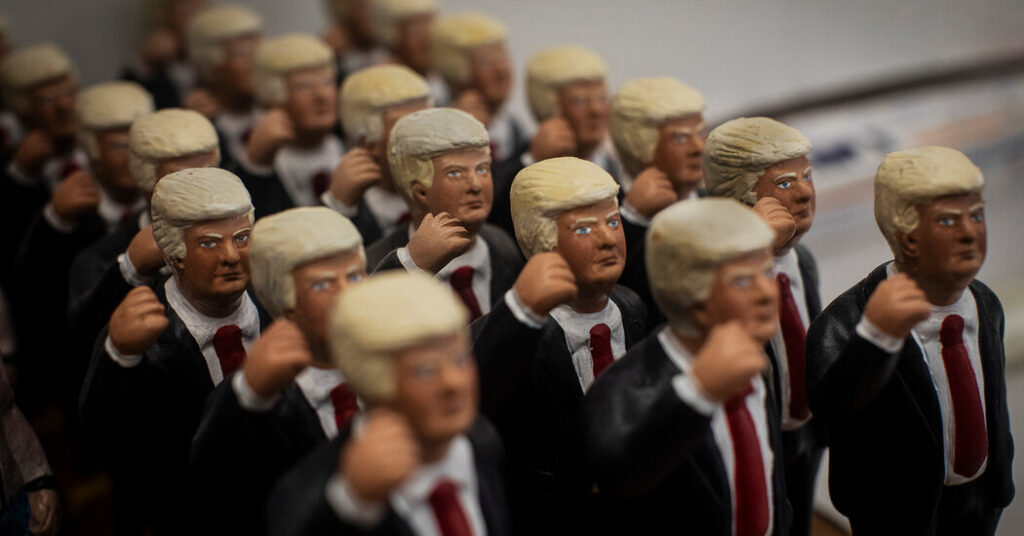
This Christmas, models of Mr. Trump are the new front-runners.
Mr. Trump “is very loved,” said Michele Buonincontro, who founded a studio and shop 32 years ago to make and sell the traditional Neapolitan Nativity scenes known as presepi. Three rows of Trump figures, wearing dark suits with red ties and crowned with bright yellow helmets of hair, stood on a table in a workshop at the back of Mr. Buonincontro’s shop.
Some of Mr. Buonincontro’s clients insert figurines of Mr. Trump into Nativity scenes as one of the three wise kings who brought gifts for the newborn Jesus, he said. “I am not saying he is a saint, but he is connected to religion, to religiosity,” Mr. Buonincontro added.
At Naples Cathedral, where an elaborate Nativity scene is set inside a chapel near the front of the church, the Rev. Federico Battaglia, secretary to the archbishop of Naples, said he saw no reason Mr. Trump wouldn’t fit in.
Jesus was born “under the Empire of Augustus,” said Father Battaglia, referring to the Roman emperor Caesar Augustus. If Jesus were born today, he added, it might be “under the Empire of Trump.”
“Augustus was the most powerful man of his time,” he said, “as Trump is of ours.”
Depending on who is recounting it, the Neapolitan tradition of ornate Nativity scenes dates back as early as the 16th century when Gaetano dei Conti di Thiene, a priest in Naples, is said to have invited locals to reinvent the custom of building dioramas commemorating the birth of Jesus. Instead of just including the biblical figures, artisans added prosaic miniatures of food merchants and denizens of local taverns or restaurants.
Bethlehem was transported to Naples, and tableaus of the holy family grew to include vegetable sellers, pizza makers, beggars and card players in traditional peasant dress.
By the 18th century, Neapolitan nobles had begun to commission ever more expansive scenes for their homes, with the presepi often growing to fill entire rooms. “It represents humanity, not only the holy family,” said Elisabetta Moro, a cultural anthropologist at the University of Naples and a co-author of “Il Presepe,” a history of the form. The Nativity scenes became like “ritual toys” that transcended time and place, with families adding figures of dead loved ones or local celebrities as a form of honoring them.
Lello Scuotto, whose family installed a large Nativity scene at the Basilica of Santa Maria della Sanità in Naples in 2021, said the presepi are a unique art form that shows that Neapolitans “have always been an anarchic people.” The Scuotto family version includes monsters, a werewolf, a naked woman, drunken barflies, a young Maradona — and a devil chained inside a cave.
Each year, the Scuotto family has pulled the devil farther out of its cave as a sign, Mr. Scuotto said, that major disruptions like the wars in Gaza and Ukraine are “the devil’s work.”
The deaths of celebrities often spur more sales of their statuettes on Via San Gregorio Armeno. On a recent day in Naples, the presepi makers said brisk sellers included figurines of Ornella Vanoni, a popular Italian singer who died in November at age 91, and Pino Daniele, a singer-songwriter who died in 2015. “He is dead, so that helps,” said Pina Gambardella, who with her husband runs a family store that sells nearly as many Trumps, Berlusconis, Maradonas and pop stars as it does baby Jesuses.
Pope Francis, who died in April, is still popular, said Elisabetta Grammatica, who helps her husband run Arte in Movimento De Maria, another presepi maker along the famous street. Figures of the last pope are so far more popular than models of the current pope, Leo XIV, Ms. Grammatica said. (Perhaps it doesn’t help that the replicas of the new pope barely resemble him.)
“People had more of a relationship, a closeness with Francis,” Ms. Grammatica said, but they “do not really talk about” Leo. She said customers frequently asked for statues of Mr. Trump. “Many Italians buy him,” she said. “They see him as high-level, very educated, very, very capable, it seems. They see someone whom they can learn from.”
Even detractors of Mr. Trump concede that his likeness is a best seller this year. Suana Pisano, a niece of Mr. Buonincontro who works in his workshop, said she did not like Mr. Trump for his “anti-feminist views.” But she gave an exaggerated shrug, saying “I have to paint him.”
The celebrity statuettes do not always end up in Nativity scenes. Dario Licci, who was in Naples on business on Wednesday, stopped by a stall to buy a small figurine of Queen Elizabeth II as a gag gift for his girlfriend, “to make fun of her because she acts like a princess.” (For his mother, he selected tiny figures of Mary, Joseph and the baby Jesus.)
Luciano Capuano, a fourth-generation presepi artist, said that he crafted models of celebrities only on special commission and that he could never insert a figurine of, say, Mr. Trump into the presepi itself.
“A Nativity scene is sacred art,” Mr. Capuano said as he glued strips of pressed cork together to form a cornice for a replica of the five-story palazzo where he lives and works. “Actors, politicians, presidents do not belong in it.”
Still, if requested, Mr. Capuano said, he would be honored to build both a stand-alone statuette of Mr. Trump — “I’ll make a masterpiece,” he said — and, separately, a special Nativity scene for Mr. Trump’s current home.
“Write in your article,” Mr. Capuano said, “that I would build a Nativity scene in the White House.”
Josephine de La Bruyère contributed reporting from Naples, Italy.
Motoko Rich is the Times bureau chief in Rome, where she covers Italy, the Vatican and Greece.
The post Wise Man? King? In Naples, Trump Joins Jesus in Nativity Displays. appeared first on New York Times.