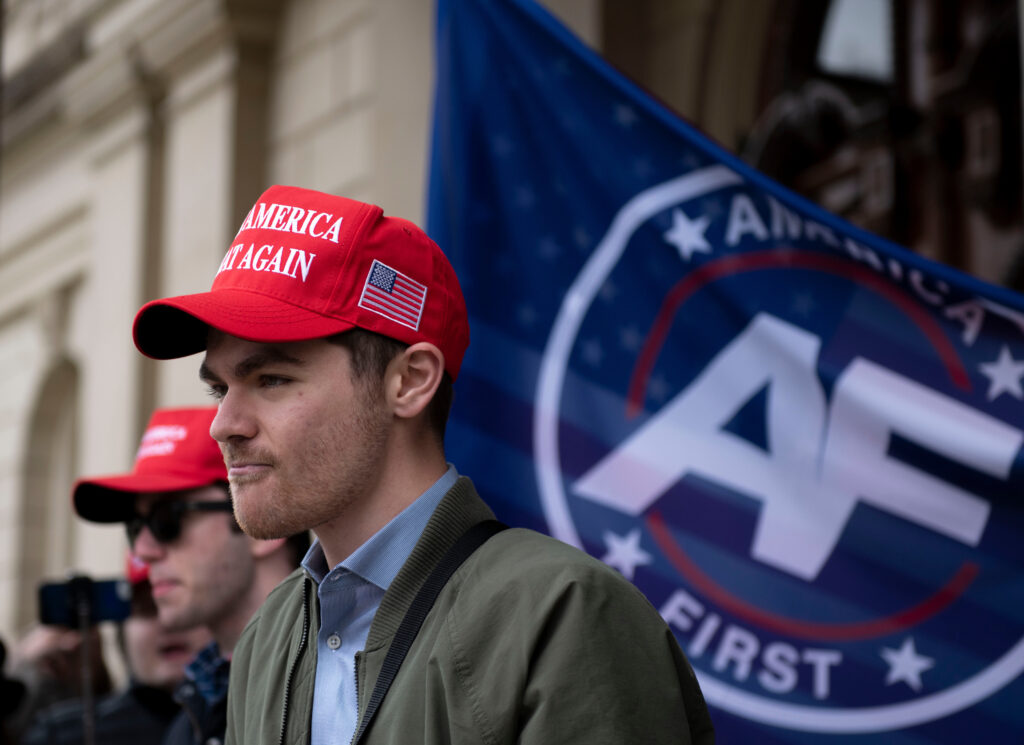
Robert P. George’s Dec. 7 op-ed, “There are valid debates among conservatives. This isn’t one.,” argued that conservatives should stop promoting “white supremacy, antisemitism, eugenics, the subjugation of women, and other forms of ideological extremism and bigotry.”
You know what this means. It means it’s too late. Telling conservatives to stop being bigots is admitting they’re bigots. And I’m pretty sure a professor of jurisprudence telling them to cut it out isn’t going to work. Hey, you guys — stop being bigots! Oh, okay.
I served in the Reagan and George W. Bush administrations and would like to believe conservatism wasn’t always thus, but I’m beginning to wonder. Was the virus from which today’s bigotry sprang lying dormant in us back then, like chickenpox leading to shingles? The moral herpes virus? Was it like a recessive gene long buried in our ancestral DNA that suddenly got switched on and has become dominant?
Are these new conservatives in fact our descendants? Were we always secretly like this but were pretending we weren’t? I’m hoping these new conservatives are mutants, but I’m not so sure about that anymore.
Bruce Carnes, Fairfax
The trillion-dollar question
The Dec. 10 editorial “The U.S. continues to underinvest in defense” argued that both the U.S. and NATO should raise their floor on military spending from 2 percent of gross domestic product to 5 percent of GDP.
Given that the Pentagon has failed seven audits in a row, on what basis does this 5 percent level exist? Why not 1 percent, or 8 percent? I have yet to see a discussion of whether 5 percent is based on a rigorous analysis of a minimum level needed to ensure security; how 5 percent reduces the risk of a war (if it in fact does); or whether this goal is chiefly set by careful military personnel or the defense industry. Remember, as GDP increases, military spending increases as well.
I fear what is happening with defense spending is what is happening with tipping. Despite prices continually rising, the suggested tip amount has gone from 10 to more than 20 percent, without explanation. Is this the future of defense spending?
Matthew Murguia, Kensington
The editorial on the Pentagon’s budget missed the mark. Spending is hitting $1 trillion for the first time. Hardly an “underinvestment.”
The Pentagon needs more spending discipline, not more spending — strong measures to reduce waste and price-gouging, canceling outmoded or dysfunctional weapons programs, and adopting a more restrained strategy that does not seek the ability to go to war anywhere in the world at any time. That approach would allow us to have a more effective defense at a much lower cost in taxpayer dollars.
William Hartung, New York
The writer, a senior research fellow at the Quincy Institute for Responsible Statecraft, is co-author of “The Trillion Dollar War Machine: How Runaway Military Spending Drives America Into Foreign Wars and Bankrupts Us at Home.”
Costco gets a sample of farmers’ pain
The Dec. 3 editorial “Costco’s lawsuit confirms who pays for tariffs” stated that “big business is now acting on what small businesses felt instantly: Tariffs are taxes on Americans.”
Indeed, tariffs often function like a hidden tax that falls disproportionately on small operations while large corporations have the resources to shift supply chains or negotiate better deals. The burden is not shared equally. In my community, many small-business owners and farmers have watched the price of essential inputs rise sharply. Equipment, fertilizer, steel and basic materials all cost more, while small operations’ ability to raise their own prices remains limited.
These are not simply economic inconveniences. They affect livelihoods, family stability and the dignity of people who work hard to keep local economies alive.
Nick Kormann, North East, Maryland
The Dec. 9 editorial “How to ‘solve’ a self-created trade mess” summed up the problem: President Donald Trump’s $12 billion aid package is not simply relief for farmers caught in a tense trade relationship with China. Federal tariff policy damaged the farm economy, and the government is sending money to cover the consequences.
The Agriculture Department will distribute the money through a new program designed to give the appearance of fresh policy, but the pattern is familiar. Trump rolled out a $12 billion bailout amid a China trade conflict in his first term. That effort expanded into billions more when the standoff dragged on. Agencies labeled those payments temporary. Farmers adapted to them because they had no choice.
These repeated interventions have created a new reality. Agriculture depends on federal support to a degree that resembles nationalization. Fortune recently reported that nearly three-quarters of this year’s growth in farm income came from government payments. As a farmer, I see producers planning their seasons around expected relief. Small farms will receive smaller checks that soften the immediate pressure but do not create long-term viability. Many of those operations will still lose acreage, herds and income. Consolidation will continue, and the landscape will tilt even further toward corporate dominance. News outlets will feature families who say the payment kept their farm open for another season. The quieter story will be the disappearance of operations that couldn’t withstand another year of instability.
Sean Carlton, Parkersburg, West Virginia
Following the Nov. 28 Optimist article “After a bitter past, woman donates kidney to her ex-husband’s wife,” Post Opinions wants to know: Have you encountered a remarkable act of forgiveness? Share your response, and it might be published in the letters to the editor section. wapo.st/forgiveness
The post As a conservative, I’m beginning to wonder: Are we the bad guys? appeared first on Washington Post.