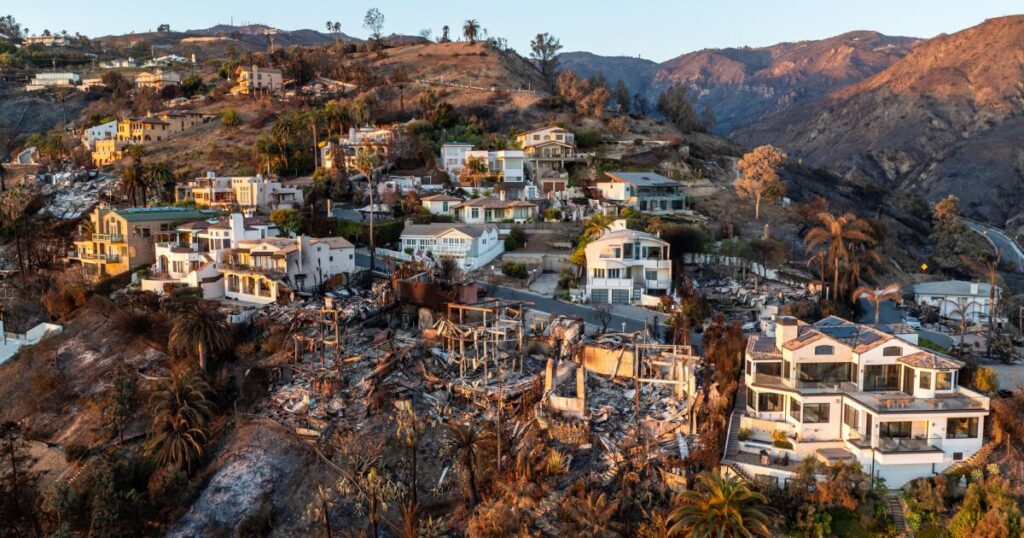
As the Eaton and Palisades fires rapidly jumped between tightly packed houses, the proactive steps some residents took to retrofit their homes with fire-resistant building materials and to clear flammable brush became a significant indicator of a home’s fate.
Early adopters who cleared vegetation and flammable materials within the first five feet of their houses’ walls — in line with draft rules for the state’s hotly debated “zone zero” regulations — fared better than those who didn’t, an on-the-ground investigation from the Insurance Institute for Business and Home Safety published Wednesday found.
Over a week in January, while the fires were still burning, the insurance team inspected more than 250 damaged, destroyed and unscathed homes in Altadena and Pacific Palisades.
On properties where the majority of zone zero land was covered in vegetation and flammable materials, the fires destroyed 27% of homes; On properties with less than a quarter of zone zero covered, only 9% were destroyed.
The Insurance Institute for Business and Home Safety, an independent research nonprofit funded by the insurance industry, performed similar investigations for Colorado’s 2012 Waldo Canyon fire, Hawaii’s 2023 Lahaina fire and California’s Tubbs, Camp and Woolsey fires of 2017 and 2018.
While a handful of recent studies have found homes with sparse vegetation in zone zero were more likely to survive fires, skeptics say it does not yet amount to a scientific consensus.
Travis Longcore, senior associate director and an adjunct professor at the UCLA Institute of the Environment and Sustainability, cautioned that the insurance nonprofit’s results are only exploratory: The team did not analyze whether other factors, such as the age of the homes, were influencing their zone zero analysis, and how the nonprofit characterizes zone zero for its report, he noted, does not exactly mirror California’s draft regulations.
Meanwhile, Michael Gollner, an associate professor of mechanical engineering at UC Berkeley who studies how wildfires destroy and damage homes, noted that the nonprofit’s sample does not perfectly represent the entire burn areas, since the group focused specifically on damaged properties and were constrained by the active firefight.
Nonetheless, the nonprofit’s findings help tie together growing evidence of zone zero’s effectiveness from tests in the lab — aimed at identifying the pathways fire can use to enter a home — with the real-world analyses of which measures protected homes in wildfires, Gollner said.
A recent study from Gollner looking at more than 47,000 structures in five major California fires (which did not include the Eaton and Palisades fires) found that of the properties that removed vegetation from zone zero, 37% survived, compared with 20% that did not.
Once a fire spills from the wildlands into an urban area, homes become the primary fuel. When a home catches fire, it increases the chance nearby homes burn, too. That is especially true when homes are tightly packed.
When looking at California Department of Forestry and Fire Protection data for the entirety of the two fires, the insurance team found that “hardened” homes in Altadena and the Palisades that had noncombustable roofs, fire-resistant siding, double-pane windows and closed eaves survived undamaged at least 66% of the time, if they were at least 20 feet away from other structures.
But when the distance was less than 10 feet, only 45% of the hardened homes escaped with no damage.
“The spacing between structures, it’s the most definitive way to differentiate what survives and what doesn’t,” said Roy Wright, president and chief executive of the Insurance Institute for Business and Home Safety. At the same time, said Wright, “it’s not feasible to change that.”
Looking at steps that residents are more likely to be able to take, the insurance nonprofit found that the best approach is for homeowners to apply however many home hardening and defensible space measures that they can. Each one can shave a few percentage points off the risk of a home burning, and combined, the effect can be significant.
As for zone zero, the insurance team found a number of examples of how vegetation and flammable materials near a home could aid the destruction of a property.
At one home, embers appeared to have ignited some hedges a few feet away from the structure. That heat was enough to shatter a single pane window, creating the perfect opportunity for embers to enter and burn the house from the inside out. It miraculously survived.
At others, embers from the blazes landed on trash and recycling bins close to the houses, sometimes burning holes through the plastic lids and igniting the material inside. In one instance, the fire in the bin spread to a nearby garage door, but the house was spared.
Wooden decks and fences were also common accomplices that helped embers ignite a structure.
California’s current zone zero draft regulations take some of those risks into account. They prohibit wooden fences within the first five feet of a home; the state’s zone zero committee is also considering whether to prohibit virtually all vegetation in the zone or to just limit it (regardless, well-maintained trees are allowed).
On the other hand, the draft regulations do not prohibit keeping trash bins in the zone, which the committee determined would be difficult to enforce. They also do not mandate homeowners replace wooden decks.
The controversy around the draft regulations center around the proposal to remove virtually all healthy vegetation, including shrubs and grasses, from the zone.
Critics argue that, given the financial burden zone zero would place on homeowners, the state should instead focus on measures with lower costs and a significant proven benefit.
“A focus on vegetation is misguided,” said David Lefkowith, president of the Mandeville Canyon Assn.
At its most recent zone zero meeting, the Board of Forestry and Fire Protection directed staff to further research the draft regulations’ affordability.
“As the Board and subcommittee consider which set of options best balance safety, urgency, and public feasibility, we are also shifting our focus to implementation and looking to state leaders to identify resources for delivering on this first-in-the-nation regulation,” Tony Andersen, executive officer of the board, said in a statement. “The need is urgent, but we also want to invest the time necessary to get this right.”
Home hardening and defensible space are just two of many strategies used to protect lives and property. The insurance team suspects that many of the close calls they studied in the field — homes that almost burned but didn’t — ultimately survived thanks to firefighters who stepped in. Wildfire experts also recommend programs to prevent ignitions in the first place and to manage wildlands to prevent intense spread of a fire that does ignite.
For Wright, the report is a reminder of the importance of community. The fate of any individual home is tied to that of those nearby — it takes a whole neighborhood hardening their homes and maintaining their lawns to reach herd immunity protection against fire’s contagious spread.
“When there is collective action, it changes the outcomes,” Wright said. “Wildfire is insidious. It doesn’t stop at the fence line.”
The post Early adopters of ‘zone zero’ fared better in L.A. County fires, insurance-backed investigation finds appeared first on Los Angeles Times.