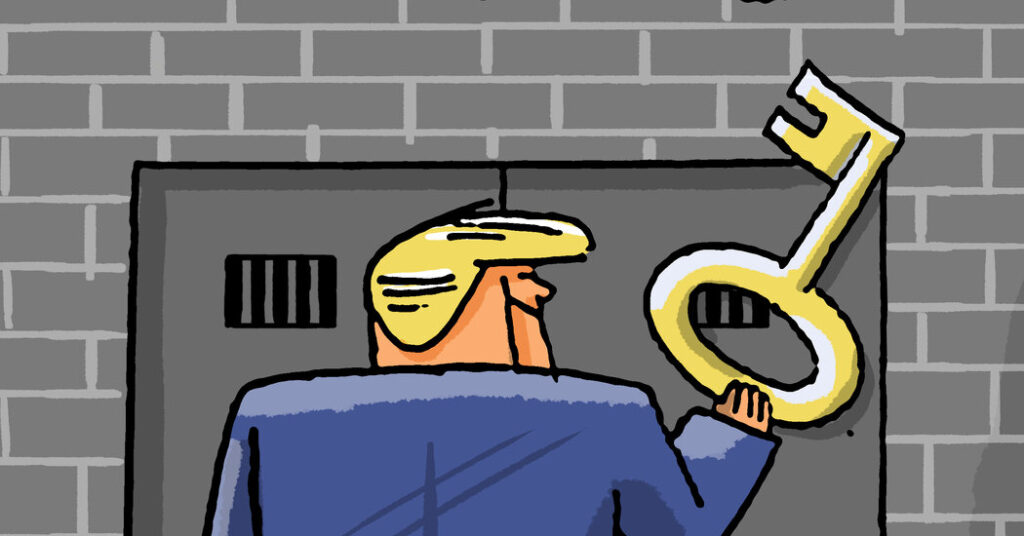
President Trump’s recent pardons of a disgraced foreign leader, a crypto king and several white-collar criminals are among the defining acts of the first year of his second term, and they all raise the same fundamental question: Why did these individuals, of all people, deserve pardons?
By modern standards, the Trump administration has been unusually opaque. It’s a mystery how the Trump family’s finances influence White House decisions. Outside advisers like Elon Musk and Jared Kushner come and go without revealing their personal stakes in the decisions they influence. But the final nature of pardon decisions make the stories behind them especially important.
The quiescent Republican majorities in the House and Senate have shown almost no inclination to examine the operations of the White House under Mr. Trump, but Democratic control of either body following the midterm elections would surely lead to greater scrutiny, including of pardons.
More than almost any other decisions, pardons tell us who and what really matters to presidents — and we all have an interest in finding out why. Yet, thanks to the Supreme Court’s decision in Trump v. United States, that information is likely to remain forever off limits to investigators.
Chief Justice John Roberts’s opinion for a 6-to-3 majority is best known for its determination that presidents may not be criminally prosecuted for “official” acts committed while in office. But the opinion goes a great deal farther. In a crucial footnote, the chief justice said that presidents cannot even be investigated for their exercise of official powers. A prosecutor may not “admit testimony or private records of the president or his advisers probing the official act itself,” the opinion states. “Allowing that sort of evidence would invite the jury to inspect the president’s motivations for his official actions and to second-guess their propriety.” Pardons are certainly “official actions,” as they are specifically authorized as a presidential power in Article II of the Constitution.
The Trump decision is premised on the idea that presidents need the freedom to deliberate with their advisers without worrying that those consultations will ever become public. That’s a dubious rationale, which seals off too much important information from scrutiny, but it’s why the Trump precedent, which addresses what information may be obtained in a grand jury investigation, would apply to congressional inquiries as well.
The need for some outside examination of the president’s deliberations is demonstrated by Mr. Trump’s pardon this week of Juan Orlando Hernández, a former president of Honduras, who was released just months into his 45-year federal prison sentence. Mr. Trump pardoned him following his conviction for engaging in a conspiracy to protect drug traffickers in his country and to import more than 400 tons of cocaine into the United States. Why pardon Mr. Hernández when the president is now threatening military action to overthrow Nicolás Maduro, the president of Venezuela — and blowing suspected drug smugglers out of the ocean — for the same crimes?
Do the career prosecutors who tried the case believe that it was a “Biden setup” as Mr. Trump said it was? Is this pardon consistent with American national security and diplomatic interests? What did the State Department advise? Does freeing a major narcotics trafficker enhance public safety in the United States? Does the Justice Department agree with Mr. Trump’s claim that the case should never have been brought? Answering those questions would not implicate any legitimate interests of the executive branch.
The president’s pardon power is an aberration in our constitutional system of checks and balances; neither Congress nor the courts may overrule or interfere with this executive prerogative. Still, there is a rich history of congressional oversight of “the president’s motivations for his official actions” when it comes to pardons. In 1974, a House subcommittee investigated Gerald Ford’s pardon of Richard Nixon, and Mr. Ford chose to become the first sitting president to provide sworn testimony in a congressional proceeding. He also answered the questions of the members of the subcommittee.
In 2001, both House and Senate committees investigated Bill Clinton’s pardon of the fugitive financier Marc Rich. Mr. Clinton did not testify, but he waived any objections to his aides responding to the committees’ inquiries. As with most congressional investigations, these pardon inquiries did not produce definitive answers, but they at least gave the issues the public airing that they deserved.
Notably, the focus of these previous congressional investigations was not whether the presidents had the right to grant the pardons — that was undisputed — but whether the pardons were part of a deal or a quid pro quo. In other words, both the 1974 and 2001 investigations consisted almost entirely of “testimony or private records of the president or his advisers probing the official act itself,” and that is what the Supreme Court says a grand jury, and presumably Congress, can no longer examine. (The quid pro quo question also arises with the president’s just-announced plan to pardon Henry Cuellar, a conservative Democratic congressman who was awaiting trial for bribery. Was this pardon a gesture of mercy — or a deal in exchange for support from a closely divided House of Representatives?)
It’s not just the Hernández pardon that cries out for greater public scrutiny. Mr. Trump pardoned Changpeng Zhao, the billionaire founder of the crypto firm Binance, who pleaded guilty to money laundering. Mr. Trump also pardoned Ross Ulbricht, the founder of the dark-web narcotics marketplace Silk Road, who was serving a life sentence for narcotics conspiracy and money laundering. Both Mr. Zhao and Mr. Ulbricht are leading figures in the crypto world, where the Trump family now has major investments and stands to benefit from the normalization of crypto misconduct. Who lobbied for the pardons of these two men — and why did Mr. Trump grant them? Who stands to benefit beyond the pardon recipients themselves?
For decades, the Department of Justice has issued guidelines for applicants for clemency. (That comes in two forms: A pardon wipes away all legal effects of a conviction; a commutation simply allows a recipient to leave prison.) The basic requirements are that applicants are supposed to complete their sentences, wait five years to apply, show “acceptance of responsibility” and maintain “good conduct.” Presidents are not obliged to follow these rules — President Biden did not, for example, when he pardoned his son, Hunter — but Mr. Trump has ignored both their letter and spirit.
He has granted clemency to more than a dozen major white-collar criminals, none of whom finished their sentences or accepted responsibility for their criminal conduct. He issued a commutation to a former investment manager, David Gentile, who was days into a seven-year sentence for scheming to defraud around 10,000 investors, and pardoned Paul Walczak, a nursing home executive who was sentenced to 18 months and ordered to pay nearly $4.4 million in restitution for tax crimes. Mr. Trump granted Mr. Walczak’s pardon three weeks after his mother, a major contributor to Republican candidates, attended a $1 million-per-person fund-raising dinner at Mar-a-Lago. The pardon also wiped out the order for Mr. Walczak to make restitution. According to a report issued in June by the Democratic staff of the House Judiciary Committee, Mr. Trump’s pardons at that point had already deprived victims of approximately $1.3 billion in restitution and fines owed to them.
A Congress that was even modestly attentive to the rule of law would surely want to know the circumstances surrounding these, and other, grants of clemency as well as their aftermath. (Recipients of Mr. Trump’s most notorious pardons, to the roughly 1,600 rioters at the Capitol on Jan. 6, 2021, have since been accused or convicted of such crimes as sexual assault, sexual abuse of a child, killing someone while driving under the influence and home invasion, among many others.) Faced with inquiries from congressional investigators about anything relating to pardons, the Trump administration can be expected to cite the language in the Trump case and ask the courts, including the Supreme Court, to approve its refusal to comply.
In a way, this would not be so different from what happened in the last two years of Mr. Trump’s first term, when a Democratic House sought to engage in genuine oversight by subpoenaing White House aides. Trump lawyers fought these subpoenas in court, drawing out the process until Mr. Trump’s term ended, even though House investigators won the most important of the cases that were resolved.
The president’s lawyers can be expected to challenge the attempts at oversight once again, about pardons and everything else, but this time the law will be on their side.
The Times is committed to publishing a diversity of letters to the editor. We’d like to hear what you think about this or any of our articles. Here are some tips. And here’s our email: [email protected].
Follow the New York Times Opinion section on Facebook, Instagram, TikTok, Bluesky, WhatsApp and Threads.
The post What We’ll Never Know About the Trump Pardons appeared first on New York Times.