One gray evening in September, a crowd of Syrians — many displaced, exiled or self-exiled — packed into a hotel ballroom in New York City to listen to the man who now governs the country many of us fled. Ahmed al-Shara, the former leader of Hayat Tahrir al-Sham, had come to address the diaspora.
The crowd cheered as he entered. “You are the liberator!” someone called out. Another added blessings, and applause went on so long that someone finally yelled at the crowd to stop.
Onstage, Mr. al-Shara started with familiar talking points about foreign proxies and the need to love Syria as it recovers from its long, dark past. Applause swallowed the end of many of his sentences. At one point, visibly embarrassed, he raised his hand and said, “Please, enough.” It felt less like a political meeting than the encore of a beloved singer.
When the floor opened for questions, I expected to hear people ask about the massacre of Alawite civilians, the Israeli attacks on the southern border or other events that had shaken the country since the ouster of Bashar al-Assad, Syria’s dictator. Instead, a man asked the interim president to establish a direct line to wealthy Syrian investors abroad. Another urged him to cancel the upcoming parliamentary elections and handpick the members of Parliament himself, because he was the only one who could be trusted. Heads nodded. People clapped.
Syrians finally have a chance to redefine our relationship to power, to imagine a presidency that isn’t a throne. But inside that ballroom were reflexes that felt instantly familiar. I’ve watched them play out in Syria this year, too — that urge to pledge loyalty to power, to celebrate the one who wields it. I found myself asking the same question that night that I’ve asked myself repeatedly for months: Why do Syrians keep returning to the patterns of dictatorship we bled to escape?
Mr. al-Assad’s fall one year ago came after 54 years of al-Assad family rule. His father, Hafez al-Assad, who rose to power in a coup, had built a dynasty so entrenched that many assumed it would outlive all of us — and it did outlive many of us. For more than a decade after the mass uprising against the regime in 2011, Mr. al-Assad crushed attempts at dissent with mass detention, aerial bombardment, chemical attacks and the destruction of entire cities. Not only had he stayed in power, he also had been drifting toward rehabilitation. But then his allies, particularly Russia, reshuffled their priorities. And when H.T.S., by then one of the last armed factions still standing after years of civil war, made its big push last December, nobody pushed back.
I had every reason to be skeptical about what came next. I know the history of H.T.S., a former Qaeda affiliate. I had reported from areas under their control. The group detained, tortured and executed civilians. It silenced people even Mr. al-Assad’s security services had failed to contain. To me, H.T.S. was one of the forces that ultimately crushed what remained of the 2011 uprising.
But last winter, as I watched videos of families wander through abandoned offices searching for traces of their sons and brothers, and saw the living proof of Mr. al-Assad’s war crimes walk blinking into the daylight, I pushed my skepticism aside. Whoever had finally caused Mr. al-Assad’s departure — if it had been the devil himself — surely deserved a chance. Anyone who was not Mr. al-Assad would be an improvement.
For a time, Syria — for those of us who, like me, had only ever known it as a police state — became almost unrecognizable. Friends recounted conversations that had once been whispered, which were suddenly being spoken aloud. Journalists and foreign researchers had new, fragile freedoms. Exiled human rights and civil society groups returned, hosting workshops and having arguments about the futures they wanted.
People who had thought they’d only ever see Syria again in their nightmares came back to find that life had moved on without them. They wept at their mothers’ graves; they met nephews and nieces who were now adults. Everything felt so untethered from reality that people coined the phrase “afternoon dreams” to describe that period.
But after the initial high, reality crept back in. It became clear that the future of the country wouldn’t depend solely on who was now in charge. Removing a ruler was one thing; unlearning the habits of half a century was something else entirely.
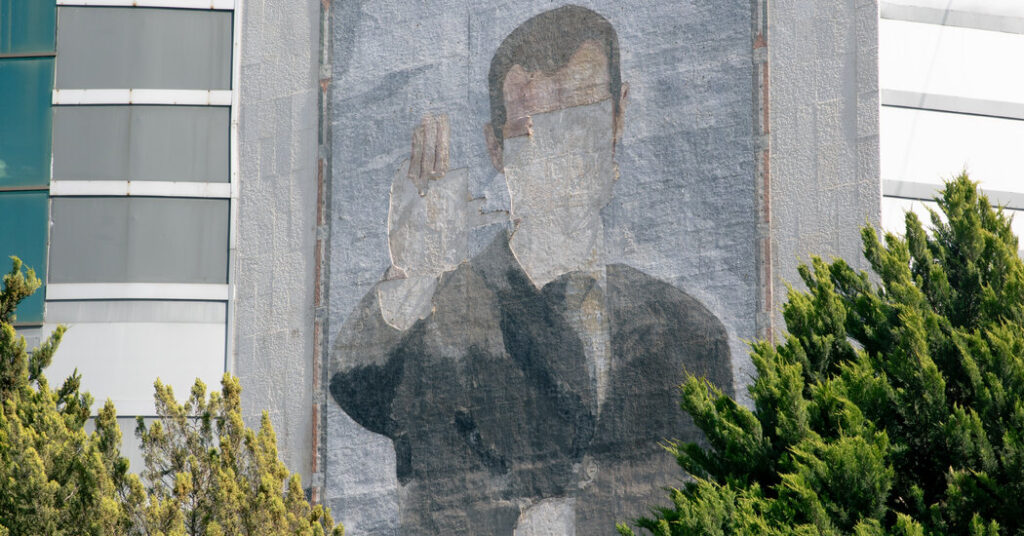
Videos circulated online of storefronts, car windshields and school gates covered in posters of Mr. al-Shara. People and places that had known nothing but authoritarianism for five decades were reflexively attaching themselves to power’s new embodiment.
That reflex also surfaced in a different way among some who had suffered under Mr. al-Assad. Within a month of his fall, unverified videos circulated that appeared to show fighters loyal to the new government humiliating captured soldiers from Mr. al-Assad’s government forces, whom Mr. al-Shara had promised amnesty. They forced them to kneel and bark — to endure the same small, deliberate cruelties that had once defined Mr. al-Assad’s security branches.
Then, in early March, violence erupted in the Alawite-majority coastal region after armed loyalists of Mr. al-Assad ambushed security forces aligned with the interim government. In the aftermath, forces loyal to the new government carried out collective punishment that presumed guilt by sect: combing through homes, accusing Alawite men of being regime loyalists or collaborators and executing some on their doorsteps while their mothers begged at the fighters’ feet. Hundreds of civilians were killed, according to war monitors, in violence Syrians had long associated with the regime’s worst massacres, now re-enacted by those who had overthrown it.
In response, many of the newly returned civil society organizations found themselves doing what they had done from afar for years: documenting violence and pushing for accountability. Even when Mr. al-Shara acknowledged that “many violations occurred,” some journalists — many of whom had begun their careers documenting Mr. al-Assad’s atrocities — followed another familiar script: They insisted the killings were Western fabrications meant to discredit the president, using lines that could have been copied from the Assad playbook. It was as though the regime’s tools had seeped into the minds of people who had once been on the receiving end of its propaganda. Perhaps repeating its talking points from the inside felt like a kind of victory.
About a week after the killings on the coast, the interim government marked the 14th anniversary of the first spark of the 2011 uprising with public celebrations. I watched the videos that circulated of crowds gathering in squares, singing and waving flags, and felt the discomfort of a familiar, unbearable dissonance. Families would have just finished burying their dead — in quiet, hurried funerals held at dawn, in fear that acknowledging one death might provoke another. Watching crowds celebrate recalled the pro-Assad rallies in Damascus held as so many other regions counted their dead.
No doubt, Syria is in a different and better place now than it was one year ago. Mr. al-Shara is eager to rehabilitate the country on the international stage. His government has welcomed back independent aid and human rights groups, and opened the doors to foreign journalists for the first time in years. But these meaningful shifts coexist with failures. A new oligarchy is already clustering around the presidency. Former militia figures, some of whom have been sanctioned for human rights abuses, have been empowered.
So what would it really take to regrow a country? As I left the event in New York in September, I felt heavy and disoriented. Then something clicked. It is easy to imagine that the fall of a dictator is enough to bring a new dawn. After years of war and violence, Syrians crave a normal life so fiercely that almost any alternative to Mr. al-Assad feels like salvation.
But that longing is where illusion begins. There is much more work to be done. Syria deserves an accounting that judges it based on what it could become rather than what it has merely ceased to be. Mr. al-Assad is gone, but the obedience and opportunism, the reflexes, the fears, the worship of a single strong leader — the survival tools of his regime — remain ingrained in the muscle memory of an entire population.
Loubna Mrie is a Syrian journalist and the author of the forthcoming “Defiance: A Memoir of Awakening, Rebellion and Survival in Syria.”
The Times is committed to publishing a diversity of letters to the editor. We’d like to hear what you think about this or any of our articles. Here are some tips. And here’s our email: [email protected].
Follow the New York Times Opinion section on Facebook, Instagram, TikTok, Bluesky, WhatsApp and Threads.
The post Anyone but Assad appeared first on New York Times.