Meetings of the Doña Ana County Board of Commissioners in New Mexico are typically snoozy and sparsely attended, with a handful of spectators in a nondescript room seated on black plastic chairs. But not on Sept. 19. That session was packed with about 200 onlookers and began with the county attorney delivering a warning from the dais. No booing, no shouting, no standing. Break these rules and you will be asked to leave.
“Failure to leave,” the attorney concluded, with a don’t-try-me stare, “is a criminal offense.”
With the specter of arrest in the air, and a cadre of police officers on hand, Lanham Napier, the star of this event, walked to a microphone in complete silence. He wore a dark blue suit and cowboy boots and introduced himself as the chief executive of BorderPlex Digital Assets, a data center marketer in Austin, Texas.
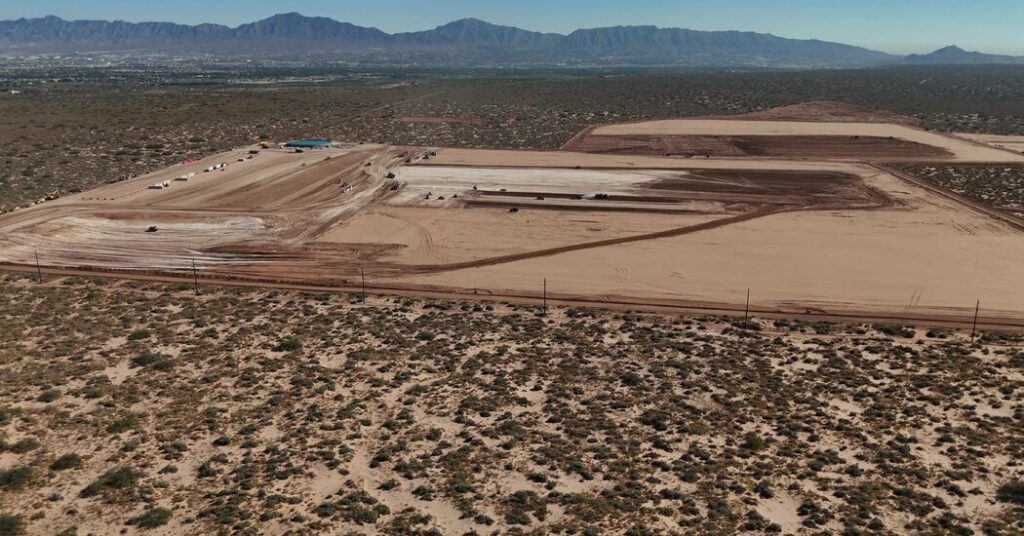
The company had come to get approval for a venture so ambitious it sounded like the fever dream of a modern pharaoh. On roughly 1,400 acres of flat and vacant scrubland near the Mexican border, BorderPlex and its partner, Stack Infrastructure, a data center builder, wanted to build a collection of data centers that would cost $165 billion. The number seemed berserk. The entire U.S. Interstate Highway System cost less than half as much in inflation-adjusted dollars. Even the International Space Station, underwritten by more than a dozen countries, was a bargain by comparison. (It was $150 billion.)
Where this epic sum of money would come from, Mr. Napier did not say, other than briefly noting that the source would be “private.” Nor was there mention of which companies would actually rent the servers and semiconductors of Project Jupiter, as the venture is called. It had to be one of a handful of big artificial intelligence giants now ravenous for computing power. But which, if any, had committed to the project was unknown.
Before this meeting, some state and local politicians had eagerly embraced BorderPlex. County civil servants had negotiated with the company under a nondisclosure agreement that kept the whole enterprise a secret, leaving even Doña Ana’s commissioners in the dark.
The colossal endeavor was unveiled a mere three weeks before this Sept. 19 meeting, and it was detailed in a 500-page proposal that was both dense and incomplete. Many of the pages were marked “draft.” Others were missing. Jupiter would sprawl across a desert, near a town of 15,000, and there were plenty of unanswered questions about water, about electricity, about noise and pollution.
During his 10-minute presentation, Mr. Napier nodded at those concerns, but he emphasized the financial rewards he would shower on the county. There’d be 2,500 construction jobs for starters, and over the next 30 years, a total of about $360 million would flow into Doña Ana’s coffers.
In exchange, as critics would point out, the company would get the mother of all tax breaks. No property taxes and no taxes on equipment purchased to build the data centers, like servers and networking gear.
“This is a generational opportunity,” Mr. Napier said as he was wrapping up. “It is here today.” Which was to say, it would be gone tomorrow. BorderPlex would find a more accommodating place for its largess. In case anyone missed the point, he explained it: “A vote to delay is a vote ‘no.’”
A “no” vote was exactly what many spectators wanted. A parade of them were given three minutes apiece to talk at the microphone, and more than a few vented. The deal was a giveaway, they said. Others noted that no one had performed an environmental impact study. A few years ago, dangerously high levels of arsenic were found in the water where the data centers would be built. Would that fiasco recur? Commissioner Susana Chaparro, the lone skeptic on the commissioners’ semicircle dais, made a plea for time.
“I’m not against your project, or for your project,” she said, addressing Mr. Napier. “I just need more information.”
None was coming. The seven-hour meeting ended with a 4-to-1 voice vote to approve Project Jupiter.
Billion or Bust
It has become a truism that the United States no longer builds much of anything on a grand scale, but one category is a spectacular exception. The country is in the midst of a data center building frenzy. Four companies — Alphabet, Amazon, Meta and Microsoft — are expected to spend hundreds of billions of dollars on A.I.-related expenditures, like chips and servers, this year alone. Seven trillion more, McKinsey predicts, will be needed in the next five years.
Naysayers contend that the astounding outlays are inflating a bubble that will end with a calamitous pop. Once that happens, they predict, the country will be covered with a lot of empty buildings, perfect for laser tag and not much else.
For the growing number of people now living near data centers, there are more immediate worries. Many face rising electric bills, strained supplies of water and lots of noise. That has caused a backlash; some $64 billion in data center deals were blocked or delayed by local opponents in the 12 months after May 2024, according to Data Center Watch, a research firm.
So the industry is looking for friendlier destinations, and those tend to have smaller populations and be more economically challenged.
“Some of these tertiary markets offer much more of a welcome,” said Dan Diorio of the Data Center Coalition, a trade association. “I think of Meta in Louisiana, Amazon Web Services in Mississippi, development happening in the state of Indiana. Previously, some of these places would not have been competing for data centers.”
Doña Ana is a poor county in a poor state. The populace is mostly Latino, and the median household income of $56,000 is well below the national average. Once Jupiter is built, BorderPlex and Stack intend to staff it with 750 locals in jobs that start at $75,000. To skeptics, the size of this promised work force sounds implausibly large, given that data centers are basically high-tech warehouses, with few moving parts, that don’t require much labor. Supporters, by contrast, regard Project Jupiter as an immense and blinking “Open for Business” billboard for New Mexico.
“Once one project comes,” said Denisse Carter, the head of economic development for Doña Ana County, “others follow.”
Given its profile, surprisingly little is known about Project Jupiter. The contract between the county and the project’s partners is available only through an Inspection of Public Records Act request. A week after this reporter asked for a copy of the contract, an email arrived from the Doña Ana County records office deeming the request “excessively burdensome.” Expect a response by mid-January, the email said.
BorderPlex, too, is a bit of a mystery. The company’s website does not have a list of employees. There’s no mention of any previous ventures by the company, on the website or in the media. Jupiter appears to be BorderPlex’s debut. The Austin address listed on its filings with the Securities and Exchange Commission — it was incorporated in Delaware last year — is a WeWork space.
The company’s website once had a “leadership” section, according to a story by El Paso News. Among those listed was Alicia J. Keyes, a former New Mexico cabinet secretary of economic development, who was appointed by Gov. Michelle Lujan Grisham. Another was George Prescott Bush, the son of the former Florida Gov. Jeb Bush. Neither returned requests for comment.
The leadership page is now gone.
Having spoken at a handful of public events, Mr. Napier is now keeping mum. He did not acknowledge emails, calls or texts for comment sent over the course of a week. After a reporter visited the WeWork address — no one from the company was there — an email from BorderPlex said the company had nothing to say “at this time.”
Mr. Napier has not been so reticent in the past. In 2019, he published an autobiographical book, “Billion or Bust!” It’s an account of his tenure at Rackspace, a web hosting and cloud services company in San Antonio, which went public eight years after he joined as chief financial officer.
So, billion! Not bust.
In 2020, he and his wife were featured in the Real Estate section of The New York Times showcasing a stylish and spacious home filled with contemporary art, including a sculpture by Tony Cragg that is so heavy the floor had to be reinforced. A specially designed panel that could hide a whiteboard had been installed in the dining room.
“It’s invisible, until you yank on the handle,” Mr. Napier told The Times. “And then out comes this mammoth Lanham-world dream.”
Mr. Napier seems to have shown up in New Mexico with little more than another mammoth Lanham-world dream. He is a familiar archetype, the deal-making middleman, in a relatively new field. At least a dozen such executives are now crisscrossing the country, says Paul Kedrosky, a fellow at the MIT Initiative on the Digital Economy.
They are buying land with access to energy and fiber optics. They are beckoning to A.I. companies in need of digital horsepower. And they are pitching states and towns on the idea that data centers offer a seat aboard the A.I. financial rocket ship.
It’s a wing-it, boom-time market where you sell first and find buyers later, and everything is supposed to happen at a frantic speed and on a gargantuan scale. Project Jupiter is not necessarily a $165 billion endeavor. That’s a best-case scenario for a multiphase build-out, contingent on demand. (Phase 1 will cost $50 billion.) But $165 billion! That’s an eye-catching number. It has put both Mr. Napier and Doña Ana County on the map.
“It’s a very speculative real estate game, but it’s sold as a no-brainer for municipalities desperate to land the next big industrial project,” Mr. Kedrosky said. “And right now, there’s this sense among economic development officials that by building a data center you’re joining the future. If you’ve been trying to land a Hyundai plant for years, a pitch like Jupiter will seem irresistible.”
The data center surge combines two elements beloved by American speculators over the centuries, Mr. Kedrosky added. Real estate and technology.
“One of those things is behind every bubble in U.S. history,” he said. “It just so happens that this time we’ve got both.”
The Power Plant Surprise
County officials first learned about BorderPlex in November of last year. Ms. Keyes, the former cabinet secretary, arranged for Stephen Lopez, then Doña Ana’s interim county manager, to meet with someone whom she didn’t name. Anonymity is pretty common in the opening steps of an economic development dance.
The guy had lots of questions, Mr. Lopez, who is now the assistant county manager, recalled in an interview. How long would it take to get building permits? In 2023, the state had sued a local water utility for failing to notify residents about those high levels of arsenic. Where did that stand?
Apparently, the man liked the answers. After 45 minutes of talking, he handed over his business card with a name: Lanham Napier.
“That was a good sign,” Mr. Lopez said. “Sometimes they don’t give you business cards.”
During negotiations, which went on for months, Mr. Napier signed a memorandum of understanding with Governor Lujan Grisham to build a scaled-back, $5 billion version of what would become Project Jupiter. Then, less than a month after the governor’s February announcement, supporters of the project in the State Legislature handed it a coup. A bill to modernize the public electrical grid had whizzed through the State House with bipartisan support. Then, on March 20, during the two-day rush at the end of the legislative session, State Senator Michael Padilla, a Democrat, introduced an amendment.
It allowed BorderPlex, and any other company, to build its own power plant, called a microgrid. Moreover, it exempted microgrids from the state’s Energy Transition Act, which mandates a shift to zero-carbon electricity for investor-owned utilities by 2045 — so long as BorderPlex does not sell any power to, say, other utilities. (Data centers consume a huge amount of energy; BorderPlex says its planned microgrid will use natural gas-fired turbines to produce between 700 and 900 megawatts of electricity, enough to power as many as 800,000 homes.)
“The amendment is intentionally deceptive — I have no problem calling it that,” said Stephen Fischmann, a former chair of the New Mexico Public Regulation Commission, an independent state agency that regulates public utilities. A vocal opponent of Jupiter, he said the amendment effectively eviscerates the Energy Transition Act. Microgrids are already being planned for other data centers in New Mexico, enough to generate more power than the state currently uses.
“Once a little more than half of the electricity generated here is exempt from the E.T.A.,” Mr. Fischmann said, “the E.T.A. is meaningless.”
In a phone interview, Mr. Padilla said he wasn’t trying to snooker anyone when he wrote the amendment. If BorderPlex ever wants to sell its excess power, it will have to comply with the clean energy law, he noted. He also acknowledged, with some pride, that the bill had helped to make New Mexico more appealing to the industry.
“We have four or five major data center projects now looking at the state as a result of what we did this year,” he said.
‘You Can’t Drink Data’
The Project Jupiter site is an hour’s drive south of Las Cruces, on a swath of land that in mid-October was unmarked but for a dirt road. Pickup trucks were parked nearby, along with a towing vehicle with “Oversized Load” written on the back. A man in a lime green safety vest said ground had been broken a few hours before.
The new data centers will be built near a vast archipelago of industrial parks and factories and a terminal of the Union Pacific Railroad. There’s a duty-free gift shop not far from the border crossing a few miles away, and just over the fence, on the Mexico side, is a huge Foxconn plant.
Doña Ana County will forgo property tax revenue from Project Jupiter, accepting something called a payment in lieu of taxes instead. How large will those payments be? After negotiations with the county’s economic development team, the payment was set at $12 million a year. If the project lasts for all 30 years of its projected life, that would amount to $360 million.
These details, and the many unknowns about the project, are a special concern of Sunland Park, a city of 15,000 a few miles from the construction site in Santa Teresa. Its Residents have been the loudest opponents of the plan. Two days after construction began, about 40 of them gathered to form a protest organization.
The meeting was held in an empty storefront in a strip mall. There were snacks on a foldout plastic table, Mexican artwork on the wall and a large screen on the side of the room, where online participants from around the state could participate.
A woman named Vivian Fuller led the discussion, passing around a microphone. One of the first orders of business was picking a name.
“Shout it out,” she said.
There was a pause.
“Project Jupiter Makes Us Stupider,” someone suggested online.
“You Can’t Drink Data,” said someone else.
The naming was shelved for another day. What followed was a debate about how to challenge a project with vast resources and powerful friends. Ms. Fuller is a plaintiff in a lawsuit led by the New Mexico Environmental Law Center against the Doña Ana County Board of Commissioners, claiming the financial mechanism for funding Project Jupiter was unlawfully approved. But construction has already begun. Calling this nascent campaign of meetings and litigation quixotic seems an understatement.
Later, Ms. Fuller said she and everyone else in that room were more than a little scarred by the arsenic episode of 2023. Locals had complained about the taste, smell and brownish hue of the water for a long time, but only when faucets produced something that looked like slime did local officials start handing out bottled water. The incident is part of a long legacy of mistrust.
“We’ve been fighting for clean, safe drinking water for a long time,” said Ms. Fuller, who works for the Empowerment Congress, a nonprofit activist group. “To have this humongous data center come in now — it’s awful.”
On one level, Project Jupiter is a ground-level, object lesson in the art of A.I.-related salesmanship and hype. It was only after BorderPlex and Stack won the commissioners’ approval on Sept. 19 that OpenAI and Oracle publicly committed to the project. A joint news release on Sept. 23 suggested that Oracle would lease Project Jupiter and that OpenAI would be the ultimate end user. (Neither company returned calls for comment. The Times has sued OpenAI for copyright infringement related to news content. The company has denied the suit’s claims.)
As for funding, that came even later. Bloomberg reported in early November that a consortium of 20 banks, including Goldman Sachs, were providing an $18 billion loan for construction. That’s a long way from $165 billion, but that number is like a brightly colored banner on the tent at a carnival, said Mr. Kedrosky, the researcher. It is designed to win attention and attract a crowd.
“You promise a great thing, you sell the story hard, you get people to buy in before the thing actually exists,” he said. “That’s how the game is played in this ‘new industrial revolution.’”
Audio produced by Tally Abecassis.
David Segal is a business reporter for The Times, based in New York.
The post A Mysterious Company Came to Town With a $165 Billion Idea appeared first on New York Times.