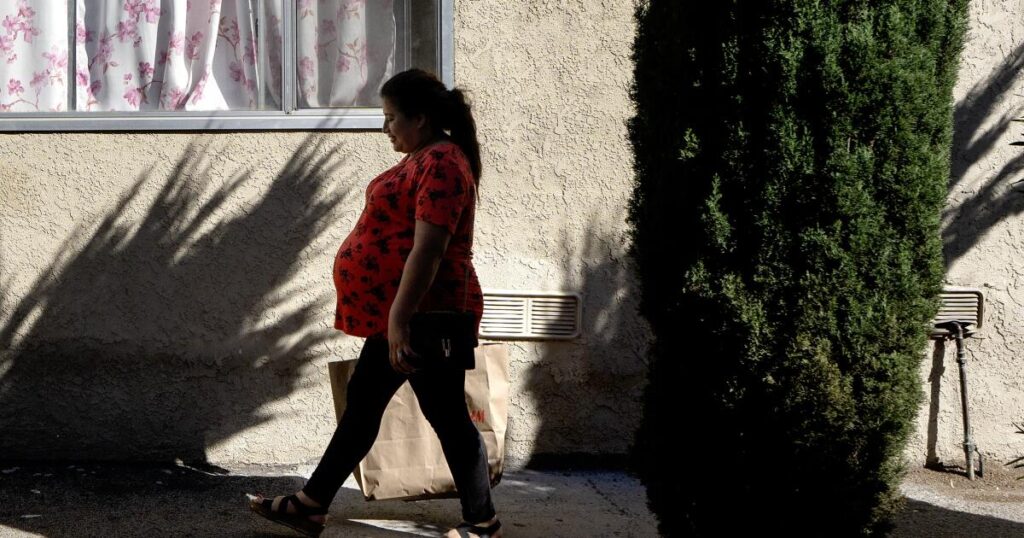
Lorena Pineda was five months pregnant when masked agents picked her up on a street corner near a San Fernando Home Depot in June.
An agent grabbed her from the vending stand she ran with her sister-in-law and put her against a car. “Be careful,” she told him. “I’m pregnant.”
“Don’t think I am going to let you go because of that,” she recalled him saying.
Immigration and Customs Enforcement policy states agents shouldn’t detain, arrest or hold pregnant, postpartum and nursing mothers for “administrative violation of immigration laws” barring “exceptional circumstances” or if their release is “prohibited by law.”
But pregnant women are increasingly picked up, deported and detained under the Trump administration, advocates and lawyers contend.
Pineda, 27, was held at a downtown L.A. processing center before being transferred to San Bernardino, flown to Atlanta and then to a staging facility in Alexandria, La., and then taken on an hours-long ride to a rural part of that state — where for 3½ months she watched her belly grow and her dreams of life in America fade.
The American Civil Liberties Union has documented more than a dozen cases of what it says are pregnant women housed without proper medical care at Stewart Detention Center in Lumpkin, Ga., and the ICE processing center in Basile, La., where Pineda was held.
In one case, a woman was shackled while she miscarried. Another woman with a high-risk pregnancy was placed in solitary confinement. In other instances, women have been denied prenatal care or not given translation services to speak with medical staff. Some complained that their pleas for medical services were ignored for weeks, according to the ACLU.
“This is only the tip of the iceberg,” said Eunice Cho, a lawyer with the ACLU and co-author of a letter sentto acting ICE Director Todd Lyons in October asking that pregnant detainees be released.
According to Department of Homeland Security spokesperson Tricia McLaughlin, it is “exceedingly rare” for pregnant women to be in detention. Those who are, she said, receive “regular prenatal visits, mental health services, nutritional support, and accommodations aligned with community standards of care.”
It’s unclear just how many pregnant and postpartum women are in custody, because a congressional mandate to semiannually report the number lapsed under the Republican-led Congress.
Lawyers around the country have said their pregnant clients have been held in dire conditions. In California, Angie Rodriguez, an asylum seeker held in the Mesa Verde ICE Processing Center in Bakersfield, miscarried in July. She has since been released.
At the facility in Basile, Neysis Mairena was six months pregnant with twins when she was hospitalized after experiencing contractions last month and was shackled to a hospital bed, said her lawyer, Thea Crane.
These women, Cho said, “have been ripped away from their families, transported to detention facilities that are thousands of miles away from their families, and they’re sitting in detention in these horrifying conditions — worried not only about their families at home being deported, but also the health and safety of their pregnancies.”
McLaughlin noted that Pineda, Rodriguez and Mairena all had crossed the southern border in the last five years and were “released into the country under the Biden administration.”
The medical care in detention, she said, is probably the “best healthcare” that many immigrants have received in their life.
McLaughlin said the ACLU’s findings don’t identify women by name and amount to “anonymous, unsubstantiated and unverifiable claims.”
“Pregnant women currently make up 0.133% of all illegal aliens in custody,” she said, adding that they “are subject to elevated oversight.”
She added that “all tragic, four miscarriages occurred at South Louisiana ICE Processing Center — that is 10% of the pregnant detainees and well below the national average.”
McLaughlin said Rodriguez didn’t even know she was pregnant when she was detained and set for expedited removal.
Mairena, a Nicaraguan immigrant, was never shackled to a hospital bed and had been arrested on allegations of cruelty to a juvenile, McLaughlin said.
Crane, her attorney, said Mairena was accused of domestic abuse with child endangerment because her 7-year-old daughter was present during an altercation with her partner. Crane is fighting those charges, saying Mairena was defending herself.
Mairena was released from detention on Nov. 26, after The Times inquired about her case.
::
After her arrest, Pineda spent more than three months in a repurposed prison in Louisiana. The state has become a hub for immigrant detention under the Trump administration.
She came to know the other immigrant women housed in a large room lined with 54 beds and a television droning most waking hours. The Salvadoran mother of two said she felt her baby grow inside her as the days passed and she settled into a heartsore rhythm, bonding with strangers longing for children, family and home.
She counted at least 20 other pregnant women at the facility. Some of those she met were released, Pineda said; others were quickly deported.
One of the women, she recalled, was about four months pregnant when she miscarried twins. The woman cried and begged guards for days after to help her get pills to expel the fetuses — help that did not come before Pineda left the facility.
Another pregnant woman she met was set to be deported, but officials held her and she wound up miscarrying. Eight days later, they deported her, she said.
“Imagine,” Pineda said. “They waited until she lost the baby before deporting her.”
The conditions at the facility were difficult. Guards yelled. The meals inside, she said, were mostly junk food. Hot dogs, spaghetti. The stories she heard rattled her.
One woman she met at the facility had been arrested leaving the hospital after having a C-section. She said immigration officials eventually deported her without her child, though they were later reunited.
“I was afraid of something like this,” Pineda said. “You don’t know what’s going to happen.” She was terrified of giving birth in custody.
::
The Women’s Refugee Commission, a Washington, D.C., nonprofit, has been attempting to track the number of pregnant, postpartum and nursing mothers detained by immigration agents and document the conditions they face. Its leaders say they have encountered significant hurdles.
“We really don’t know what is happening inside detention centers,” said Zain Lakhani, the commission’s director of migrant rights and justice.
With the reporting requirements eliminated and access to facilities diminished after the administration ended many legal programs inside the facilities, it is hard to get a true picture. “We used to be able to speak with them and then escalate complaints, either to the office of civil rights and civil liberties or directly, sort of internally to the facility. We are no longer able to do that.”
Since launching the tracker, she said, the group has “received significant reports of pregnant, postpartum, lactating women who are being detained,” though she was not willing to share figures. There’s also evidence that ICE is not following policy to provide adequate housing, medical care and nutrition.
“These are extremely vulnerable populations that require specialized healthcare, that require a specialized nutrition and diet,” Lakhani said. “We know very clearly from all of the medical guidelines around pregnancy that you are someone who needs to be able to go to a doctor on a very regular basis. There are all kinds of routine and emergency, and just urgent kind of healthcare needs that you have.”
In July, an investigation spearheaded by Sen. Jon Ossoff (D-Ga.) into human rights abuses in immigration detention found “14 credible reportsof mistreatment of pregnant women, and 18 credible reports of mistreatment of children.” The reports included lack of adequate medical care, timely checkups or adequate meals.
“The inhumane treatment of pregnant women by the administration is shameful,” the Democratic Women’s Caucus wrote to acting ICE Director Lyons last month, demanding the release of pregnant, postpartum and nursing immigrants who don’t pose a security risk.
::
Pineda migrated from El Salvador in 2023, part of an unprecedented wave of millions who arrived at the U.S. border between 2020 and 2025. Her husband and two young children, along with her mother and brother, fled the country hoping to escape gang members who harassed and beat her husband at work, she said. Her father had already settled in the U.S.
They found a “coyote” who charged thousands of dollars and asked her mother to put up her land as collateral until the debt was paid off. But when they arrived, they found making ends meet difficult. They shuffled between homes in the San Fernando Valley, staying with relatives and sometimes strangers.
After a while, her husband had steady work in construction. Her daughter, now 7, was learning English and enjoyed school. Her 3-year-old son was making friends. Pineda and her sister-in-law had started a food stand, where she sold breakfast and pupusas to day laborers near the Home Depot.
On June 19, she rose hours before daybreak, dressed and went to her sister-in-law’s apartment. As the sun rose, they began preparing the food and were selling it in the parking lot by 6 a.m. She earned about $200 a week from the stand and used the money to help buy groceries and odds and ends for the children. She had been nervous about heading out that morning.
Two weeks earlier, raids orchestrated by U.S. Border Patrol Cmdr. Greg Bovino had upended Los Angeles’ immigrant community.
Around 8:30 a.m. agents pulled up in an unmarked car.
Pineda still has the surveillance video of the arrest on her mother’s phone. You can barely make her out.
“I couldn’t run because I was pregnant,” she said. “They handcuffed me with my hands in the back, put me in the car and took me.”
She arrived at the South Louisiana ICE Processing Center on June 24. Pineda said there were medical staffers on site, but nobody equipped to conduct sonograms or any of the normal care she was accustomed to. To see a doctor, she was bused nearly three hours each way to a medical center in Monroe, La.
For the first month, she said, she couldn’t call her family.
Separated from her daughter and son by 1,500 miles and walls and fences, she had to get out of there.
“It was really hard for her,” she said of her daughter. “Every time she talked to me, she cried.”
She befriended a group of seven women. To pass the time, they weaved bracelets and rings out of plastic bags and talked about their homeland. She saw women who fought their cases.
After more than three months, guards told her that she was set to see a judge.
“I told them I didn’t want to,” she said. “I had signed my papers” to self-deport to El Salvador.
The judge set her departure date for Oct. 3 and she was told to arrange a flight to Los Angeles.
Her family skipped paying the rent and purchased her a ticket. It was Sept. 29. Guards dropped her off at the airport.
Days later, she met with immigration officials in Los Angeles. With her pregnancy nearly full term, the officials extended her departure date to March.
The day is bearing down on her.
“My husband said he won’t let me go alone,” she said. So she is trying to figure out how to pay for four tickets home. And how they will put food on the table in El Salvador.
Her mom still has a plot of land in the country where she planted fruit trees. There are mangoes, guayabas, jocotes and peaches.
And there are also the women she befriended in detention.
“Estan esperandome,” she said. They are waiting for me.
The post Pregnant immigrants held for months in detention despite rules against it appeared first on Los Angeles Times.