The plaintiffs in a lawsuit challenging the tactics of federal immigration agents in the Chicago area moved to withdraw the suit on Tuesday, saying that since the Border Patrol has sharply diminished its presence in the city, there was no need to continue fighting in court.
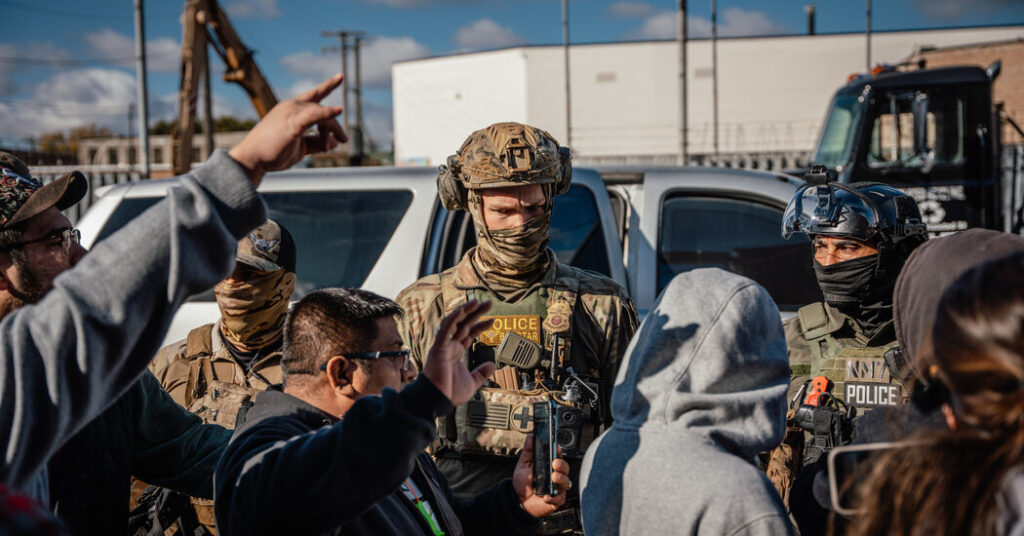
The lawsuit was brought in October in the early weeks of the Trump administration’s immigration crackdown in the Chicago area, known as Operation Midway Blitz. A coalition of media organizations, protesters and clergy members sued the Department of Homeland Security, accusing federal agents of “a pattern of extreme brutality” intended to “silence the press and civilians” in the Chicago area, including shooting pepper-spray balls and tear gas at protesters outside a federal detention facility in Broadview, Ill., and in residential neighborhoods.
The plaintiffs were initially successful with their case. Judge Sara L. Ellis, of Federal District Court for the Northern District of Illinois, ruled last month that government officials, including Gregory Bovino, the senior Border Patrol official who led operations in Chicago and California, had repeatedly lied about their own tactics and the actions of protesters. Judge Ellis also placed restrictions on Mr. Bovino and the Border Patrol, ordering agents to wear body cameras, warn protesters before using tear gas and use riot control weapons only to “preserve life or prevent catastrophic outcomes.”
“I see little reason for the use of force that the federal agents are currently using,” Judge Ellis, who was nominated to the federal bench by President Barack Obama, said in her ruling. She added, “The use of force shocks the conscience.”
But Judge Ellis’s ruling was quickly blocked by a three-judge appellate panel, made up of Republican appointees. That panel, with two judges nominated by President Trump and one by President Ronald Reagan, said Judge Ellis’s restrictions were too prescriptive and violated the separation of powers.
The judge’s injunction “enumerates and proscribes the use of scores of riot control weapons and other devices in a way that resembles a federal regulation,” the panel from the U.S. Court of Appeals for the Seventh Circuit, based in Chicago, said last month.
Given the panel’s finding, the plaintiffs in the lawsuit were seen as unlikely to prevail in the Seventh Circuit if the case would proceed further. Since Judge Ellis’s ruling had already been stayed by the appellate court, the withdrawal of the lawsuit is expected to have little practical effect on the ground.
Mr. Bovino and the Border Patrol agents have mostly left Chicago and moved on to other cities.
But dropping the lawsuit effectively prevents a ruling unfavorable to the plaintiffs that could establish precedent on the Border Patrol’s use of force when conducting immigration enforcement operations.
The Department of Homeland Security did not immediately respond to a request for comment on Tuesday. In the past, the Trump administration has said that its use of force has been necessary to carry out immigration arrests under the threat of violence from protesters.
Steve Art, a lawyer for the plaintiffs, said in a statement that the case had succeeded in several ways, including revealing the actions of federal immigration agents. “Because of the work of many Chicagoans, including the brave plaintiffs in this case, the brutality of Operation Midway Blitz was carefully documented for all to see,” he said.
Julie Bosman is the Chicago bureau chief for The Times, writing and reporting stories from around the Midwest.
The post Lawsuit Challenging Border Patrol’s Use of Force in Chicago Area Is Dropped appeared first on New York Times.