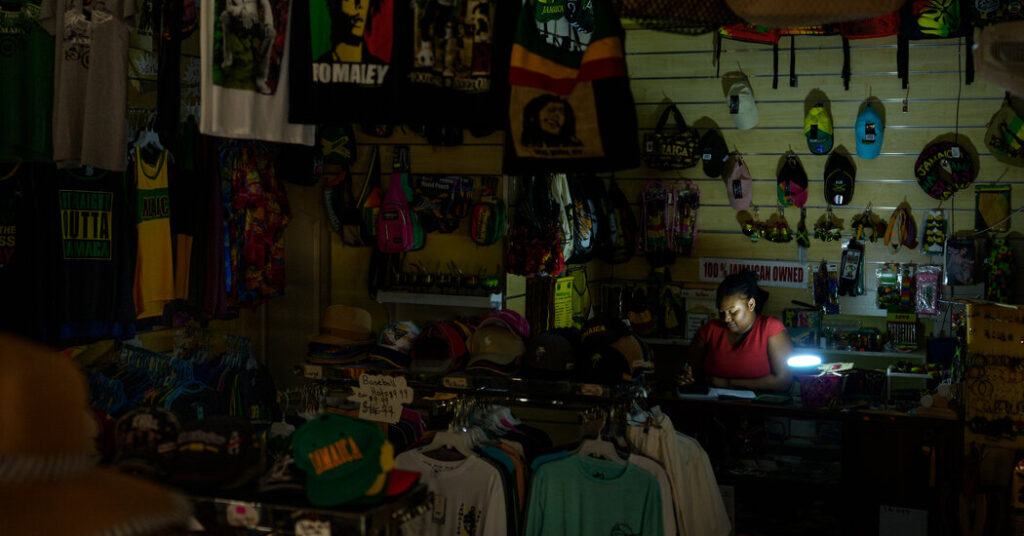
With power still out nine days after Hurricane Melissa swept through western Jamaica, Kellanie Kerr stood in the dark at the stifling hot souvenir shop in Negril where she works, waving a fan at her sole customer.
She tried to “guesstimate” how dependent Negril, a beach town on Jamaica’s far west coast, is on tourism.
“From a scale of one to 10? Ten,” she said. “Or maybe 100, because that’s what we use here to survive.”
Ms. Kerr is one of the more than half a million Jamaicans whose jobs depend directly or indirectly on tourism in the Caribbean country that, in October, was battered by its first Category 5 hurricane.
The storm killed at least 45 people, damaged about 150,000 buildings and homes and crippled the tourism industry, which the island nation relies on for nearly a third of its economy.
With dozens of hotels wrecked by the storm’s extraordinarily fierce winds and deluges of water, Jamaican authorities are rushing to reopen tens of thousands of hotel rooms in time for the crucial winter travel season. Tourism authorities announced that the country would be back in business for visitors by Dec. 15, which the government considers the start of the season, an ambitious goal that many hotels said they would not meet.
Some hotels still do not have electricity and water. Others were too damaged to reopen.
Still, about 70 percent of the country’s 35,000 hotel rooms are set to reopen in a matter of weeks, according to the tourism ministry. Jamaican tourism officials and hotel operators are desperately pushing the message: “If you want to support us, visit us.” That point is critical for everyone from street vendors to taxi drivers to the owners of luxury resorts.
As Jamaicans in hard-hit areas clean up the wreckage and repair damaged buildings, tourism officials and hotel operators want international visitors to know that many neighborhoods are intact.
While the damage was worst on the southwest shore, Ocho Rios, a key tourism destination on Jamaica’s north coast, saw little if any damage.
In Montego Bay, a northwestern city that is Jamaica’s most popular tourism destination, a numbers of hotels were damaged. The authorities planned to prioritize restoring electricity to the city to speed the reopening of those the storm spared.
While the electricity was off for several weeks in Negril, its hotels were largely unscathed.
Sandals, a Jamaica-based company that has eight all-inclusive resorts on the island, said it would reopen five on Dec. 6, but three, including its flagship property in Montego Bay, will remain closed until at least May.
Edmund Bartlett, the minister of tourism, said the industry lost about $62 million just in the first week after the storm.
About 40 to 50 percent of the country’s hotels suffered at least some damage. Nearly two dozen hotels will not reopen until 2026, according to the tourism ministry. But Mr. Bartlett said he hoped that by the end of January, 80 percent of Jamaica’s hotels will be reopened.
“Two-thirds is still active and productive,” Mr. Bartlett said, referring to the hotels expected to open in mid-December. “I think that point has to be made a little stronger — that the impact has been on the western part of the island.”
But that’s also where much of the tourism is concentrated. Jamaica’s capital, Kingston, which was not damaged, is in the east — but it is not typically a beach destination.
Christopher Jarrett, the president of the Jamaica Hotel and Tourist Association, said the ability of hotels to reopen depended not just on the extent of their damages but also on when they got water and power back. Mr. Jarrett, who owns two hotels in Montego Bay, is a member of a tourism task force formed to help the industry cut bureaucracy and accelerate recovery.
The Covid pandemic essentially shut down Jamaica’s tourism industry, but it had largely managed to bounce back. The outbreak, however, did not wipe out utilities, Mr. Jarrett noted.
Nearly a third of Jamaica still has no electricity, though about half has been restored to Montego Bay and parts of Negril.
“Let’s be realistic: Right now it’s not a pretty sight on the west coast,” Mr. Jarrett said.
Jason Henzell, owner of Jakes, a family-owned hotel in Treasure Beach, said a third of the rooms at his southern coast property were usable. Another third were in bad shape, and the remaining third were “very bad.”
“I have never seen concrete bend in a hurricane before,” he said, looking at the smashed oceanfront honeymoon suites.
But he hopes to open by Dec. 18 and has already received calls from loyal customers who plan to come — and bring power tools.
(In the days after the storm, journalists from The New York Times rented four rooms and a villa, which were undamaged and running on generator power.)
“It’s essential for persons to know Jamaica is open for business,” said Mr. Henzell, who chairs the south coast chapter of the Jamaica Hotel and Tourist Association.
Houston Moncure, the owner of Bluefields Bay Villas, a luxury boutique hotel on Jamaica’s southwest shore about an hour west of Treasure Beach, a region that took a particular beating, said the biggest obstacle to reopening more hotels quickly will be Jamaica’s ability to import building materials.
He is offering to rebook tourists who had reservations.
“It would compound things and make things much worse if everyone came looking for refunds, in terms of hurting cash flow,” he said.
Five of his six villas are damaged, he said, one of them “catastrophically.”
He looked around the remains of his property and found a missing banister in the swimming pool. All the furniture was piled up so he could send it off to Kingston for refurbishing.
Mr. Moncure, 40, said he had ridden out the storm in the bathroom of one of the villas, the one where his mother went into labor when he was born. The roof blew off.
Mr. Moncure’s grandparents are buried on the property so he is not about to give up, despite all the damage.
“The reason people come to Jamaica can’t be taken by a storm,” he said, choking back tears. “The heart, the culture, the food, the reggae. That’s not gone, and if anything, it will be here in spades, even if the landscaping isn’t perfect.”
He plans to reopen in phases, aiming to have three villas ready by the end of the year.
Jeremy Jones, regional managing director for Sandals, acknowledged that it was going to take some hotels more time.
“You don’t want to put a product that’s not 100 percent back on the market,” he said. “You’re going to damage your brand more than anything else. ‘You told me it was great, and now I’ve come, that’s what I’m seeing?’”
Even hotels that suffered little damage — like the Sandals in Negril — had to grapple with the dozens of workers who lost their homes. More than half the staff at the three hardest hit Sandals hotels were displaced, Mr. Jones said.
For most hotels in western Jamaica that means efforts are underway not just to fix the hotels, but to also repair the homes of their employees.
Mr. Jones said Sandals would use this time to refurbish and refresh hotel properties, making them more resistant to hurricanes.
“Definitely different kinds of roofs,” Mr. Jones said. “The slab roofs that stay on? We’re going to probably do more of those.”
Frances Robles is a Times reporter covering Latin America and the Caribbean. She has reported on the region for more than 25 years.
The post What Jamaica Wants After Deadly Hurricane? ‘Visit Us,’ Island Says. appeared first on New York Times.