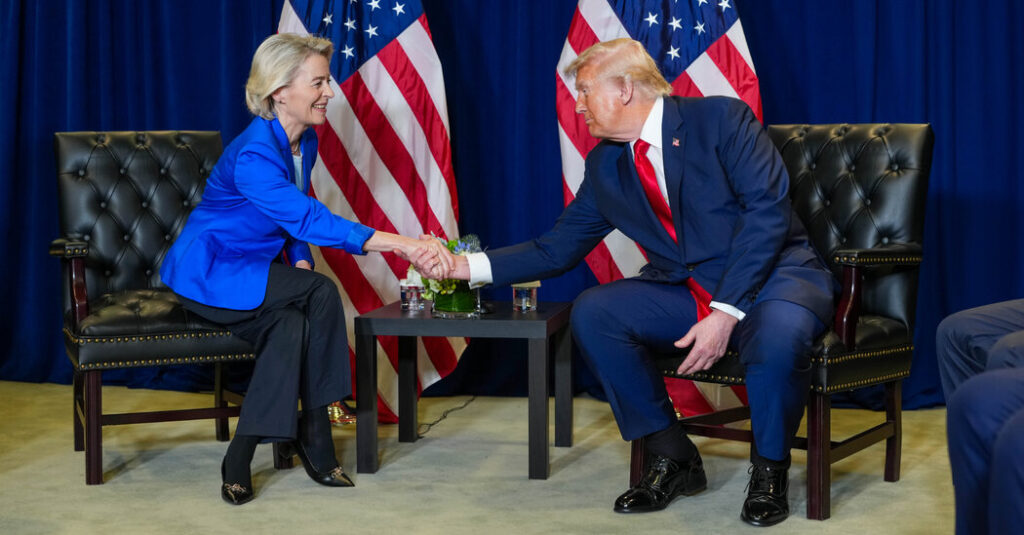
It’s been nearly four months since Ursula von der Leyen, the president of the European Commission, and President Trump made a handshake deal to resolve trade tensions between their economies. But details of the trade pact have proven contentious — and they will be up for debate again this week, when American trade officials visit their counterparts in Brussels.
Jamieson Greer, the U.S. trade representative, met Maros Sefcovic, the European Union’s trade commissioner, on Sunday. Both Mr. Greer and Howard Lutnick, the American Commerce secretary, will attend a meeting of trade ministers in Brussels on Monday.
The visit is an opportunity for a back and forth between two of the world’s most active trading partners at a moment when their trade relationship remains somewhat in flux. Both sides have signed onto a trade agreement in principle — one that has left the 27-nation bloc facing 15 percent tariffs across the board, with various exceptions. But key parts of the deal have not been completed and carried out.
Europe is hoping for a better deal on a list of items, including wine and spirits, steel, aluminum, medical devices and pasta. The United States has implied that the Europeans must do more to meet their commitments, including making promised investments. U.S. officials also continue to push for changes, like Europe rolling back key technology regulations.
In an interview with Fox News on Sunday, Mr. Greer said that the Europeans had started a legal process to meet their trade commitments and that it was well underway. “We’re here to just take stock of that progress,” said Mr. Greer, who was speaking from outside of the European Union buildings in Brussels.
“We’re happy to talk to them about, you know, alternatives in the future and next steps,” he added. “But I want to make sure that the current deal is fully implemented.”
“There is a risk that Europe does not understand that everything with this administration is a constant negotiation,” said Jörn Fleck, senior director with the Europe Center at the Atlantic Council, a research institute. He noted that the deal Ms. von der Leyen and Mr. Trump struck several months ago at his golf course in Turnberry, Scotland, was temporary.
“Europe should take that quite literally,” he said. “Because this administration will.”
A senior Trump administration official said that the United States would seek to conclude a binding, written agreement with the E.U. The official added that the Americans aimed to address issues that hadn’t been fully resolved, including challenges related to digital services taxes, discrimination against U.S. companies and pharmaceutical pricing.
While the American side has been pushing Europe to pare back its digital regulations for months, European leaders have resisted on key points, especially regarding their policing of speech on large social media platforms. Europe paints the issue as a matter of sovereignty.
The U.S. official also said that European requests for further tariff reductions were “out of sync” with the progress of the negotiations, suggesting that a framework the parties agreed to in July would need to go fully into effect before the United States reduces its tariffs further.
But that could take time. The European Union has put forward legislation that would cut tariffs on U.S. industrial goods and some agricultural exports as part of its side of the trade deal.
That legislation still needs the approval of the European Parliament, where some lawmakers are worried that the United States is not fully holding up its end of the bargain.
European officials remain concerned about U.S. steel and aluminum tariffs. Leaders from the bloc have made it clear that they believe the 15 percent cap should extend beyond products specifically listed in the deal, like cars and wood. For now, Europe still faces a 50 percent duty on steel and aluminum, and on many products that contain those metals.
Bernd Lange, the German social democrat who chairs the European Parliament’s trade committee, has pointed out that the list of products using steel and aluminum and covered by a 50 percent tariff has expanded since the deal was struck.
“Only if the U.S. reduces this 50 percent back to 15 percent will I allow the reduction, a zero percent tariff on steel and steel products in Europe,” he said at a news conference last month.
The European Commission, the bloc’s executive arm, has also suggested that it wants to see the lower rate apply more broadly.
“The single, all-inclusive 15 percent cap on tariffs for E.U. exports to the U.S. agreed in the deal should be applicable also to aluminum derivatives,” Mr. Sefcovic, the trade commissioner, said in a speech last week.
The United States and Europe also have important shared concerns to work out. They are trying to find a way to secure their supply chains at a moment when China has been flexing its power over rare earth minerals and other critical raw materials, restricting exports.
Both the European Union and the United States are concerned about overcapacity in China that prompts companies to dump cheap products into their markets, potentially putting European and American manufacturers out of business.
In the United States, Mr. Trump’s tariffs and trade deals face an additional source of uncertainty from a legal challenge at the Supreme Court. The court is expected to deliver a ruling within weeks or months that would uphold the tariffs that Mr. Trump has imposed as part of his trade deals, or order him to remove them.
If the court rules against Mr. Trump, his administration may be left scrambling to use other legal authorities to impose tariffs, and to persuade trading partners to uphold their deals.
Even so, for industries in Europe, a finalized deal between the two nations — preferably with the wish list of carve-outs that the E.U. is planning to present to the United States this week — is the top priority.
“We are hoping that we will be on that list, and, more importantly, we are hoping that the list will be received favorably,” said Pauline Bastidon, director for trade and economic affairs at Spirits Europe, an alcohol industry group.
But she noted that it was not clear how welcome such suggestions would be.
“I believe there is one man who decides,” she said, referring to Mr. Trump.
Ana Swanson covers trade and international economics for The Times and is based in Washington. She has been a journalist for more than a decade.
The post Why Europe and the U.S. Are Still Haggling on Trade appeared first on New York Times.