Female leaders on the right
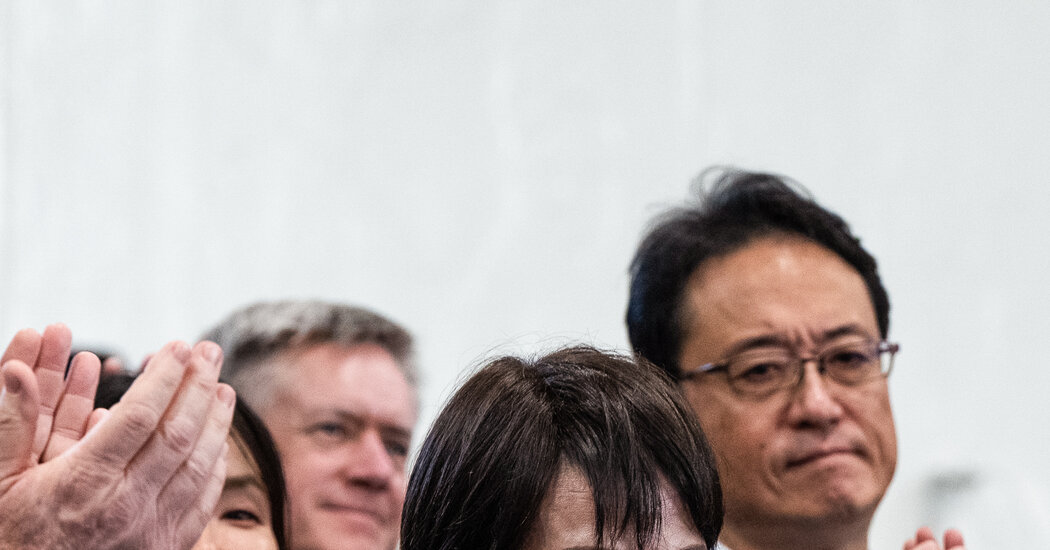
The election of Sanae Takaichi was a milestone moment. The last time a woman led Japan was in 1771, when Empress Go-Sakuramachi sat on the imperial throne.
Takaichi’s election means there are now two women who lead their nations in the G7. She joins Giorgia Meloni, the prime minister of Italy. Their predecessors include three British prime ministers — Margaret Thatcher, Theresa May and Liz Truss — Angela Merkel of Germany, Kim Campbell of Canada and Edith Cresson of France.
Notice anything about that group?
With the exception of Cresson, a Socialist who was in power for just under a year, all other female G7 leaders have come from the right.
An exclusive club
The primary thing women leaders around the world have in common is that there have been very few of them.
The small numbers, and the fact that these women were elected by different countries at different times, make it hard to deduce patterns. Each person’s rise necessarily involved singular circumstances.
The politics of the women are different too: The center-right Angela Merkel who welcomed migrants into Germany is a very different politician from a Takaichi or a Meloni, both of whom have pushed immigration restrictions.
And not all women leaders come from the right. Looking beyond the G7, you can readily find examples of left-leaning heads of government, such as President Claudia Sheinbaum of Mexico and the Danish prime minister, Mette Frederiksen.
Still, in that group of industrialized nations, the failure of liberal parties to produce female leaders who win is something of a puzzle. In the United States, the two women who have come closest to the presidency were both Democrats, but they lost. In the United Kingdom, Labour has never even chosen a female leader.
This may strike some as counterintuitive. Typically, it’s the left that has explicitly championed women in politics, often through the use of instruments like gender quotas, which now exist in roughly half the countries in the world. Much of the right finds these kinds of measures distasteful; Meloni, for her part, opposes them.
Takaichi has talked about the loneliness of being a woman in Japanese politics. But she’s also embraced positions that critics say hold women back. She’s opposed changing a law that requires married couples to share a surname, and has backed efforts to preserve the male lineage of Japan’s imperial family.
Iron maiden, iron ladies
The experts I spoke to suggested a few different dynamics might be interacting with one another.
The push for women in politics, largely from left-leaning parties, can be contagious, both within countries and even across borders, said Pippa Norris, a professor of comparative politics at the Harvard Kennedy School.
And the more women in politics, the more likely it is that women break into leadership, regardless of what party they belong to.
Germany’s Social Democrats instituted gender quotas in 1988, which put pressure on the conservatives to include more women on their electoral lists. One of the women who was elected to the Bundestag in the next election was a young Angela Merkel.
And a close look at each woman’s individual rise to power does reveal some patterns, said Silvana Koch-Mehrin, the founder of a network of current and former women political leaders.
Many of the early women leaders came to power as outsiders in a moment of political crisis. Thatcher rose in the 1970s when Britain was in economic and political turmoil. Merkel won her party’s leadership after a corruption scandal in the early 2000s. May became leader in the messy aftermath of the Brexit vote.
Today, political crisis has become the norm.
That is both fueling the rise of the hard-line right and lending credibility to leaders who can sell themselves as being different from those who came before. And women vying for roles that were previously held almost exclusively by men are inherently outsiders.
Meloni was elected after a decade of post-Berlusconi, testosterone-fueled turmoil that saw Italy churn through six prime ministers. In France, Marine Le Pen’s far right is the most popular force in a country that has seen four governments in less than a year. In Japan, Takaichi, an Iron Maiden fan and amateur drummer who beat out four men to become leader of the L.D.P., takes the helm of a party that has been losing support, in a country that has been dealing with stubborn economic stagnation.
The rise of women on the right is intriguing. It may also be short-lived. The steady growth of the number of women in parliaments in recent decades that has helped right-wing women to power has now stalled. On the other hand, France, where Le Pen continues to outpoll her rivals, is slated to hold its next presidential election in 2027.
Interested in providing feedback on this newsletter? Take our short survey here.
MORE TOP NEWS
A deadly attack in Pakistan’s capital
An attacker detonated a bomb outside a courthouse in Islamabad yesterday, Pakistani officials said. At least 12 people were killed and 27 others wounded in the capital city, which has been largely free from such attacks over the last decade.
There was conflicting information about whether the Pakistani Taliban, which has been fighting a fierce insurgency against the Pakistani government, was responsible. An analyst warned that the attack in Islamabad, a heavily guarded city, was an ominous sign for security in the country.
The attack occurred a day after an explosion near a subway station in New Delhi that killed at least eight people, which police are investigating as a possible terrorist attack. There is no evidence that the two attacks are connected, but tensions are high after this year’s military clashes between India and Pakistan, which were triggered by a terrorist attack in Kashmir.
OTHER NEWS
-
Iraqis voted for a new Parliament in an election watched closely by the U.S., which wants the next government to disarm Iran-backed militias.
-
The U.S. Senate passed a bill to end the nation’s longest government shutdown, sending the legislation to the House.
-
A Turkish prosecutor has called for Ekrem Imamoglu, the jailed mayor of Istanbul, to be sentenced to more than 2,000 years in prison.
-
The U.S. Navy’s most advanced aircraft carrier moved into the Caribbean as the Trump administration weighed further military strikes against Venezuela.
-
SoftBank sold its entire stake in Nvidia for $5.8 billion to help pay for new investments in artificial intelligence.
-
Thieves stole several Roman-era statues from Syria’s National Museum in Damascus.
-
A South Korean court overturned the indecent assault conviction of Oh Young-soo, an actor in “Squid Game.”
-
Tatsuya Nakadai, one of Japan’s biggest movie stars who was best known for his role in “Ran,” died at age 92.
SPORTS
Football: Lionel Messi made a secret visit to Barcelona’s stadium.
Cricket: A familiar war of words is in full swing ahead of this year’s Ashes.
DISCOVERY OF THE DAY
The world’s largest spider web
— Researchers discovered a spongy web the size of a small house in a cave between Albania and Greece. It’s home to around 111,000 spiders, including two species that had previously been thought to be hostile (one tends to eat the other.)
MORNING READ
Three years ago, the actor Sarah Jessica Parker posted a plea on the Booker Prize’s Instagram page. She wanted to judge the prestigious award. “Oh let me try!!!!” she wrote.
Now, she’s done just that. On Monday night in London, Parker watched David Szalay, the author of the winning novel, “Flesh,” collect the award. Winning is a life-changing experience for an author. Parker said that being a judge was also transformative. Reading 153 books in a year required her to bow out of most family activities. Read more.
AROUND THE WORLD
How they’re using Cold War holdovers … in Helsinki
Most European countries have stopped building civilian bomb shelters. But Finland, which shares a long border with Russia and ceded a tenth of its territory to the Soviet Union during World War II, has not. In the capital, shelters can take in every resident, with room to spare.
Day to day, the civil defense shelters serve as parking lots, metro stations, skateboard parks, go-kart tracks and archery ranges. There’s also Helsinki’s beloved Itäkeskus swimming hall and the Vapaan Taiteen Tila, which offers stage productions and art exhibitions in a cave.
But the original purpose is never far from mind. Russia’s invasion of Ukraine nearly four years ago “changed a lot,” one city planner said. “In ’22, there was a humongous increase in calls coming in: ‘Where’s my shelter?’” Read more.
RECOMMENDATIONS
Travel: These floating hotels will rock you to sleep.
Watch: Here are 65 movies to enjoy in the coming season.
Listen: Jazz greats like Charlie Parker will make you fall in love with the saxophone.
Decorate: Fringe-embellished maximalist sofas are so hot right now.
RECIPE
Shira-ae is a Japanese side dish of creamy mashed tofu mixed with green beans and an umami-rich sesame sauce. Traditionally, toasted sesame seeds are pounded using a Japanese-style mortar and pestle, but you can use sesame paste or tahini as a shortcut.
WHERE IS THIS?
Where are these dinosaurs?
TIME TO PLAY
Here are today’s Spelling Bee, Mini Crossword, Wordle and Sudoku. Find all our games here.
You’re done for today. See you tomorrow! — Katrin
We welcome your feedback. Send us your suggestions at [email protected].
Katrin Bennhold is the host of The World, the flagship global newsletter of The New York Times.
The post Women in Power, and on the Right appeared first on New York Times.