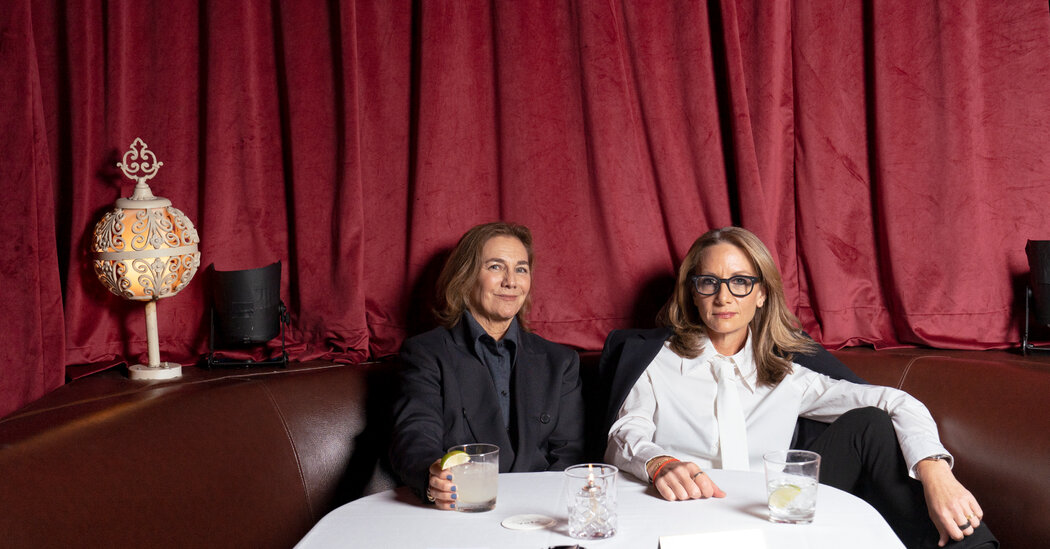
Almost 20 years ago, the television creator Ilene Chaiken took an unusual pitch to her bosses at Showtime.
Just like a fictional character on her series, “The L Word,” she wanted to create a social network: “a lesbian Myspace.” The real Myspace had recently been acquired by Rupert Murdoch’s News Corporation for more than half a billion dollars.
“Today, I would know how to do all of that myself,” said Ms. Chaiken, who has by now learned not to rely on television networks’ capacity for innovation.
In December, she co-founded a media company, Run-A-Muck, that aims to build digital worlds around movies and television shows — much like her old Myspace concept.
Ideally, every project in development will have a tandem nontraditional media sibling (or two or three): a podcast, newsletter, live show or social video series. Some big networks already release their own companion podcasts alongside television shows, like HBO’s “The White Lotus Official Podcast.” But Run-A-Muck wants to extend those efforts beyond watch-a-long podcasts, forming a suite of products that can potentially be wildly monetized.
This pitch is more reminiscent of influencer brands than Hollywood executives.
“Creators are the new Hollywood,” as YouTube’s chief executive, Neal Mohan, has said, echoing many other media prognosticators. Top personalities, they say, can reach more people through their TikTok accounts than studios can through the traditional box office or late-night television.
Yet Hollywood can be slow to change, and the industry’s focus has largely remained the same: making and promoting movies and television.
Still, as pressures mount in traditional entertainment, there are signs of change. Streamers are ramping up creator deals and adding new kinds of content to their slates. This month, Paramount bought the Substack newsletter The Free Press, and Netflix announced that video podcasts were coming to its platform.
It is the kind of ethos long embraced by YouTubers such as MrBeast, who owns a snack company, hosts a game show on Amazon Prime and appears to be opening a bank; Alex Cooper, the “Call Her Daddy” podcaster, has two satellite radio channels, a Hulu documentary and a new advertising agency (her first client is Google).
Pam Drucker Mann, who co-founded Run-A-Muck with Ms. Chaiken and the “L Word” actress Jennifer Beals, said the idea came to her while she was the global chief revenue officer at Condé Nast.
She was complaining to a Hollywood superagent about his business, which she called “linear.” “What’s wrong with you guys?” she recalled saying. “There’s so much consumption happening everywhere else.”
Until this month, Run-A-Muck looked from the outside much like a standard production company. It had more than 20 projects in development, including a television series starring Kristen Stewart and an adaptation of “Stag Dance,” a buzzy book by Torrey Peters that Ms. Drucker Mann described as “‘The Revenant’ meets ‘Fargo.’”
But its broader goal is to stretch its intellectual property as far as it can reasonably go.
For example, a project called “Consent” is being shopped to studios as a legal procedural with the production company New Regency, but it is also being developed as a stand-alone reality show and a true crime podcast around the same concept: sex and crime.
“We may not call all of them ‘Consent,’ but it fits into the ‘Consent’ world,” Ms. Drucker Mann said.
An unscripted series about the WNBA is being developed in conjunction with a weekly sports video podcast hosted by Coach Jackie J, a TikTok commentator.
While these projects are still theoretical, Run-A-Muck produced its first public-facing product last week: a Substack called “Drafting.” The newsletter is edited by the former editor of Paper magazine, Justin Moran, and is meant to document the drafts and creative processes of the company’s collaborators and friends. It’s already profitable — not from subscriptions (there are only about 1,000) but advertising deals with eBay and Moncler.
In its first edition, the fashion designer Daniella Kallmeyer shared sketches and screenshots from her phone. She also hosted a sleek launch party for “Drafting” inside a dimly lit, mezcal-drenched jazz lounge in Los Angeles.
Elaborate events are on the rise in new media. Ms. Cooper of “Call Her Daddy,” recently hosted a Las Vegas bacchanalia under the banner of Unwell, her media company. The $300 weekend included a pool party with Paris Hilton, male stripper interludes and various “Real Housewives” on emcee or D.J. duty. (Unwell also sells hydration drinks for, among other things, hangovers.)
Amazon, which acquired the podcast network Wondery in 2020, hosted a fan tailgate party last month for “New Heights,” its video podcast, ahead of an N.F.L. game between the Kansas City Chiefs and Philadelphia Eagles. (The show’s hosts, the Kelce brothers, are current or former players for those teams.)
“The definition of what a podcast is has changed pretty radically in the last three, five years,” said Eliza Mills, head of content and strategy at Run-A-Muck — and formerly of Wondery.
This fall, over coffee at Soho House in New York, Ms. Drucker Mann called Condé Nast “a big company with a lot of legacy weight” that was “not moving fast enough” for her. She left in 2024, after nearly two decades. (She was the publisher of Bon Appétit when the magazine created its “Test Kitchen” video universe; years later, that franchise’s stunning rise ended with toxic-workplace allegations.)
She pointed repeatedly to “Barbie,” “Game of Thrones,” “Stranger Things” and Beyoncé’s “Homecoming” as examples of “cultural moments” that had been thoroughly monetized across platforms, even beyond digital media: books, toys, clothing, vinyl albums.
The Met Gala, she said, drew millions in advertising revenue and viewership when Vogue, a Condé Nast publication, began livestreaming its red carpet on YouTube. At the same time, E! Entertainment was also broadcasting the carpet on its cable television channel.
While at Condé, she didn’t see this as competition or conflict. “We were helping each other,” Ms. Drucker Mann said. “But imagine if it had been one company’s moment.”
Jessica Testa covers nontraditional and emerging media for The Times.
The post What Can Hollywood Learn From New Media? appeared first on New York Times.