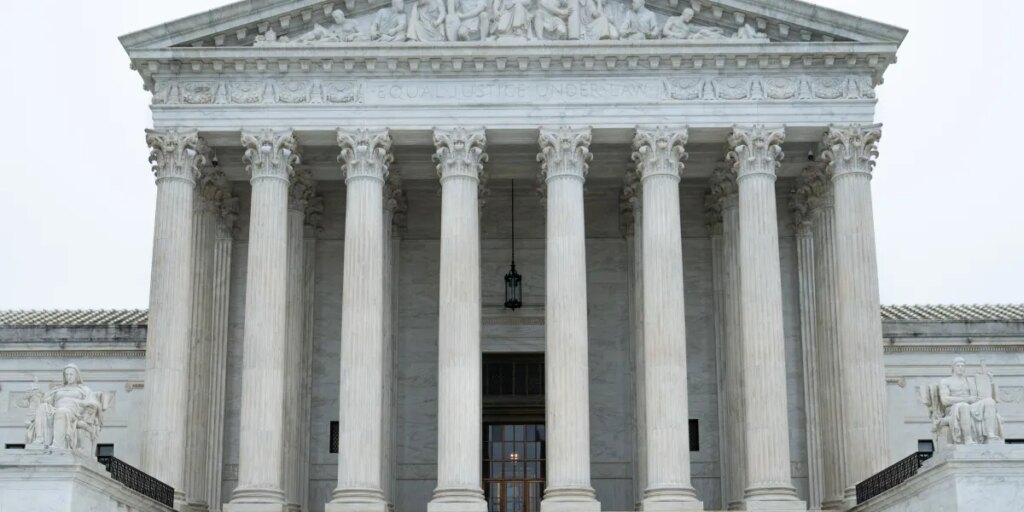
A Supreme Court ruling on Friday struck down certain tariffs, potentially offering relief to businesses and finance chiefs who have been operating amid prolonged uncertainty.
On Friday morning, the court ruled 6–3 that President Trump cannot impose tariffs under the International Emergency Economic Powers Act (IEEPA), as he did throughout much of 2025. The decision narrows the scope of the president’s unilateral tariff authority and invalidates portions of the levies on steel and aluminum, as well as certain tariffs on imports from China, Fortune reported.
For many companies, particularly smaller manufacturers, that uncertainty has had tangible consequences. Large firms have been affected by tariffs, but small and midsize businesses have felt the impact disproportionately.
In February 2025, during a period of heightened tariff volatility, Fortune spoke withMatt Totsch, CFO of Trim-Tex since 2020, a family-run manufacturing company based in Illinois. Founded in 1969, the company employs about 250 people.
Trim-Tex processes more than 25 million pounds of PVC annually to manufacture drywall and stucco corner beads used in residential and commercial construction. Although all of its products are made in the U.S. and its raw materials are domestically sourced, Totsch was concerned about the broader ripple effects of tariffs on trade with countries such as Canada, a major supplier of softwood lumber to the U.S., and the downstream consequences for construction demand.
“Over the past year, tariffs have continued to be a significant drag on the construction market,” Totsch told Fortune on Friday. Combined with current immigration policies, tariffs have contributed to instability around both material costs and labor availability, he explained. “Construction and development require predictability—as builders need confidence in raw material pricing and workforce stability before making large-scale investments.”
That instability has shown up in the data. The producer price index for materials and services used in nonresidential construction rose about 3.3% from December 2024 to December 2025, according to an analysis by the Associated General Contractors of America, which is the largest annual increase in several years. Much of that growth was driven by price increases for tariff-exposed materials.
For Trim-Tex, the effects were direct. “We ended 2025 down about 10% in sales from 2024, due in large part to that uncertainty,” Totsch said. When input costs fluctuate and labor supply is unclear, projects are often delayed or canceled. “At a time when the country is facing a housing crisis, that uncertainty only compounds the problem.”
Still, Totsch framed the court’s decision as a broader constitutional issue. “The Constitution gives Congress, not the president, the authority to levy taxes and create trade policy,” he said. “Regardless of politics, no single person should have unilateral authority over something as consequential as tariffs, particularly given how interconnected and fragile today’s supply chains are. Manufacturers need predictability, not chaos.”
He added that he believes strongly in free markets and sees the government’s role as creating a stable framework rather than introducing volatility. “If we want to address housing affordability and increase supply, we need policy certainty, a reliable labor force, and a more efficient permitting process,” he said. “When markets are allowed to function with clarity and consistency, American manufacturers and builders consistently rise to the challenge.”
Totsch is not alone in his tariff concerns. According to the Q4 2025 CFO survey released by Duke University and the Federal Reserve Banks of Richmond and Atlanta, trade policy and tariffs remained among finance chiefs’ top worries. Respondents anticipated price increases of more than 3% in 2026.
Even with the court’s decision, however, the story may not be over. A ruling does not necessarily mean immediate resolution, according to Andrew Siciliano, a KPMG partner and leader of the firm’s Global and U.S. Trade and Customs practices. Companies should be cautious about adjusting prices or removing surcharges too quickly, he said.
“There are still many open questions, such as whether IEEPA tariff enforcement stops immediately and how the refund process will be handled,” Siciliano told Fortune. “For companies importing products subject to these tariffs, it’s unclear whether they should stop paying right away.” Customs will need to update its systems, and the timing will depend on when the administration issues further guidance.
Mark Williams, a master lecturer in finance at Boston University, echoed that caution. U.S. retailers, importers, and exporters should avoid moving too quickly before adjusting pricing strategies, he said.
“The financial benefit of the Supreme Court ruling could be short-lived, especially if the Trump administration responds by imposing new anti-trade policies,” he said.
The ruling reduces trade policy uncertainty but doesn’t eliminate it, he said. At the same time, Williams described the decision as “a win for free market economics,” arguing that increased trade with China, Mexico, and Canada could reduce consumer costs, ease inflationary pressures, and provide support for U.S. GDP growth.
For now, Totsch said that given Trim-Tex’s cost structure, the company is not in a position where immediate pricing adjustments are necessary. “We’ll continue to monitor developments, but our focus remains on stability and maintaining consistent pricing for our customers,” he said.
For businesses, the ruling may represent a legal check on executive power, and a measure of relief, but not yet a guarantee of lasting stability.
The post CFO whose business fell 10% from tariffs cheers Supreme Court ruling: ‘No single person should have unilateral authority over tariffs’ appeared first on Fortune.