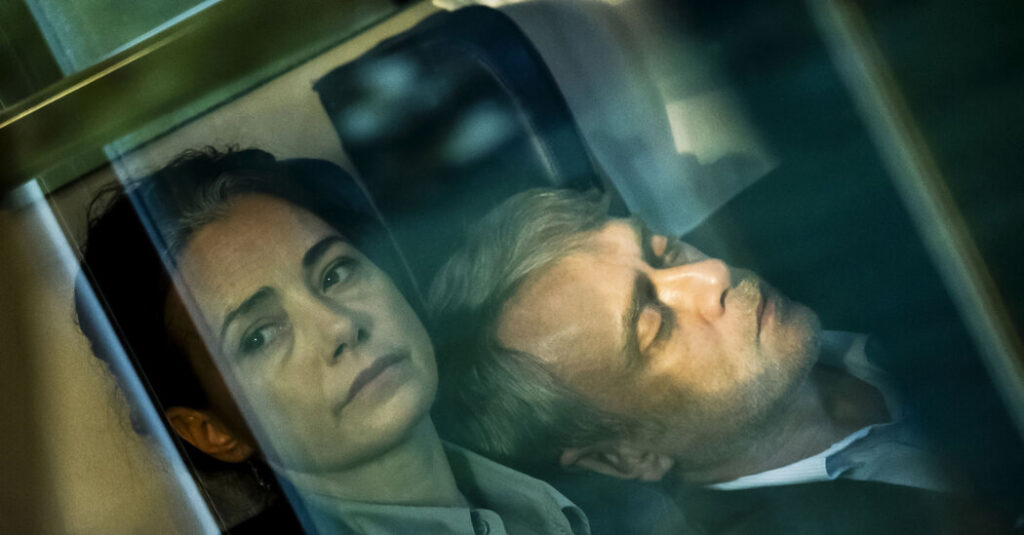
When “Yellow Letters,” Ilker Catak’s domestic drama about political repression in Turkey, premiered at the beginning of this year’s Berlin International Film Festival, it reflected the mood of what was already shaping up to be another controversial edition of the German event.
The film is about two esteemed artists — a stage director and an actress — whose marriage comes apart after they are ousted from their positions at a public university and national theater for speaking out against the Turkish government. Although the film is set in Turkey, it was shot entirely in Germany, where Catak, who directed the Oscar-nominated “The Teacher’s Lounge,” lives and works. “Yellow Letters” foregrounds this with bold-faced title cards that announce the film’s location changes. “Berlin for Ankara,” “Hamburg for Istanbul,” they read, suggesting that politics can weigh on artists’ freedom in Western democracies, too.
That is one of the issues that some filmmakers and journalists wanted to call attention to as the festival, also known as the Berlinale, came under scrutiny for comments made by some of its guests rejecting the role of politics in film.
It all began last Thursday when the jury president, Wim Wenders, declared, “We have to stay out of politics,” when asked about the festival’s position on the war in Gaza, stoking outrage that seemed to encourage a similar line of questioning at news conferences throughout the week. Wenders’s comments ultimately fed into the perception that Berlinale organizers are beholden to the German government — the event’s main funder — and therefore condone its position that conflates criticizing the Israeli military with anti-Jewish sentiment.
A boycott by pro-Palestinian groups of the festival and other state-funded institutions, which began in 2024, was revitalized as a result, and on Tuesday an open letter signed by prominent stars and filmmakers accused the festival of “censoring” artists. (Tricia Tuttle, the festival’s director, told The New York Times on Thursday that accusations of censorship were untrue.)
“This place, they are not so welcoming to Palestinians,” Abdallah Alkhatib, the Syrian-Palestinian filmmaker behind the wartime drama “Chronicles From the Siege,” said in a video interview with Middle East Eye. “So my task as a Palestinian filmmaker is to be exactly in this place,” he added.
The film, inspired by Alkhatib’s experience living in a Syrian refugee camp, weaves together stories of people living in war zones, and although it avoids mention of any one place as a means of universalizing this struggle, it inevitably evokes the Palestinian plight with dizzying urgency and formal originality.
The platforming of films like “Yellow Letters” and “Chronicles from the Siege” — as well as panel discussions and a talk by to the Palestinian “Succession” actress Hiam Abbass — tell us that, at the very least, Berlinale organizers want to express their independence from the German government through the festival’s programming. For some, however, the festival’s silence on Gaza remains a disturbing exception given the public statements it has issued in the past expressing solidarity with Ukraine and protesters in Iran.
For better or worse, this tension oriented my Berlinale experience and my thinking about the relationship between politics and film. When Wenders — and, in later news conferences, Neil Patrick Harris and Ethan Hawke — spoke about cinema being detached from political imperatives, they may have been referring to the ideals of artistic freedom. Yet their statements also sounded weirdly myopic, as if artists lived in a vacuum and “politics” were strictly activism and not the dynamics of power that course through every one of our lives.
Take one of the finest films at the festival, Nicolás Pereda’s “Everything Else is Noise,” which is, at face value, a wry chamber piece set in Mexico City about a mother and daughter, both musicians and composers, who tease and intimidate the men who pass through their apartment.
With deadpan delivery and improvisational lightness, the two women (Teresita Sánchez and Luisa Pardo) put on an impish performance when a television director and his cameraman show up wanting to shoot an interview about women in the rarefied field of classical music. All the while, the lights go on and off (there’s an electricity issue in the building) and the awkward silences are filled with sounds from outside, complementing the women’s gleeful disruption of the men’s established ideas about the arts and the sexism that pervades that world.
Elsewhere, in the festival’s experimental Forum section, I was taken by Pascale Bodet’s documentary “A Lot Talk,” an absurdist comedy of manners about the precarity of becoming a European resident and the unease (and sometimes beauty) of miscommunication. By spending time with Bodet’s Egyptian friend, Amre, who doesn’t speak French, we’re connected to his humanity, which contrasts sharply with the Kafkaesque French bureaucracy he must contend with.
In the competition, Sandra Hüller is riveting in Markus Schleinzer’s “Rose,” a taut black-and-white period drama in which the German actress plays a 17th-century woman who successfully convinces the villagers of a Protestant community that she is a man — and entitled to a wife and farm.
Juliette Binoche and Tom Courtenay, in Lance Hammer’s provocative and impressively calibrated second feature “Queen at Sea,” deliver performances of remarkable anguish and vulnerability. Elegantly composed, this somber melodrama flecked with moments of humor and possibility illuminates the ethical turmoil of those caring for loved ones with dementia.
Likewise, the dynamics of death and loss inform two titles from the audience-friendly Panorama section that stand out for their detailed senses of place and their throbbing life forces: André Novais Oliveira’s Afrofuturist drama, “If I Were Alive,” which is set in southeastern Brazil, and Kelly O’Sullivan and Alex Thompson’s teen weepie “Mouse,” which unfolds in Little Rock, Ark.
This year, Perspectives, a new section launched in 2025 dedicated to feature film debuts, hit its stride, offering up a medley of inventive works from Argentina (“The River Train”), the Philippines (“Filipiñana”) and China (“Light Pillar”) — not to mention “Chronicles From the Siege.”
The Berlinale has historically positioned itself as the most political of all the major film festivals, which adds to the frustration and confusion around the talk of being “apolitical” today — although, paradoxically, this heated atmosphere also made it feel like the most politically charged film event I’ve attended in years, for reasons that perhaps align with Alkhatib’s comments about difference and responsibility.
In any case, the film that lingers in my mind over all the others I watched these past 10 days embodies the many radical, unconventional forms that political statements can take in film. Alain Gomis’s competition movie, “Dao,” a 185-minute hybrid-documentary epic, uses music and dance to immerse us in Gomis’s deeply personal experience of the Black diaspora.
The film weaves together scenes from a patriarch’s funeral in Guinea-Bissau and a wedding in the South of France. Both events are fictionalized versions of family ceremonies that Gomis attended in real life, and many of the cast members (including one of the protagonists, played by Katy Correa with soulful intensity) are also his relatives.
On one level, “Dao” plays like one long, exuberantly loud party. West African funeral rituals are more about collective unity and the celebration of life than mere solemn remembrance, which explains how effortlessly the film’s two threads come together. Gomis, who is French-Senegalese, considers the evolution — if not erosion — of his family’s native culture by the changes wrought by future generations living in the West.
This transformation can also be life-affirming, joyous — and joy, too, can be a political act.
The post At a Festival Stirred by Controversy, the Politics Are Onscreen, Too appeared first on New York Times.