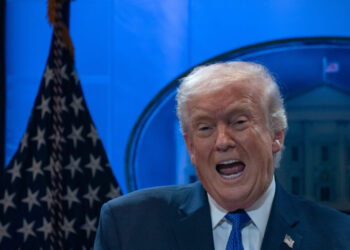
So what now? As expected, the Supreme Court invalidated the Trump administration’s signature economic policy on Friday, ruling that the law did not permit the president to impose trillions of dollars of tariffs on our trading partners across the globe. Back in August, President Trump said that a ruling like this would “literally destroy the United States of America.” Was he right?
The answer: This reversal is definitely bad for the economy, just not for any of the reasons Mr. Trump had in mind. And in the long run, it’s likely a lot better than where we were otherwise headed.
Tariffs alone — either imposing them or repealing them — are not going to destroy the United States, for the simple reason that imports are only a little more than 10 percent of the economy. Services, such as health care and education, account for about 75 percent of the economy, and tariffs don’t really affect them. That’s not to say that sky-high import taxes are benign: Estimates suggest that tariffs at the levels this administration imposed will shrink the economy by around 0.3 percentage points going forward. That’s about $90 billion a year of losses — far from chump change but not enough to either destroy or save the nation.
What does have a huge and potentially devastating impact on the economy is universal confusion about what the rules are or how they might change day to day.
Even in the best of times, this administration makes it hard to plan. Remember how the tariffs were announced with great fanfare on “Liberation Day,” then put on hold, then revised and revised and revised? The Trump administration has imposed tariffs on countries that angered the president. (For a moment, China’s rate was 145 percent.) It lowered tariffs on countries that pleased him. (Mexico’s president brokered multiple reprieves.) By my count, the effective tariff rate has changed more than 60 times since Mr. Trump returned to office. And that was when there was at least something on the books. Now we’re back to Square 1. It’s like Groundhog Day, but for Liberation Day.
The court ruled that the International Emergency Economic Powers Act, which the administration had cited as the basis of its actions, did not grant the president the broad powers Mr. Trump invoked. But the court did not rule out tariffs altogether. Jamieson Greer, Mr. Trump’s trade negotiator, last month said that if the Supreme Court brought us to this point, the administration would “start the next day” to establish tariffs by other means.
Among the options the administration might pursue, it could turn to Section 122 of the Trade Act of 1974, which allows for tariffs at up to 15 percent for up to 150 days. Or it could try Section 1338 of the Tariff Act of 1930, which allows tariffs of up to 50 percent against countries that adversely affect U.S. commerce. Or it could ask Congress to enact a slate of tariffs, or pass a new statute that expands the president’s powers to do so on his own. Or any combination thereof.
All of these approaches would require more work than the prior slate of tariffs, which were imposed with only a stroke of Mr. Trump’s pen. They would all be subject to their own legal challenges, which would almost certainly make their way back to the Supreme Court, at which point the cycle might begin anew. But it’s probably true that, as Justice Brett Kavanaugh noted in his dissent, the court’s decision may not ultimately do much to constrain the president’s tariff authority.
How should people budget for their families in the face of this much uncertainty? And how should any company strategize about how to set prices, acquire inventory or expand its business?
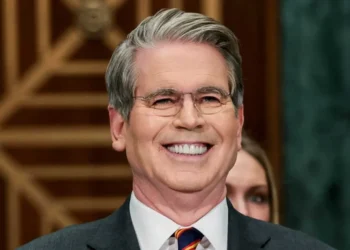
Trading partners around the world will face vexing choices of their own. What happens to negotiations that are underway with China and the European Union if no one knows whether or how or when U.S. tariffs are coming back? Should those parties assume — as Treasury Secretary Scott Bessent has asserted — that high tariffs are still “here to stay” and negotiate accordingly? Or bet that the court will keep playing Whac-a-Mole with all new tariff strategies? The only certainty is no certainty, at least in the present.
The uncertainty extends into the past, too, as regards the upward of $125 billion in tariffs that have already been collected. Heading into Friday’s decision, it seemed possible that the government would issue narrow refunds to the plaintiffs in the suits and no one else. Perhaps the court would let the government keep the tariff revenue that has already been collected. Or perhaps this whole “mess,” to use the term of Justice Amy Coney Barrett, who voted against the president’s tariff authority, would be left to the lower courts to sort out.
As it turns out, the decision says nothing about how to resolve that mess, a shortcoming that Justice Kavanaugh’s dissent called out. And any refunds, should they ever come, will go to companies that imported goods at higher tariff rates, not to consumers who paid higher prices for tariffed goods at the store. That money could lead to more investment and a larger economy, but those effects are likely to be much smaller than the losses consumers have already suffered.
Big business has largely stayed on the sidelines of this legal fight. The cases that made their way to the Supreme Court were brought by small companies, not by Amazon and Walmart and the like, despite the significant impact of these policies on the largest retailers. Trade groups representing large businesses did not even join on to briefs detailing the irreparable economic harm tariffs are having on American businesses. That may be because they fear alienating the president. But it may also be because, as Michael Potter, a Corsair executive, has said, “It’s not the tariffs themselves, it’s the uncertainty around where they actually are going to be” that “causes the extra management angst.”
Over a long horizon, the Supreme Court’s decision is a step toward stability. We now know that there are limits to the president’s tariff authority. The International Emergency Economic Powers Act does not authorize the executive to change trade policy on a whim, in response to commercials presidents don’t like or policies other countries choose that we disfavor. But Mr. Trump will try many other ways to achieve those same unilateral ends. And in the short run, Friday’s decision will do little to address the uncertainty problem.
Natasha Sarin, a contributing Opinion writer, is a professor at Yale Law School and the president of the Budget Lab at Yale. She served in the Treasury Department during the Biden administration.
The Times is committed to publishing a diversity of letters to the editor. We’d like to hear what you think about this or any of our articles. Here are some tips. And here’s our email: [email protected].
Follow the New York Times Opinion section on Facebook, Instagram, TikTok, Bluesky, WhatsApp and Threads.
The post The Tariff Chaos Is Over. The Tariff Chaos Is Just Beginning. appeared first on New York Times.