South Africa will not host a pavilion at this year’s Venice Biennale, the country’s culture ministry said on Friday — even though its government won a court case this week over its choice of artist for the major art event.
The court ruling dismissed a lawsuit brought by the artist Gabrielle Goliath that aimed to force the ministry to send her to Venice with a Gaza-focused artwork. Stacey-Lee Khojane, a ministry spokeswoman, said in a WhatsApp message that although the government welcomed the ruling, “there will not be a South African-government-backed exhibition” at this year’s event.
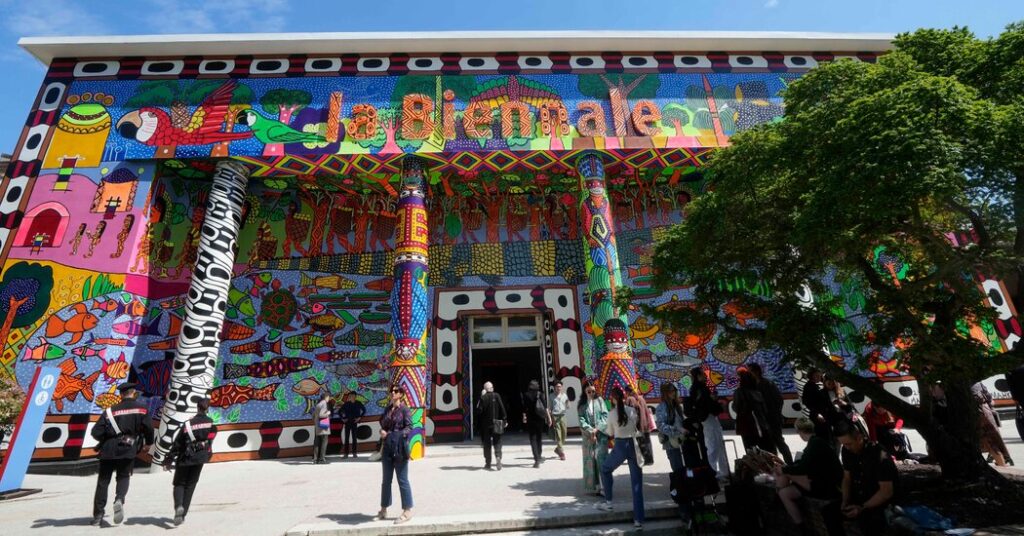
At the Venice Biennale, which is sometimes described as the Olympics of the art world, countries host exhibitions in national pavilions alongside a sprawling group show that features artworks chosen by an independent curator. This year’s edition is from May 9 to Nov. 22.
South Africa has sent artists to every biennale since 2011, helping cement the country’s reputation as a regional art center. It also has a long-term lease on a space in Venice to host its national pavilion.
Annchen Bronkowski, a University of Cape Town researcher who has published a history of South Africa’s involvement in the biennale, called the decision not to go to Venice “really embarrassing” for a country that “has one of the most robust art worlds on the continent.” She said some South African lawmakers have long seen the biennale as a low priority, with money better spent elsewhere.
The furor around South Africa’s participation began in December, when Art Periodic, a nonprofit that was running the pavilion, told Goliath that she had been chosen to go to Venice.
A few weeks later, Gayton McKenzie, the culture minister, wrote to Art Periodic, saying that he was concerned about Goliath’s show because he had learned that it “centers on the subject of Palestine.”
Although South Africa has supported the Palestinians by bringing a genocide case against Israel at the International Court of Justice over the war in Gaza, McKenzie has been a vocal supporter of Israel.
Goliath planned to stage “Elegy,” a video and sound installation in which singers stand on a dais and hold a sung note. Goliath has said that the performance is a tribute to women, gay and trans people who have died by violent means. In Venice, the work was to include a section dedicated to Hiba Abu Nada, a Palestinian poet killed in an Israeli airstrike.
In January, McKenzie again wrote to Art Periodic, this time terminating the agreement to run the South Africa pavilion and saying that he would instead feature art in Venice that gave “a positive message” about his country.
Goliath filed a lawsuit against McKenzie in response, calling his actions unlawful.
On Tuesday, Judge Mamokolo Kubushi issued a two-page ruling dismissing Goliath’s lawsuit and ordering that she pay the minister’s legal costs. The document does not give any reasons for the decision.
Goliath said in an email on Friday that she was waiting for the judge to publish the reasoning, but that she intended to appeal the decision and was “considering other possibilities to realize this work in Venice and elsewhere.” She called the decision to not go ahead with a pavilion “nothing short of shameful” and said that South Africa’s shuttered pavilion would be “a space of erasure, cancellation, censure.”
The ministry had tried to find an alternative artist to send to Venice and had held discussions with a collective called Beyond the Frames. Hannes Koekemoer, a spokesman for that collective, said on Friday that it was “a deep sadness” to have learned that pavilion would stay closed.“ Our involvement was driven to prevent an empty pavilion,” he said.
A Venice Biennale spokeswoman said that the event “cannot comment on the decisions of the countries.”
Alex Marshall is a Times reporter covering European culture. He is based in London.
The post South Africa Pulls Out of Venice Biennale After Gaza Artwork Furor appeared first on New York Times.